Abbot–Moriarty family curse
Under Your Spell: A Romance Boxed Set of Masked Balls, Haunted Gardens, Magic, and MoreThe Abbot–Moriarty family curse is the central hereditary affliction governing the history of the Abbot plantation. Born from the Abbots’ deception of the Moriartys, it turns stolen property into a supernatural debt: Abbot descendants repeatedly die in October, and the curse continues until the family line is exhausted or the original wrong is addressed. Its decisive significance lies in the way it converts family inheritance into both a source of danger and the means of repair.
Origin in the Plantation’s Seizure
The curse begins with the transfer of the plantation from the Moriartys to the Abbots in the early 1800s. The Abbot family did not purchase the property honestly; according to Gertrude, they acquired it through trickery, probably a card game, though she is not completely certain of the precise method. The Moriartys had moved south from Salem, Massachusetts, and after losing the plantation they laid a curse on the Abbots. The supernatural conflict therefore rests on a concrete historical injury rather than an unexplained haunting: ownership itself is contaminated by fraud.
The plantation’s former prosperity sharpens the contrast between its public history and its hidden cost. When the Abbots first acquired it, the place was beautiful, well maintained, and filled with parties attended by local politicians, actors, wealthy people, and other respectable figures. That social glory gradually gave way to collapse as Abbot deaths accumulated. The house later began falling apart, and maintaining it became a financial burden, turning the inherited estate into a money pit as well as a death trap.
The Pattern of Hereditary Death
The curse initially resembles misfortune, but repetition reveals its design. Over the years, the Abbot family notices that its members are dying in October, making coincidence increasingly impossible. The pattern includes Jade Abbot’s parents and grandparents, while the family’s earlier generations are also implicated. Jade recalls that her mother once repeated a warning from an older grandmother who hated living in the plantation and was nearly afraid to remain there, yet even more frightened of what might happen if she left.
The curse does not simply kill at random. It preserves the line long enough for an heir to be produced and then continues its work. Jade understands that the victims live only long enough to ensure another generation, after which the curse advances toward the next Abbot. This makes reproduction part of the mechanism of destruction: the family must continue in order for the curse to continue, so survival and doom become temporarily indistinguishable.
By the time of Jade’s grandparents’ funeral, the curse has reduced the Abbot genealogy to a single living descendant. The funeral is scheduled for October thirteenth, which is also the anniversary of Jade’s parents’ funeral. She recognizes the month as historically lethal, recalling that even Harry Houdini had not fared well in October, and concludes that she is the sole living Abbot left. The curse’s threat is consequently both familial and immediate: its apparent endpoint is Jade herself.
Fear, Secrecy, and Inherited Stigma
The curse shapes the emotional life of those who inherit it as much as it shapes the death record. Jade’s fear is not merely fear of a haunted house; it is the resignation of someone who believes the curse has already consumed her parents and grandparents and will not stop until the last Abbot is dead. When she says that she is that last Abbot, the statement makes lineage sound like a sentence rather than an identity.
The family’s history also passes through silence and partial knowledge. Gertrude knows that the Abbots did not acquire the plantation legitimately and that the Moriartys retaliated, but even she cannot state every detail of the original deception with certainty. The story therefore presents the curse as an inherited historical narrative whose facts have been damaged by time while its consequences remain vivid. The descendants inherit the house, the deaths, the warnings, and the shame without necessarily inheriting a complete account of what happened.
This pattern has a social counterpart in the experience of Sophia Durocher’s descendants. Griffin Durocher explains that he and his brother were treated as curiosities because their grandmother was a celebrity murderess: they were expelled from school, their parents lost clients, and apparent friends approached them because of the notoriety attached to their family. Although this is not the Abbot–Moriarty curse itself, it provides a parallel image of inherited stigma. In both families, descendants are forced to live under the moral and public consequences of acts they did not commit.
The Attempt to Break the Curse
Jade eventually identifies the curse’s original cause as the family’s wrongful possession of the plantation. She proposes returning the property to Katrina Moriarty, reasoning that if the Abbots cheated the Moriartys out of the place, restoring it should nullify the reason for the curse. Her plan treats the supernatural affliction according to a moral logic of restitution: the spell may persist because the theft persists, and the theft may be undone through a deliberate transfer of ownership.
Jade presents Katrina with the proposal in practical terms, asking how she would feel about owning a southern plantation. The gesture is deliberately disinterested. Jade intends to wash her hands of the property and tells Katrina that she may do whatever she wants with it. The inherited estate ceases to be a prize or an obligation and becomes the instrument through which the two family histories can be separated.
The return is tested by the house itself. Afterward, Jade, Ryder Warren, and Katrina walk through the entire plantation, including the secret room Ryder had discovered. Nothing attacks them; no doors or windows open or close on their own, no cold air appears, and nothing else seems out of the ordinary. The folders connected with the investigation have disappeared, but the absence of further supernatural disturbance marks a decisive change in the house’s behavior.
Resolution and Significance
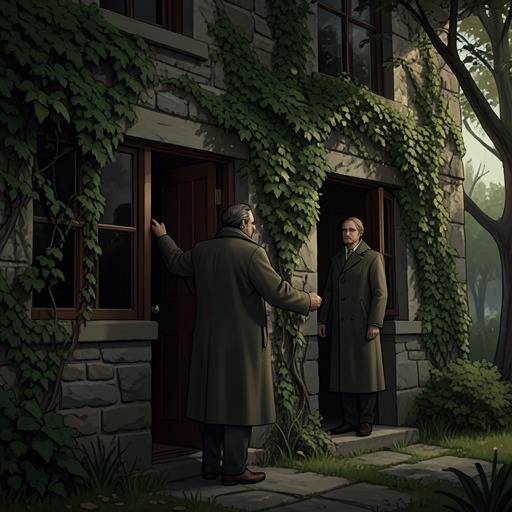
The final confirmation comes through an image showing two men associated with the opposed family lines. At first, one man stands before the house while another hides behind a tree, facing him with a murderous expression. The image then changes, placing the two men arm in arm. The visual reconciliation makes the curse’s logic legible: hostility has been replaced by peace, and the antagonistic lines are no longer locked into the original conflict.
Katrina confirms that the curse is over because peace has been brought between the families. She remains saddened that so many Abbots had to die before the reconciliation occurred, but Jade can finally regard herself as safe. The curse ends not through force or evasion, but through the surrender of the property that embodied the original betrayal.
The aftermath gives the resolution a concrete domestic form. One year later, Jade is married to Ryder and has a daughter, Jasmine, who is already one year old. Jade bends to kiss her child in the car seat, then kisses her wife more deeply. The family once defined by October funerals and threatened extinction now continues through an ordinary scene of parenthood and affection. The curse’s end therefore means more than survival: it permits Jade to begin a life not organized around inherited death.