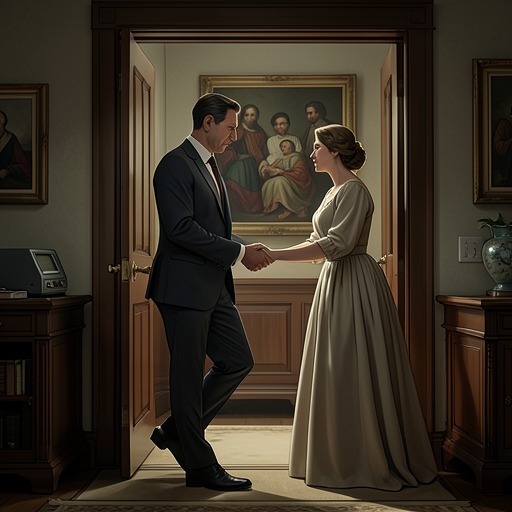
Julie Deveaux
Under Your Spell: A Romance Boxed Set of Masked Balls, Haunted Gardens, Magic, and MoreJulie Deveaux is introduced as a woman who responds to disorder by mastering it. Nothing calms her nerves more than demonstrating that chaos does not control her, and she carries that principle into both her work and her academic life. Her immediate objective is to survive a decisive meeting with her graduate advisor, Miranda, after failing to achieve the breakthrough she had hoped would secure more time for her thesis. The project is not an abstract exercise: its rejection could end her research altogether, while its success could lead to an honors degree, a history professorship, and a continued role helping to run the family ghost-tour business.
Identity and Background
Julie’s authority comes from a combination of scholarship, local knowledge, and practical endurance. She has led hundreds of ghost tours through New Orleans, giving her an intimate command of the streets and haunted sites of the French Quarter; the work has also given her the physical stamina to move confidently through the crowded historic district. On the morning of her meeting, she follows a familiar route through the French Market and toward Jackson Square, navigating congested streets and a seedy alley with the efficiency of someone who knows the neighborhood as lived space rather than merely as research material.
Her intellectual identity is equally forceful. Julie is studying the Madame Sophia murders, a pair of crimes whose historical uncertainty has become the central problem of her thesis. She imagines the future as something produced through effort: she will write a provocative thesis, graduate with honors, obtain a professorship, and remain connected to the family business. This self-authored plan reveals both confidence and pressure. The stalled research threatens not only an academic deadline but the coherent future she has constructed for herself.
Skepticism and the Supernatural
Julie’s skepticism is not a simple rejection of the supernatural. She does not claim that psychics are impossible; instead, she refuses to surrender authority over her future to them. In Jackson Square, she avoids the street psychics gathered between the St. Louis Cathedral and the park because their promises of true love, destiny, and soulmates conflict with her belief that the future must be created rather than awaited. A cryptic message concerning the river and the number three strikes her as an unwelcome disruption to a life already burdened with enough uncertainty.
That confidence is challenged when a medium tells her that she is right about Sophia and that Sophia did not commit the murders. The statement is unnerving precisely because it touches the subject Julie has been studying and articulates the conclusion toward which her research is moving. Julie’s reaction is not immediate conversion but disturbance: the message enters the space between her empirical work and the forbidden possibility that knowledge may arrive from the other side. Her mind remains committed to solving the historical mystery, yet the supernatural begins to interfere with the methods by which she believes truth can be secured.
A later tarot reading makes the conflict more intimate. Francine tells Julie that she seeks three things, although she acknowledges only two: one to satisfy her mind, one her home, and one her heart. The reading gives symbolic form to the divisions Julie has been managing through discipline. Her thesis represents the demands of the mind, while her connection to home is bound to her family and the ghost-tour business. The third desire, associated with the heart, is the one she has resisted naming, and its emergence suggests that Julie’s carefully controlled future cannot remain purely professional or intellectual.
Meeting Griffin Durocher
Julie’s encounter with Griffin Durocher turns her historical investigation into a personal crisis. After she gives him her phone number, he introduces himself by name, and the surname immediately links him to Sophia Durocher, the subject of Julie’s thesis. The coincidence feels to Julie as though the separate strands of her day have been arranged by invisible strings: the detour to the psychic, the collision with Griffin, and the handshake all acquire the pattern of orchestration rather than chance.
The attraction is therefore inseparable from apprehension. Griffin is not merely a stranger encountered during an unsettled morning; he is connected by family to the very woman whose innocence Julie is trying to establish. The relationship begins under the pressure of divided loyalties. Julie is drawn toward Griffin while recognizing that the research she values may wound him, and that any claim about Sophia will necessarily enter his family history as a personal judgment.
Duty, Research, and Conflict
Julie’s work as a ghost-tour guide requires her to turn historical violence into a public narrative. During a tour, she tells the crowd that fifteen years earlier, technically the following week on Halloween, two of the most puzzling and grisly murders in recent New Orleans history occurred in the house before them. The precise timing and location give the story its authority, while the crowd’s renewed attention confirms Julie’s skill at controlling a room. When the audience’s focus begins to drift, the murder history restores her command of the scene.
Yet Griffin’s presence makes that professional performance morally unstable. Julie feels sick at the thought of applying lemon juice to his old wounds, but she also believes she has a duty to her uncle, especially because of what he has done for her over the years. Her obligations are therefore layered: she owes loyalty to family, responsibility to her scholarship, and honesty to the historical record. None can be fulfilled without affecting the others. The ghost tour becomes a miniature version of Julie’s larger predicament, forcing her to make an entertainment of the past while recognizing that the past remains painfully alive for the people connected to it.
The conflict becomes explicit when Griffin confronts her about the claim at the center of her research. Julie states that Sophia Durocher is innocent. Griffin’s hand withdraws, his expression closes, and he asks whether she is studying his grandmother. The exchange transforms a scholarly conclusion into an interpersonal rupture. Julie had anticipated that Griffin might react this way, but anticipation does not protect her from the emotional force of his withdrawal; the link between them suddenly feels severed, leaving her with the knowledge that truth can function as both ethical commitment and source of injury.
Character Arc and Narrative Role
Julie’s early arc is defined by the collision between control and interruption. She believes that disorder can be mastered through effort, that historical secrets can be opened by a persistent mind, and that the future belongs to whoever works hard enough to create it. The day’s events challenge each certainty in sequence: the psychic speaks directly to her research, Francine identifies a desire Julie refuses to acknowledge, Griffin’s name binds romance to investigation, and her declaration of Sophia’s innocence threatens the relationship that discovery helped create.
Her importance lies in the fact that she does not approach the supernatural as a passive believer or an unquestioning initiate. She is an investigator whose skepticism is itself part of the drama. Julie wants evidence, academic legitimacy, and a future she can deliberately build, yet she is repeatedly confronted with signs that evade those categories. Her attraction to Griffin does not cancel her intellectual commitment, and her research does not erase her emotional vulnerability. Instead, the story makes both dimensions inseparable: the woman trying to solve the Madame Sophia murders must also decide what kind of truth she can bear when it reaches beyond the archive and into the life of someone she has begun to care about.