Pretty Polly
Under Your Spell: A Romance Boxed Set of Masked Balls, Haunted Gardens, Magic, and MorePretty Polly is presented first as a song that Nicole Sherry sings while settling into her home, but it quickly becomes more than background music. Its lyrics describe a fiancé, Polly, and a grave, and the song’s recurrence links domestic routine to an unseen supernatural history. When Nicole realizes that she has never heard it before, the song becomes a sign that something outside her conscious memory is speaking through her.
The Song in Domestic Routine
Nicole Sherry sings Pretty Polly while putting away clothing in her bedroom. The scene is deliberately ordinary: she is alone, arranging plain white cotton undergarments alongside unworn red-and-black lingerie, and enjoying the freedom to be as eccentric as she likes without anyone watching. She has always loved singing, although her working life is directed toward paralegal work rather than music. That casual, private performance gives the song its first force. It enters the narrative not through a formal ritual but through a familiar household gesture, making the supernatural intrusion feel embedded in everyday life.
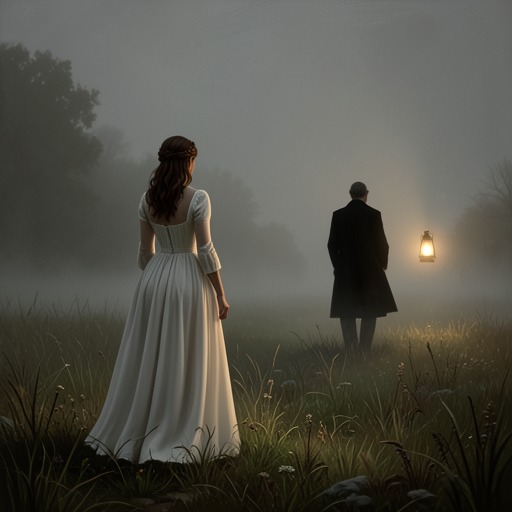
The song’s opening refrain repeats the image of Pretty Polly standing somewhere in the distance: “Oh, where is Pretty Polly, oh yonder she stands.” The repetition has the rhythm of a traditional ballad, but it also creates a disturbing insistence, as if the singer is being made to return to the same point. Polly is then described through the incongruous beauty of “rings on her fingers and lily-white hands.” The adornment suggests courtship and femininity, while the pallor of the hands quietly anticipates death. Pretty Polly therefore joins romantic imagery to the visual language of the corpse before Nicole understands what she is singing.
Grave Imagery and Interrupted Recognition
The song becomes explicitly threatening when its fiancé is said to have dug Polly’s grave. He throws the dirt over her and turns away, repeating the action before the lyric breaks off at “Down to the river—”. The interrupted line leaves the destination unfinished, but the narrative has already supplied the essential violence: Polly has been buried, the earth has been returned over her, and the lover who participates in the burial departs. Nicole recognizes that the song is creepy precisely because its courtship setting contains a concealed murder or death rather than a harmless love story.
Her recognition is also a failure of ordinary memory. Nicole stops singing and asks what the song is because she has never heard it in her life. The moment is not simply discovery of an unfamiliar tune; it is the collapse of her assumption that her own voice and recollections belong entirely to her. The song has been repeated through her before she can identify its source, making belated recognition the form in which its trauma reaches the living.
Supernatural Compulsion
The song’s meaning sharpens when Nicole encounters camellias whose odor seems to resemble putrefying corpses. While staring at the blooms, she receives the thought or message, “They made me sing that song.” This statement changes Pretty Polly from an eerie ballad into evidence of coercion. Someone—or some presence associated with the flowers and the house—was forced to sing it. The pronoun “they” implies an earlier act of control, while the song itself functions as the surviving trace of that control.
Nicole’s response shows that the compulsion is physical as well as psychological. She feels unable to throw the camellias into the garden, and even the thought of opening the back door makes her shaky; she cannot look toward it. The domestic threshold, normally a route of disposal and escape, becomes inaccessible. Pretty Polly thus operates within a larger Gothic pattern in which an apparently safe home preserves an old violation and converts ordinary objects, rooms, and habits into instruments of pressure.
Memory, Violence, and Narrative Function
Pretty Polly gives the haunting a form that can be carried by the body. Nicole’s voice reproduces words she does not remember learning, while the flowers provide an external sensory disturbance and the unfinished lyric points toward what remains undisclosed. The song’s repeated refrain mirrors the narrative’s return to an event that has not yet been fully explained: each repetition keeps Polly present, but never restores her to life or supplies a complete account of what happened.
The song also establishes a contrast between social performance and concealed violence. Nicole sings while sorting intimate clothing, in a room where private identity appears to be under her control; beneath that scene lies a melody about a woman whose body has been ornamented, buried, and abandoned. Pretty Polly consequently makes feminine domesticity double-edged. The home offers solitude and self-expression, yet it is also the space through which an imposed voice enters and through which an earlier death demands recognition.
As an expression within the novel, Pretty Polly is therefore both artifact and mechanism. It preserves the image of Polly’s rings, pale hands, grave, and covered body, while its unexplained arrival in Nicole’s singing demonstrates that the past is not remaining silent. The song’s decisive significance lies in that transition: what begins as an old tune becomes a supernatural testimony, turning repetition into evidence and private singing into involuntary witnessing.