Robert Williams
Under Your Spell: A Romance Boxed Set of Masked Balls, Haunted Gardens, Magic, and MoreRobert Williams is the tragic protagonist of The Killing Touch, a man whose ordinary hopes for family, work, and love are overturned by catastrophe and supernatural violence. His decisive significance lies in the contradiction at the center of his character: he longs to care for Anna Williams, yet the power that grows within him makes physical closeness fatal. Robert’s hands remain clean while the lives around him are destroyed, turning the familiar gesture of touch into the visible sign of his isolation.
Identity and Ordinary Life
Robert is first established through work, family responsibility, and an unspoken attachment to Anna Williams. While his father instructs him in packaging, supervising the unloading of maple trees from the nearby Sugar Bush forests, and training workers to press wood pulp into even layers, Robert’s mind repeatedly returns to Anna’s soft skin, sweet scent, eyes, curled hair, and sincerity. His labor is practical and demanding, but his emotional life is already organized around an imagined future with her. The contrast makes his later transformation more devastating: the man who begins by handling timber and building a life is eventually made dangerous by his own hands.
His desire for Anna is not merely private fantasy. When he recognizes her arriving on horseback, he drops his hat and nearly runs toward her before forcing himself to slow down and appear natural. After helping her from the horse, he can think only of kissing her. That bodily rush—his hurried movement, his attempt to restrain it, and the immediate fixation on contact—presents affection as a physical force before Robert can fully articulate it. Anna’s eventual response confirms the reciprocity he has hoped for: she blushes, lowers her chin, smiles, and tells him that she would like to walk with him. Their intimacy therefore begins as a fragile promise embedded in ordinary life rather than as a supernatural bond.
Fire, Family, and Rupture
Two years later, in October 1871 in Williamsonville, Wisconsin, Robert’s domestic world is still shared with his brother Charles Williams. The brothers meet at the cabin around supper, with Robert stirring stew while Charles arrives exhausted and comments on the roof Robert is nearly finished patching. These details place Robert within a modest pattern of mutual work and household dependence, a pattern that the approaching fire will obliterate. His concern for Anna remains immediate even during ordinary conversation; he asks how she is, hoping that discussion of her will quiet the unsettled feeling in his stomach.
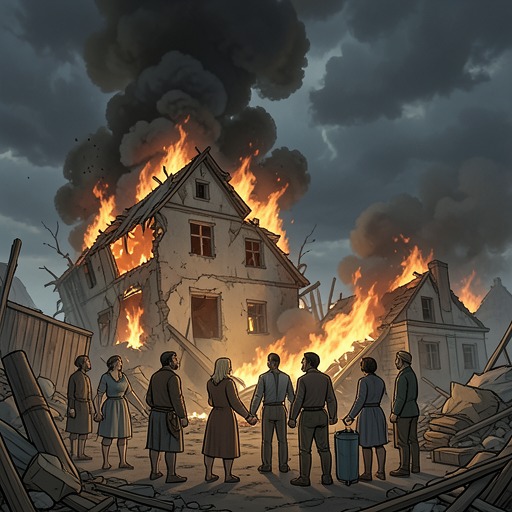
The fire siren awakens Robert in absolute darkness. Smoke and burning leaves have already entered the cabin, and he struggles free of his blankets before calling for Charles. Charles descends from the loft with panic etched across his face, while Robert opens the door onto a fire-lit night. Terror overwhelms him as the danger becomes bodily and immediate. The scene turns his earlier caretaking instincts into emergency action: he calls, urges escape, and tries to move his brother out of the burning environment.
The fire produces the wound that governs Robert’s later existence. Mere hours afterward, the nightmare has quieted, but he cannot erase Charles’s retreating back or his final instruction, “Take care of her.” Robert’s response is both grief and anger; he remembers shouting that Charles could not leave. The flames rage around the brothers while seeming to spare them within a narrowing protective circle, transforming the disaster from a natural catastrophe into an experience of uncanny confinement. Charles’s last words also redirect Robert’s life toward Anna, making love carry the weight of a dying brother’s command.
The Killing Touch and Moral Horror
Robert later encounters Harold and another man in the woods, where a power he has never known rises through him. When Harold slips from his monstrous grasp onto the ashy ground, Robert sees the consequences of his strength rather than mastering them. A strangled sound draws his attention as the second man runs into the woods, leaving Robert on his knees beside Harold. The most terrifying fact is not that his hands are injured or marked, but that they are perfectly clean. Their cleanliness becomes an emblem of invisible violence: the body bears no evidence, while the world around him bears the result.
Robert recognizes the nature of what he possesses as the killing touch. He asks what kind of monster he is, but the question does not resolve whether the power has changed his identity or merely exposed a danger within his existence. Rain falls through his fingers, wind howls, and the water first registers as cold against his collar and shoulders before the sensation fades. He becomes unable to feel even the rain that people had spent the summer praying for. The loss is therefore sensory as well as moral: Robert is cut off from the ordinary physical world at the same moment that touch becomes lethal.
His horror is followed by disorientation. He does not know what to think, what to believe, where to go, or what to do once he arrives there. He stumbles in an unknown direction, with no one left to share his life or truly see him. His sense of loss sinks into the rainwater and is buried deeply, suggesting that the killing touch does not simply make him a threat to others; it removes him from ordinary human recognition. Robert’s tragedy is the conversion of intimacy into danger and of self-knowledge into exile.
Anna Williams and the Failure of Love
Despite the catastrophe, Anna remains the emotional center of Robert’s life. At one point he knows only that he can leave Earth happy because Anna has finally kissed him. The kiss gives him a memory strong enough to replace fantasy, and it briefly allows love to appear as fulfillment rather than punishment. He also remembers the cradle he began making in Williamsonville. Originally intended as a final act of lingering attachment, the cradle takes on a new meaning after the kiss: he wants to finish it as a demonstration of his love.
The image of the cradle reveals Robert’s continuing attempt to answer destruction with care. He cannot restore Charles Williams or undo the fire, but he can make something intended for a future life and offer it to Anna. His craft becomes a form of emotional testimony, while the memory of the kiss gives that testimony renewed purpose. Yet the surrounding narrative makes the gesture precarious: Robert’s desire to build a safe future exists in the same story as a power that turns contact into death.
In the kitchen, Anna gives everything she has to the man she loves, and her energy flows into Robert despite his desperate attempts to stop it. He struggles to pull her fingers from his wrist, furious that she will not release him and angry that she has been so foolish. His anger is inseparable from terror: he understands the danger and tries to prevent the transfer, but his effort fails. Anna fades before him and whispers that she loves him with her last breath. Robert loves her as well and has for years, which makes her death not a rejection of him but the cruelest fulfillment of their mutual devotion.
Change, Isolation, and Tragic Significance
Robert’s trajectory moves from embodied hope to embodied estrangement. At the beginning, physical sensation brings him toward Anna: he notices her appearance, runs to help her from the horse, and imagines kissing her. After the fire and the emergence of his power, physical sensation becomes unreliable; rain loses its feeling against his skin, and his clean hands conceal lethal consequences. By the time Anna dies, contact has become the mechanism through which love and destruction arrive together.
His awakening also acquires a strange temporal quality. Robert wakes as though he has actually been asleep, searches his memory for the last thought that occupied him, and realizes that he cannot remember it. During the preceding weeks he had become practiced at letting his mind wander while he “rested,” but this waking is marked by a blankness he cannot explain. He hears his own voice as foreign and imagines it reverberating into a deep well. The experience suggests a fractured relation to his own consciousness: even before the final loss, Robert is no longer securely housed in the self he once knew.
Robert is therefore defined less by mastery of supernatural ability than by his inability to reconcile power with responsibility. He wants to protect Anna because Charles Williams charged him to take care of her; he wants to love her because his attachment has endured for years; and he tries to stop the transfer that kills her. None of those motives can overcome the force working through his body. The ending leaves him not triumphant or redeemed, but radically alone, with grief, guilt, and the knowledge that the hands through which he tried to offer care have become instruments of death.