True-Love Sacrifice
Under Your Spell: A Romance Boxed Set of Masked Balls, Haunted Gardens, Magic, and MoreTrue-Love Sacrifice is the supernatural and emotional act by which Anna willingly gives her life force to Robert, placing love, consent, and self-offering at the center of a crisis that otherwise appears to be fatal. Its decisive significance lies in the reversal it produces: Robert’s touch seems capable of killing Anna, yet her voluntary surrender may be precisely what breaks the curse governing his existence and returns him fully to life.
Definition and Conditions
True-Love Sacrifice is not merely the transfer of energy from one body to another. It depends on willingness and on an exceptional bond between giver and recipient. Anna does not simply become a victim of Robert’s power; she chooses to reach for him after deciding that he can control the force for her. The sacrifice therefore joins physical surrender to an act of trust. Her life is offered consciously, rather than taken without intention, and that distinction becomes the possible source of the supernatural reversal.
The concept also changes the meaning of Robert’s life force. Robert has believed that a simple touch could kill Anna, and the scene initially confirms the danger of that belief. When Anna grips his hand, energy moves out of her and toward him, while darkness overtakes the kitchen and an unfamiliar cold advances across her skin toward her heart. The bodily symptoms make the sacrifice immediate: its cost is measured in failing breath, weakness, and the disappearance of light rather than in abstract magical language.
The Kitchen Sacrifice
Anna’s action begins as a test of Robert’s restraint. He falls back and refuses, but his denial lacks conviction; Anna watches his hands and forms the idea that he might control his power for her. She then reaches out with the suddenness of lightning and takes Robert’s hand. The gesture collapses the distance between danger and devotion, turning a feared touch into the instrument through which she attempts to save him.
Robert’s energy drains from her as the kitchen fades into darkness. Anna does not resist. Instead, she urges him to control the force, holding to the belief that his love can prevent the touch from becoming an execution. As her lungs tighten and each breath becomes hurried and insufficient, she fixes her mind on a small remaining point of light and on memories of Robert’s kindness, gentleness, strength, and patience. The scene makes affection an active sustaining force even while her body is failing.
At the final moment, Anna tells Robert that she loves him and gives everything she has to him. The sacrifice reaches its fullest form when she exhales for the last time and deliberately surrenders the remainder of her life. The action is therefore both intimate and catastrophic: a private declaration becomes a complete transfer of vitality, and the apparent value shift is from life toward death before the consequences reverse that movement.
Reversal and Possible Curse-Breaking
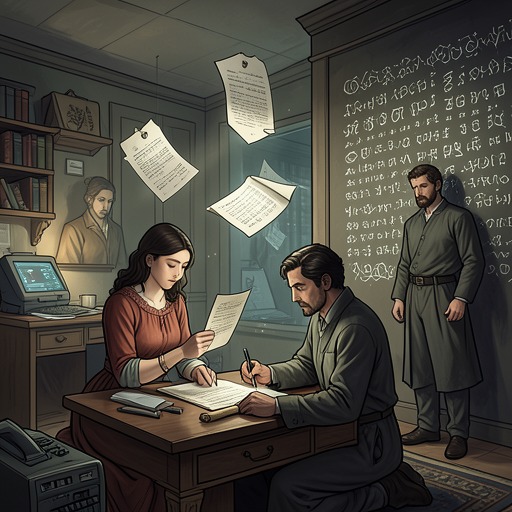
Robert initially believes that he has killed Anna. After the transfer, however, a faint heartbeat remains. Relief overwhelms him, and he lifts her into his lap, strokes her hair, and begs her to wake. When Anna opens her eyes, weak but alive, she tells him that he controlled the power. Robert rejects that explanation, insisting that he took everything she had and admitting that what happened does not make sense.
The contradiction is the core of the concept. Anna’s life was apparently consumed, yet she survives; Robert has taken all her energy, yet he feels whole, full, and completely alive, with a steady and powerful heartbeat. The sacrifice thus produces a result neither character expected. It is not ordinary predation, because the giver survives, and it is not simple resistance, because Robert is restored rather than merely prevented from causing further harm.
Robert later understands Anna’s statement that she gave him her life willingly as evidence of an act of true love. The narrative presents his interpretation cautiously: the sacrifice may have broken the curse, restored his life, and saved Anna. That uncertainty preserves the supernatural mystery while still establishing the event’s concrete consequence. The act is powerful not because the text reduces it to a fully explained formula, but because its emotional condition supplies what brute consumption could not.
Contrast with Earlier Feeding
The sacrifice also recasts Robert’s earlier dependence on stolen vitality. He wonders whether he ever needed to feast on the life force of the burn victims in Chicago. The possibility raised by Anna’s act is that the energy required to sustain or restore him had to come from someone who loved him enough to sacrifice for him, not from indiscriminate suffering.
This contrast separates consumption from communion. The life force taken from burn victims represents survival through harm, while Anna’s gift creates a reciprocal transformation: Robert receives the energy, but Anna’s willingness changes what the transfer means and what it can accomplish. The scene does not erase the horror of the earlier feeding; instead, it places that horror beside a form of surrender that may achieve the same immediate end without destroying the giver.
Thematic and Narrative Significance
True-Love Sacrifice converts love from an emotion spoken in private into a force capable of altering supernatural law. Anna’s declaration is followed not by a conventional rescue from outside but by her bodily offering, and Robert’s restoration follows the moment when the offering becomes complete. Love is consequently represented as both vulnerability and agency: Anna risks death, yet her choice becomes the condition of survival for both people.
The concept also makes consent structurally decisive. Robert’s power begins as something that threatens to make him a killer, but Anna’s willing action interrupts that pattern. Her gift does not simply excuse his violence; it exposes a different rule governing the exchange of life force. The resulting ambiguity—whether the curse was truly broken, whether Robert’s restored life depends on Anna’s love, and why Anna survived—keeps the event open while grounding every possibility in the visible evidence of the scene: the darkness, the failing breath, the faint heartbeat, and the return of strength.
In narrative terms, True-Love Sacrifice is the turning point from apparent death to uncertain renewal. Anna gives Robert everything, Robert believes he has lost her, and both emerge altered: he is restored to a fullness he has not felt, while she remains alive but weak. The sacrifice therefore resolves the immediate crisis without making its cost disappear, preserving the paradox at the heart of the episode—that the act most resembling death becomes the means by which life is recovered.