Williamsonville
Under Your Spell: A Romance Boxed Set of Masked Balls, Haunted Gardens, Magic, and MoreWilliamsonville is a small Wisconsin mill settlement whose rise depends on lumber, family labor, and communal interdependence, but whose defining historical rupture is the Great Peshtigo Fire of 1871. The settlement’s destruction turns an apparently ordinary industrial town into a site of mass death, survivor trauma, and enduring remembrance.
Foundation and Industrial Community
Williamsonville is presented in October 1871 as a settlement connected with the town of Brussels, Wisconsin. Robert’s father, a Belgian emigrant, founded its small shinglemill, and the enterprise became successful enough for Robert’s parents to begin building what was regarded as the nicest house in the settlement. The mill’s prosperity was not confined to one household: Robert’s brothers, cousins, and nephews benefited from it, while roughly seventy-five workers lived and flourished in Williamsonville.
The settlement’s economy is materially demanding. Deliveries require long days of hauling sticky logs, and the mill workers spend still longer weeks pressing tacky wood pulp into shingles. This labor binds the town’s prosperity to the surrounding forest and to a production system sustained by extended family networks. The same industry that makes Williamsonville viable also leaves its residents exposed to combustible materials, exhausting work, and the environmental conditions around the mill.
The Great Peshtigo Fire
Two years after an earlier meeting between Robert and Charles, the narrative returns to Williamsonville in October 1871, with winter approaching and Robert still trying to finish repairs to his roof. Smoke has already become part of daily life: fire sirens have not sounded for almost a week, yet the air remains sticky in his lungs, and the northern sky carries a smoky darkness with a red hue. The danger is therefore both sudden and cumulative, arriving after a period in which the settlement has had time to live with warning signs without being able to escape them.
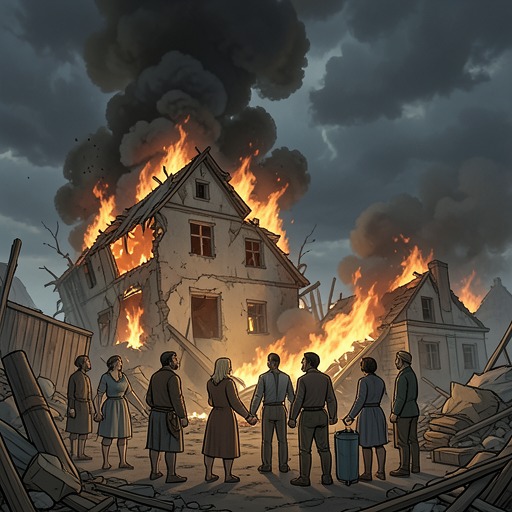
When the fire reaches the settlement, Robert and Charles confront a storm so violent that it swallows shouted warnings. Robert refuses to lead his companions into an open field because he believes it offers no protection. As the fire forms an opaque tornado of gold, red, and orange, debris rains down around him, separating him from Robert’s cousin John, John’s wife Emily, and the people with whom he had worshiped, eaten picnics, and worked.
Robert eventually reaches the town center, where flames lick buildings on both sides of the dirt lane. The family house stands directly ahead, burning through its windows, open door, and unfinished roof. A piece of blue calico draws his attention to a body outside the house, and he recognizes it as his mother. Charles restrains him before he can rush forward, turning the scene from an attempted rescue into an immediate confrontation with overwhelming loss.
Casualties and Survivor Knowledge
Robert survives but remains unconscious for three days. When he wakes, Anna tells him that Charles is not coming because their father found his body on the shore. She also explains that more than sixty people from the settlement have died, with some bodies unidentified and others recovered near or within Williamsonville. The mill and every building are gone, as is the forest in the Sugar Bushes across the bay; apart from the city of Peshtigo, Williamsonville has suffered the most casualties.
The scale of the destruction changes Robert’s understanding of survival. His own survival is described as miraculous, but it does not restore what the settlement has lost. The question of how many parents, cousins, friends, and mill workers have died becomes part of his first consciousness after the fire. A mass ceremony in Williamsonville is planned for the following day, giving the ruined settlement a communal ritual through which unidentified and known dead can be mourned together.
Anna’s presence also connects private grief to the settlement’s wider catastrophe. She has suffered the same kind of loss, and her gentle touch communicates understanding before either character can fully articulate it. Yet Robert’s trauma has altered his bodily response to intimacy: when he senses the life force pulsing from Anna, he feels an alarming desire to hold her and absorb it. Williamsonville’s destruction thus leaves its survivors carrying not only memories of death but also unfamiliar, frightening changes in their relationship to life itself.
Historical Memory and Family Legacies
Williamsonville remains tied to family history long after the fire. In another family’s remembrance, October is marked by funerals and anniversaries of parental death; the date of a grandparents’ funeral also coincides with the anniversary of the speaker’s parents’ funeral. Although this later remembrance concerns the Abbot family rather than the mill settlement itself, it places Williamsonville within a broader pattern in which October repeatedly gathers family loss, ritual mourning, and inherited memory.
The settlement’s history also appears alongside accounts of the Abbot family and the Moriarty family. Gertrude explains that the Abbots acquired their plantation through trickery rather than purchasing it from the Moriartys, who had moved south from Salem, Massachusetts, in the early 1800s. The Moriartys’ curse on the Abbots is linked to the loss of their plantation, and the resulting belief that most Abbots do not live long connects property, family transmission, and death across generations. Williamsonville is not the origin of that curse, but its history of industrial prosperity and mass destruction provides another model of how place can become inseparable from inherited catastrophe.
Narrative Significance
Williamsonville functions first as a working community: its mill organizes employment, settlement, and kinship, and its buildings embody the material success of Robert’s family. The fire reverses that value structure in a single catastrophe. The mill becomes ash, the forest becomes part of the destruction, the family home becomes a trap, and the social world of work, church, and shared leisure is reduced to bodies that must be identified and mourned.
Its significance lies in the contrast between communal flourishing and communal erasure. The settlement is not merely a backdrop for Robert’s ordeal; it is a network of labor, family, landscape, and memory whose destruction gives supernatural and family-centered narratives a historical depth. Williamsonville remains legible through its survivors’ bodies, ceremonies, anniversaries, and altered attachments, making the place a memorial to both the violence of the Great Peshtigo Fire and the fragile human systems built around the mill.