Willingdon Manor
Under Your Spell: A Romance Boxed Set of Masked Balls, Haunted Gardens, Magic, and MoreWillingdon Manor is both a tangible New Hampshire estate and a supernatural instrument of memory, desire, and recognition. Its hidden approach, imposing nineteenth-century architecture, ancestral portraits, and impossible painting transform it from a place Julia longs to visit into the point where her life intersects with the Willingdon family’s inherited dream-vision phenomenon. The manor does not merely contain the story’s secrets; it repeatedly draws characters toward them, turning architecture into a threshold between what can be historically explained and what can only be experienced.
Location and First Impressions
Willingdon Manor stands in Wakefield, New Hampshire, concealed so effectively by trees and overgrown holly bushes that Julia and Carly had spent many Sundays searching for a way in before concluding that no entrance existed. Two years earlier, Julia had seen the house while hiking and then had been unable to find it again. That disappearance made the manor more than an impressive building: it became an unresolved image that captivated Julia’s imagination and helped lead her to major in history. Her fascination is therefore rooted in both scholarship and personal mystery.
When Julia finally approaches the estate on Halloween, the setting is made hostile by a deteriorating storm. Rain intensifies, wind lashes the car, clouds darken, and the roads are inundated before she reaches Carly’s driveway. The entrance itself remains almost hidden until Carly points out the open wrought-iron gate among the pines and holly. Once the car passes through, the forest falls away and reveals the manor. The delayed revelation gives the house the force of an apparition: it is present only after the landscape has concealed it, and its appearance seems to answer a search that had previously failed.
The building is a rambling nineteenth-century manor made of roughly hewn grey stone, apparently impervious to the storm. Its oriel windows project from the second floor and contain leaded glass; a sharply peaked dark-slate roof crowns the structure; ivy climbs one wall; and smoke rises from each of four broad chimneys. Julia finds it even more impressive than she remembers, while Carly compares the experience to entering a Jane Austen novel. The house consequently carries two identities at once: it is a beautiful historical residence associated with inherited wealth and cultivated taste, and it is a Gothic presence whose scale, concealment, and resistance to the weather make it feel larger than ordinary domestic space.
Founding History and Family Space
Paul E. Willingdon explains that the manor was built by Lord James Willingdon, heir to a vast fortune and extensive property in England. The founder might have remained a gentleman living a life of leisure, but three successive loves redirected his existence. As a teenager, he fell in love with ships after visiting the Bristol dockyards with his uncle. He abandoned the expected life of an estate gentleman, hired a manager for his property, and devoted himself to shipping; within eight years he had established a highly successful company and more than doubled the family fortune.
Lord James’s second love was Lady Elspeth Grace Farmingham, whom he met in Boston. Their relationship began as a scandal because she was engaged to another man and was due to sail home to marry her fiancé. Instead, she deliberately missed the boat so she could spend more time with Lord James, and they married within a month. The third love was the landscape itself. Although the couple intended to honeymoon in France, Lord James came to Wakefield to meet a potential business partner and fell in love with the White Mountains. The estate thus embodies a chain of redirected desires: ships replace inherited leisure, Lady Elspeth replaces an expected marriage, and New England replaces England.
The couple never returned to live in England. They built Willingdon Manor as a smaller version of the house Lord James had left behind, preserving the form of the old world while adapting its life to the Appalachian landscape. The new residence has a library but no ballroom, a conservatory but no gatehouse. Instead of reproducing the obligations of English aristocratic life through extravagant dinners and large balls, Lord James and Lady Elspeth hosted picnics and walked through the hills. The manor therefore records migration without simple abandonment: it carries English architectural memory into Wakefield, then reshapes that memory around forests, lakes, and open-air intimacy.
The house remains a living family space rather than a museum detached from its owners. Paul tells Julia that the portraits depict his ancestors and confirms that the manor is his home, although he lives in the city and spends some weekends there. His connection to Clavis Security places the ancestral estate within a modern professional world, but the house retains a separate temporal gravity. Corporate celebration, inherited history, private desire, and supernatural tradition meet under the same roof.
Interior and Threshold Spaces
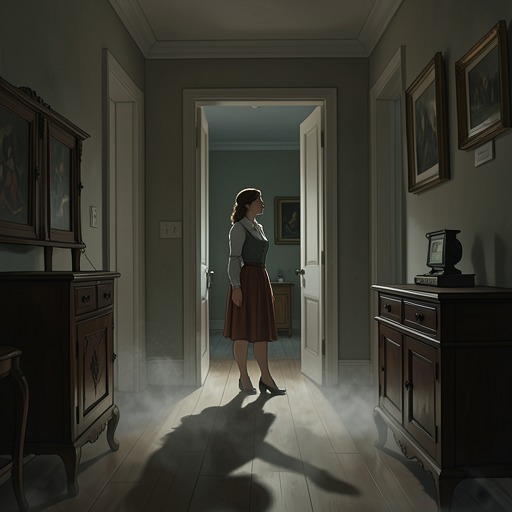
The library gives the manor its most vivid interior identity. Antique red and coral furniture fills the room, while floor-to-ceiling shelves of leather-bound volumes stand behind leaded glass. An antique gramophone occupies one corner, and a massive stone fireplace sends warmth through the room. During the Clavis Security party, the historical furnishings coexist with a temporary bar, unpacked glasses, crates of alcohol, speakers, turntables, and headphones. The room becomes a layered space in which ancestral culture and contemporary social life overlap rather than replacing one another.
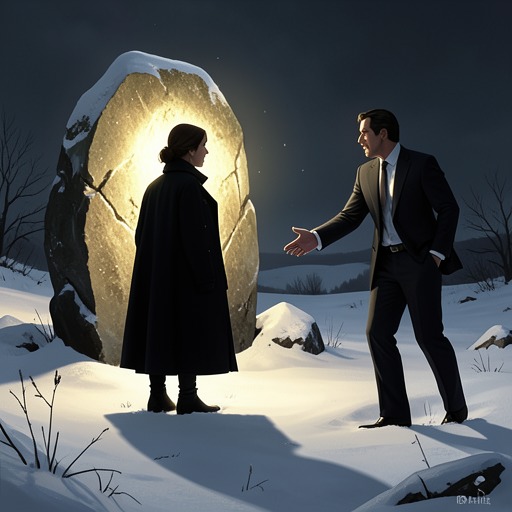
The conservatory serves a different function. It is the setting for Julia’s encounter with Jason, but the glass enclosure cannot contain the experience within ordinary space. When Julia kisses him, the rain and marble bench vanish, and she finds herself on a rough rock in warm, dry summer air, looking across an emerald-green valley toward Willingdon Manor. The sudden displacement turns the house into the fixed point of a vision that disregards linear time and physical distance. Julia is brought back to the conservatory, yet the event changes the meaning of the building: the manor is no longer merely where the vision occurs but the destination around which the vision is organized.
The estate also contains evidence that makes its supernatural history visible. Julia discovers a painting titled The Solstice, signed by Paul E. Willingdon. It shows a forested valley, a river, Willingdon Manor in the distance, and a blond-haired woman sitting on a rocky outcrop with her back to the artist. The woman wears the same hiking boots, khaki shorts, and white T-shirt Julia wore on the day she first saw the manor. The painting converts Julia’s supposedly private memory into a pre-existing image preserved inside the house. Its frame functions almost like a second threshold: by looking past her reflection, Julia sees an image that appears to have been waiting for her.
Supernatural Recognition and Narrative Significance
Paul explains that he dreamed about Julia on the same day she saw the house. He also points out that the view represented in The Solstice cannot be reached by any trail: a hundred-foot rock face and forest stand between the supposed vantage point and the manor. Julia’s sight of the house therefore cannot be accounted for by ordinary exploration alone. Paul does not claim to understand the mechanism, but he states that the phenomenon has existed for at least five generations, counting himself as the sixth. Willingdon Manor is consequently the material archive of a family pattern in which dreams, landscape, paintings, and encounters repeat across generations.
The manor’s concealment intensifies this function. Its hidden gate and apparently inaccessible setting make arrival feel like a privilege granted by the place rather than a route discovered by determination. Julia first sees it while hiking, loses it, searches for it repeatedly, and finally reaches it through directions supplied for an exclusive party. That progression gives the house a selective quality: it remains unavailable while she approaches it as an object of historical curiosity, then opens when the personal and supernatural strands of her story converge.
Its Gothic force arises from the tension between welcome and threat. The four chimneys smoke, the fire warms the library, and the interiors offer books, music, and family history; yet the same building appears during a violent storm, has been impossible to locate, and preserves a painting that anticipates Julia’s clothing and position. The manor is beautiful without becoming safe, and intimate without becoming ordinary. It makes the past feel inhabitable while also demonstrating that the past can observe, predict, and summon the living.
For Julia, entering Willingdon Manor marks a decisive movement from fascination into participation. She had believed that the house changed her life simply because she once saw it and built her academic interests around it. At the Halloween party, however, the estate links her to Paul’s ancestral dream tradition and supplies material proof that her earlier vision was part of a larger pattern. Willingdon Manor thus operates as the novel’s architectural center of fated recognition: a secluded family home, a repository of migration and memory, a stage for desire, and a supernatural threshold through which Julia’s private experience becomes legible as inherited destiny.