Willingdon Manor solstice phenomenon
Under Your Spell: A Romance Boxed Set of Masked Balls, Haunted Gardens, Magic, and MoreThe Willingdon Manor solstice phenomenon is the supernatural force or recurring manifestation associated with Willingdon Manor and the summer solstice. Its decisive significance is that it transforms Julia’s earlier, apparently impossible sight of the manor into evidence of a larger pattern: the house can reveal itself across distorted space and time, and the phenomenon appears to arrange a meeting between Julia and Paul E. Willingdon. What begins as a fleeting alteration in a rainy landscape develops into a family legend, a painted record, and an unsettling claim of inherited recurrence.
Manifestation at the Threshold
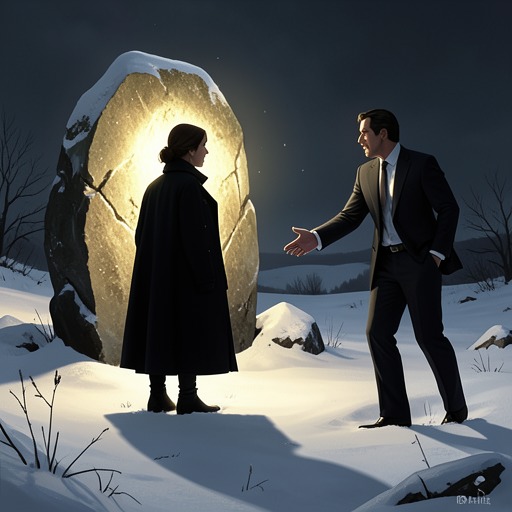
Julia encounters the phenomenon while traveling with Carly toward Willingdon Manor. The moment occurs as the car crosses the property’s threshold: the black asphalt road suddenly becomes grey gravel, the forest withdraws on either side, the rain stops, and the sky brightens. A warm breeze moves through the car, accompanied by a soft whisper at Julia’s ear. The transformation is not gradual and does not obey ordinary weather or geography; it arrives as a complete replacement of the surrounding world. The altered scene disappears almost as soon as Julia begins to speak. The road becomes black again, the forest thickens, the air turns damp and cool, and rain hammers the car. The abrupt reversal leaves Julia blinking and asking what has happened, while Carly can only ask whether she is all right. The phenomenon therefore produces no stable public spectacle. It is a private rupture in perception, witnessed most intensely by Julia and immediately withdrawn before it can be tested. The threshold is important because it makes the manor’s boundary function as more than a physical entrance. Crossing into the grounds initiates a brief passage from an ordinary storm into a summer landscape, then returns Julia to the storm before she can establish which reality has priority. The episode preserves the central tension of the phenomenon: the experience is concrete enough to alter Julia’s senses, yet unstable enough to invite doubt.
The Solstice Date and the Hidden Legend
Paul connects Julia’s earlier sighting to June twenty-second, the summer solstice. Julia remembers the date precisely but does not tell him that it is also her birthday. Paul’s immediate response identifies the date as the solstice and places Julia’s experience within a seasonal pattern rather than treating it as an isolated hallucination or coincidence. Before entering the house, Julia had heard only rumors. Some people claimed that Willingdon Manor belonged to an Italian fashion designer; others attributed it to a reclusive Hollywood star; many simply said that it was haunted. No one, according to the information available to her, had actually been inside. These contradictory explanations show the manor circulating as local hearsay before the phenomenon acquires a more specific meaning. Paul’s reaction changes the status of those rumors. He is not merely confirming that the house is haunted. He recognizes the solstice as a recurrence connected to his family, and he later explains that the phenomenon has operated for at least five generations, counting himself as the sixth. The claim shifts the manor from an obscure, inaccessible building into the center of a hereditary supernatural tradition. Its mystery is not just that the house exists, but that it repeatedly participates in encounters whose significance becomes legible only afterward.
Painting, Vision, and Recognition
Inside the manor, Julia finds a painting that reproduces the impossible view she once experienced. It depicts a lush forested valley on a clear summer day, a river, and the manor on the opposite side. In the foreground, a blond-haired woman sits with her back to the artist on a large rocky outcrop. The woman wears brown hiking boots, khaki shorts, and a white T-shirt—the exact clothing Julia wore on the day she first saw Willingdon Manor. The painting is titled The Solstice and signed by Paul E. Willingdon. Its details make the object more than a general likeness or atmospheric image. The clothes identify Julia specifically, while the landscape records a view that should not have been available from any ordinary trail. When Julia recognizes herself in the picture, the earlier vision becomes materially present inside the house, as though the manor had preserved an image of an event before Julia understood what she had seen. Paul explains that the painting presents a geographical impossibility. There is no trail leading to that view of the manor: a 100-foot rock face stands before it, followed by forest. He knows this because he has been there himself. The contradiction between the painting’s precise perspective and the actual terrain prevents a simple natural explanation. The phenomenon does not merely make Julia see the house; it gives her access to a vantage point that physical space denies. The painting also complicates the direction of perception. Julia believes she saw the manor first, but the painting suggests that she had already been anticipated within the manor’s story. The house seems to operate through images, visions, and retrospective confirmation, making recognition reciprocal rather than one-sided. Julia is not simply discovering a place; she is discovering that the place has, in some sense, already represented her.
The Manor, the Dream, and Paul’s Prophecy
The phenomenon becomes explicitly relational when Paul tells Julia that he dreamed about her on the same day she saw the house. His dream and her vision therefore occur simultaneously, joining two people who are separated by distance but connected through the solstice manifestation. Paul does not claim to understand the mechanism. He admits that he only knows that it works, a limitation that preserves uncertainty even as he asserts the phenomenon’s reality. The connection is intensified when Julia kisses Jason in the conservatory. At the instant of the kiss, the rain vanishes, the marble bench disappears, and Julia finds herself on the rough surface of a rock in warm, dry air scented with summer grass. Across a valley of emerald-green pine trees stands Willingdon Manor. She returns almost immediately to the conservatory, where rain again strikes the glass walls and the smell of rich earth surrounds her, but the vision has changed the emotional meaning of the encounter: Julia recognizes an overwhelming sense that another person is the one meant for her. The recurrence of the rocky outcrop links this later vision to the painting and to Julia’s first sight of the manor. The phenomenon thus repeats its imagery while changing its function. At first it establishes the house as an impossible object; later it becomes a medium for emotional recognition. The landscape is not background decoration but the stable visual grammar through which the solstice connects Julia, the manor, and Paul’s family history. Paul interprets the connection as part of the force that brought Julia to the house. Julia protests that they have only just met and that she came because of someone else. Paul acknowledges that prior attachment but argues that something had to pull her there, because otherwise they could not have found each other. His interpretation turns coincidence into destiny, while Julia’s hesitation keeps the claim from becoming wholly settled fact.
Recurrence and Narrative Significance
The Willingdon Manor solstice phenomenon occupies the unstable ground between natural explanation and supernatural certainty. The road changes, the weather reverses, the impossible landscape appears in a painting, and Paul reports a coinciding dream and a tradition lasting at least six generations. These details strongly support a supernatural pattern, yet the phenomenon is never presented as a mechanism that characters can fully control or explain. Its manifestations are brief, selective, and resistant to verification. That uncertainty gives the phenomenon its particular narrative power. Each occurrence first appears as a sensory disturbance, then receives meaning through another form—a date, a painting, a dream, or a family account. The reader is repeatedly asked to reconsider an earlier experience in light of evidence that arrives later. The effect is not simply surprise but a gradual conversion of private doubt into relational and historical significance. The phenomenon also makes Willingdon Manor a threshold between ordinary chronology and inherited memory. Julia’s vision on June twenty-second, Paul’s dream on the same day, the painting signed by Paul E. Willingdon, and the family tradition across generations all collapse separate moments into one repeating pattern. The solstice does not merely reveal a haunted building; it binds place, season, image, and encounter into a structure of fated recognition. Its most consequential outcome is Julia’s arrival at the manor and her discovery that what she experienced as an inexplicable glimpse may have been the first sign of a connection the house and the Willingdon family have been waiting to repeat.