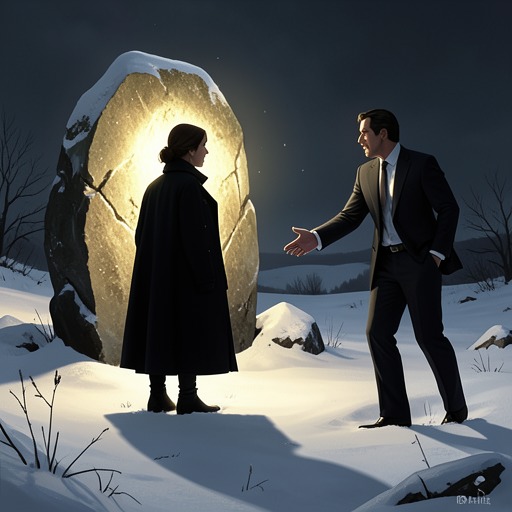
Willingdon family destined-partner dream
Under Your Spell: A Romance Boxed Set of Masked Balls, Haunted Gardens, Magic, and MoreThe Willingdon family destined-partner dream is a hereditary pattern of vivid romantic visions that identifies a future spouse before the couple meets. In the family’s own history, the dream functions as both prophecy and test: it can challenge an arranged marriage, expose a connection that neither lover can explain, and make a seemingly accidental meeting appear to be the latest recurrence of a tradition extending across at least five generations.
Definition and Family Pattern
The tradition is introduced through Paul’s account of his great-great-grandfather, Lord Willingdon. Before meeting Elspeth, Lord Willingdon was engaged to a countess selected by his family, and every arrangement for the marriage had already been made. Three days before the wedding, however, he cancelled it because he had dreamed of his future wife. The woman in that extraordinarily vivid dream was not the countess. His decision made him appear irrational to his contemporaries: his mother was furious, his sister mortified, and the family treated the dream as a dangerous departure from social expectation rather than as reliable knowledge.
The older generation provides the tradition’s first concealed precedent. Lord Willingdon Senior had experienced a similarly vivid dream when he was approximately the same age as his son, seeing the woman he felt certain would become his wife. Unlike his son, he told no one. He persuaded himself that the vision was merely a trick of the subconscious and proceeded with the marriage arranged by his parents. Three years after that marriage, he met the woman from his dream. The contrast between the two men establishes the rule’s central tension: the dream may be ignored, but ignoring it does not necessarily prevent the predicted encounter.
Julia and Paul’s Shared Vision
Paul tells Julia that he dreamed about her on the same day that she saw Willingdon Manor. The coincidence gives the family story immediate personal force. Julia is not merely hearing an old legend about distant ancestors; she is being placed inside the same pattern, with Paul identifying her as the woman who appeared in his vision and Julia confronting the possibility that her own sight of the manor was connected to him.
The vision is strengthened by the geography of the house. Paul points out that there is no trail leading to the view of the manor that Julia saw. A 100-foot rock face and forest block that perspective, and Paul says he has personally been there. The physical impossibility of Julia’s vantage point makes the experience difficult to reduce to ordinary observation. The dream tradition therefore links two forms of knowledge that should be inaccessible: Paul’s precognitive dream and Julia’s impossible view of the hidden manor.
Julia responds with disbelief and emphasizes that they have only just met. She also says that she came to the manor because of someone else, which appears to undermine the idea that Paul’s dream alone brought them together. Paul interprets that prior attraction differently. In his view, something had to pull Julia there, and the person or circumstance that first drew her toward the house may have been part of the same chain that allowed the two of them to find each other.
Transmission Across Generations
Paul describes the pattern as having existed for at least five generations and counts himself as a sixth if he is included. This count transforms an isolated family anecdote into an inherited tradition. The recurring element is not simply that Willingdon men fall in love unexpectedly; it is that a dream supplies a form of recognition before ordinary acquaintance, then is confirmed by a later meeting.
The family history also shows that the tradition is transmitted unevenly. Lord Willingdon acted on his dream, while Lord Willingdon Senior concealed his and followed the marriage his parents arranged. The two outcomes do not cancel one another. Instead, they imply that the dream’s authority persists whether the dreamer obeys it openly or suppresses it. One generation treats the vision as a reason to break an engagement; another treats it as subconscious error, only to encounter the dreamed-of woman years later.
This difference makes the dream a family inheritance with an ethical dimension. It offers no simple command and does not erase the consequences of choice. A dreamer must decide whether an unseen future has enough authority to overturn family plans, social duty, or an already promised marriage. The tradition thus places inherited expectation and personal recognition in direct conflict.
Narrative Function and Significance
Within Julia’s story, the dream tradition explains why her arrival at Willingdon Manor feels less like a planned visit than a convergence. Paul does not claim to understand how the phenomenon works; he only insists that it has continued through the family for generations. His uncertainty preserves the mystery while the repeated historical pattern gives the claim evidentiary weight inside the narrative. The tradition remains supernatural in its implications, but it is presented through remembered family history, repeated testimony, and a concrete contradiction between Julia’s vision and the manor’s actual geography.
The rule also changes the meaning of first recognition. Paul’s dream and Julia’s view of the manor suggest that the relationship begins before their meeting, not because either character consciously chooses it, but because both are caught in a pattern that precedes them. Yet the narrative does not reduce Julia to a predetermined bride. She questions the premise, notes the shortness of their acquaintance, and points out that another person was the immediate reason for her journey. Her resistance keeps the tradition from becoming an uncomplicated guarantee of romance.
The family legend’s decisive significance is therefore double. It offers a supernatural explanation for Julia and Paul’s improbable connection, while the older examples demonstrate that prophecy can collide with family authority, arranged marriage, secrecy, and regret. The dream is at once a promise of recognition and a source of pressure: it makes love seem fated, but leaves the characters responsible for deciding what to do with that apparent fate.