
From Smith’s Restoration to Fundamentalist Schism
Under the Banner of HeavenThis flow follows the growth of Mormonism’s claim to continuing revelation, the struggle over plural marriage, and the emergence of fundamentalist groups that preserve doctrines the mainstream church abandoned.
increasing Bearing strength in each event
 decreasing
Bearing strength in each eventdecreasingA New American Scripture
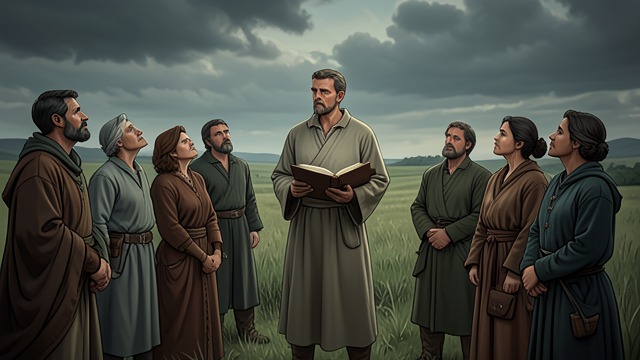
A Restoration Takes Shape
The plates and a new authority
In the religious ferment of the Second Great Awakening, Joseph Smith presents himself as a prophet entrusted with an ancient record. He says that the angel Moroni directs him to Gold Plates, which he translates into The Book of Mormon.
The story gives converts more than a new text: it makes a recent American prophet the center of a restored sacred history. The claim that divine truth has returned in the present becomes the basis for a church with its own scripture and authority.
Revelation as a living principle
Joseph Smith’s movement also teaches that God can continue to speak to a prophet. This promise helps distinguish the new church from established denominations and offers followers direct answers to questions of doctrine and practice.
The same principle contains a tension that will persist across the book. If God can speak anew, followers may ask whether the prophet is the only person who can receive authoritative instruction—or whether another claimant can challenge the institution by claiming revelation of his own.
The Plural Marriage Revelation

Marriage as Sacred Doctrine
A secret practice
Joseph Smith’s private plural relationships precede the public formalization of the doctrine. The narrative describes relationships with women including Fanny Alger and later plural marriages with young women in Nauvoo, while Joseph denies the practice to many of his followers.
The secrecy creates a widening gap between official public statements and private religious conduct. A practice presented to insiders as sacred is, to others in the community, betrayal and a threat to the church’s credibility.
Doctrine codified
In July 1843, Joseph dictates Section 132 of the Doctrine and Covenants, setting out plural marriage as a divine covenant and threatening consequences for disobedience. Emma Smith rejects the revelation and refuses to accept her husband’s other marriages.
The doctrine’s consequences extend beyond one marriage. It places competing claims—prophetic authority, marital consent, and the demands of revelation—inside the church itself, setting the stage for later disputes over whether plural marriage can ever be relinquished.
Succession and Exodus
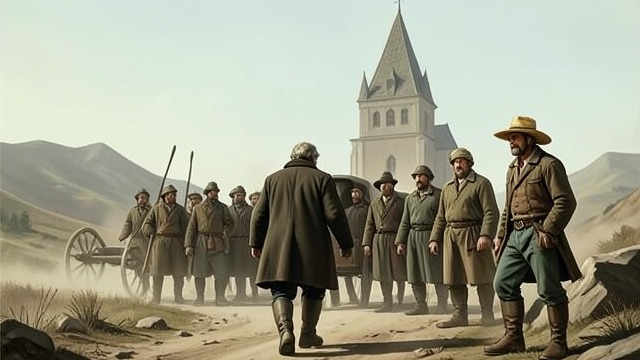
A Church Without Its Founder
The succession struggle
Joseph Smith’s murder in 1844 leaves no uncontested mechanism for choosing a successor. Joseph Smith III, Samuel H. Smith, Sidney Rigdon, and Brigham Young are among the figures associated with competing claims to leadership.
The dispute is also a struggle over plural marriage. Some Mormons hope a successor will abolish it; others, including leaders already practicing it, insist that the doctrine must survive. Brigham Young’s rise secures leadership for the pro-polygamy camp.
Flight and consolidation
After violence and pressure in Illinois, Brigham Young leads the Saints west. The arduous migration strengthens communal bonds and places the community under a leader whose authority is tied to discipline, survival, and obedience.
The move does not settle the question of relations with the United States or the place of plural marriage. Instead, the migration carries the unresolved doctrine into the new Mormon center in the Great Salt Lake Valley, where it will become public and provoke a national confrontation.
The Federal Contest

Polygamy and the State
Open defiance
In 1852, Brigham Young publicly announces plural marriage as a doctrine of the church. Federal laws and political pressure increasingly challenge the practice, while church leaders frame resistance as a matter of religious liberty and obedience to God.
The conflict escalates into the Utah War and later anti-polygamy legislation. The argument is not only about marriage: it is about whether church authority or federal law will govern the lives of the Saints.
The Manifesto
After the Edmunds-Tucker Act threatens the church’s institutional survival, Wilford Woodruff announces in 1890 that the church will submit to laws prohibiting plural marriage. The Manifesto marks a decisive change in official policy and clears a path toward acceptance in American public life.
Yet the change is neither immediate nor universally accepted. Some leaders continue plural marriages secretly, and believers who regard Section 132 as permanently binding interpret the retreat as a betrayal rather than a final doctrinal resolution.
The Fundamentalist Inheritance

A Covenant Beyond the Manifesto
Taylor’s revelation
While hiding from federal cohabitation prosecutions, John Taylor receives a revelation affirming that plural marriage has not been revoked. He gathers trusted followers and authorizes them to preserve the practice, creating a lineage of authority that fundamentalists will later claim continues outside the mainstream church.
For believers in this account, the Manifesto cannot cancel an eternal commandment. Their opposition to the mainstream church therefore rests on a competing history of revelation, priesthood authority, and covenant.
A continuing split
As the LDS Church moves toward enforcing the Manifesto, fundamentalist communities carry plural marriage into remote settlements in the American West, Canada, and Mexico. Their prophets claim to restore the church to its original order and anticipate the coming of the “One Mighty and Strong.”
The resulting movement is not a single unified body. Disputes over succession and revelation repeatedly divide it into rival groups, making the founding principle of continuing revelation both its source of vitality and a persistent engine of schism.
1820s, around Palmyra
1830s to July 1843, culminating in Nauvoo
1844 to 1847, from Nauvoo to the Great Salt Lake Valley
1850s through the 1890 Manifesto
1886 to the early twentieth century
