
The School of the Prophets and the Removal Revelation
Under the Banner of HeavenThis flow traces how Onias’s invitation to seek revelation draws the Lafferty brothers into a rival religious community, and how a disputed command to kill becomes their justification for violence.
increasing Bearing strength in each event
 decreasing
Bearing strength in each eventdecreasingOnias’s Claim

A New Prophet in the Tradition
Private revelation
Robert Crossfield, known as Onias, says that God began speaking to him in 1961. His revelations defend plural marriage and criticize the mainstream LDS Church for abandoning what he regards as Joseph Smith’s original principles.
Onias publishes these messages as books of commandments and eventually claims that he is a prophet with a role in setting the church in order. His message draws people dissatisfied with the distance between institutional Mormonism and the intense spiritual experience they seek.
A school for revelation
After moving near Salem and the Dream Mine, Onias organizes the School of the Prophets. Its central aim is to teach members to receive and interpret revelations, rather than leaving that capacity solely to the LDS president.
That project revives an appealing feature of Mormonism while weakening the usual chain of authority. Once many members are encouraged to hear God directly, the group has no simple way to contain a revelation that conflicts with its leader’s judgment.
The Lafferty Brothers Join
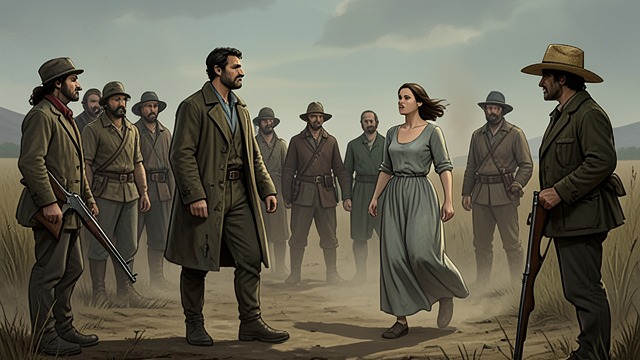
A Meeting of Convictions
Recruitment
Bernard Brady introduces Dan Lafferty and his brothers to Onias. They are drawn to his claims that the mainstream church has compromised essential doctrines, including plural marriage and the authority of continuing revelation.
The brothers bring their own growing distrust of government and their belief that religious and political authority cannot be separated. The School gives these views a shared setting, a vocabulary of restoration, and a leader who appears to confirm their sense of a special mission.
Ron’s appointment
Onias appoints Ron Lafferty bishop of the school’s Provo chapter. The position matters personally: Ron has lost his home, marriage, church membership, and ordinary status, and the new office gives him authority within a community that treats his convictions as significant.
For a time, the alliance appears mutually useful. The brothers help distribute Onias’s messages, while the school gives their radical ideas religious legitimacy. But the group’s openness to revelation will soon make that alliance unstable.
Ron Receives Revelation
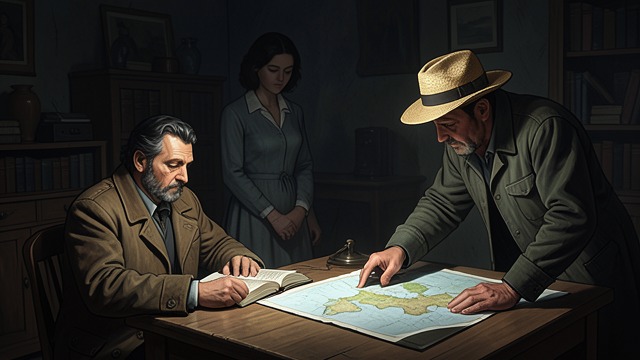
The Voice on the Screen
A new authority
Ron Lafferty begins receiving revelations during the school’s instruction. Some messages elevate him, describing him as one of the figures chosen to set the church in order; he interprets this attention as confirmation that his losses have prepared him for a sacred calling.
His revelations arrive amid the collapse of his marriage and his rejection by the LDS Church. Religious certainty gives those events a new meaning, turning humiliation into evidence of election and supplying a basis for anger toward the people he believes obstructed his path.
The named targets
A late-March revelation names Brenda Lafferty and Erica Lafferty first, followed by Chloe Low and Richard Stowe. It commands their removal so that God’s work can advance.
Dan Lafferty becomes the person who will act on the command. He and Ron debate whether the message is genuinely from God, but their standard for certainty is shaped by a stark division between the righteous and the wicked: once they classify the targets as enemies of God’s work, murder can be reframed as obedience.
The School Rejects the Command
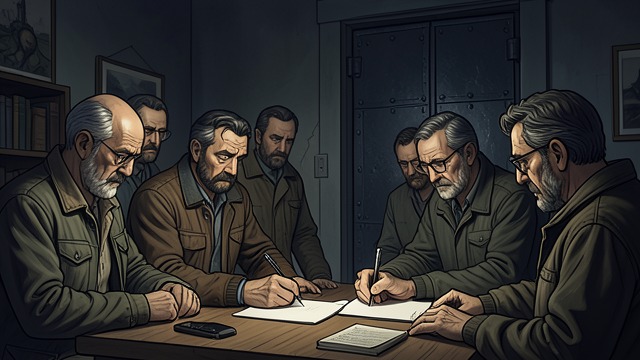
A Communal Test Fails
A vote against violence
Ron Lafferty brings the removal revelation to a meeting of the School of the Prophets. The members discuss it and reject it; Onias and most of the men present do not accept that God has commanded the killings.
Bernard Brady is deeply alarmed. He records his concern in an affidavit, but neither he nor the other members warn the people named in the revelation or alert the police. The group recognizes the danger without converting its fear into effective protection.
Departure from restraint
Ron, Dan, and Watson Lafferty leave the school after the rejection. The disagreement does not persuade them that the revelation is false; instead, they treat the group’s refusal as a failure to recognize God’s authority.
The institutional check has therefore been tested and discarded. Ron and Dan are now more isolated from people who might challenge their interpretation, while the intended victims remain unaware that the brothers have moved from prophetic language toward a plan of action.
The Journey to Execution

A Command Carried West
Planning on the road
Ron and Dan travel through the West with Ricky Knapp and later Chip Carnes. The brothers repeatedly discuss the revelation; Ron becomes increasingly focused on July 24 as the date for the killings, while Dan prays for guidance and says he receives the answer to stay with his brother.
Their road trip connects religious planning with growing practical preparation. They carry weapons, visit fundamentalist communities, and seek support for their imagined City of Refuge, even as the removal command remains unresolved for everyone outside their circle.
Violence in American Fork
On July 24, the group reaches Allen Lafferty and Brenda Lafferty’s apartment. After an initial unanswered knock, Dan returns, forces entry, and kills Erica and Brenda with Ron’s participation.
They fail to kill Chloe Low and abandon the plan to reach Richard Stowe. The partial completion does not weaken Dan’s belief that the act was righteous; the brothers flee to Nevada, leaving the School’s warnings unheeded and the murdered family at the center of a criminal investigation.
1961 to the early 1980s
Late 1983, in Utah County
February to March 1984
April 5, 1984
May to July 24, 1984
