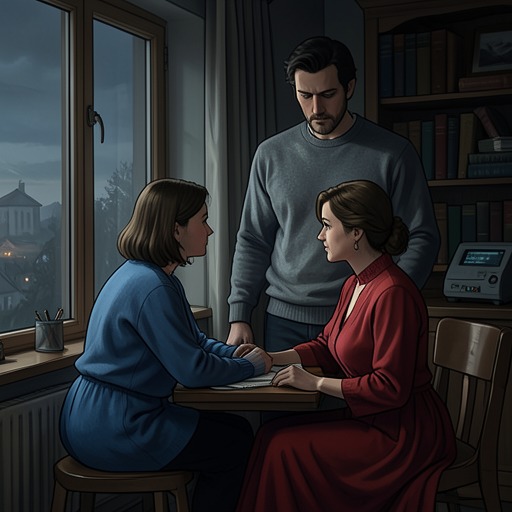
Allen Lafferty
Under the Banner of HeavenAllen Lafferty, the youngest of the six Lafferty brothers, is presented through a painful contrast: he was the husband Brenda loved and the father of their infant daughter, Erica, yet when his brothers disclosed their intention to kill his family, he did not warn Brenda. The account does not describe Allen as participating in the murders. It instead traces how his marriage, his continuing ties to his brothers, and his silence placed him at the center of the family tragedy without making him its killer.
Identity and marriage
Allen met Brenda Lafferty while she was studying at Brigham Young University and attending a young-adult congregation in Provo. Although Allen was not a student, he began attending the congregation. Brenda’s family remembered him as charismatic, a returned missionary, and, at first, someone who seemed to fit the respectable Latter-day Saint family image associated with the Laffertys. Brenda fell in love with him, and they married in the Salt Lake City temple on April 22, 1982, when she was twenty-one.
Brenda was ambitious and had built experience in communications: at Brigham Young University she anchored a television newsmagazine, and she hoped to pursue broadcast journalism. After the marriage, Allen did not want her to work. She set that ambition aside for a lower-profile job at a department store, partly to obtain insurance and help support the family, but Allen also pressed her to leave that position. Brenda’s mother later said that Brenda had been offered a teaching job in the university’s communications department and that Allen would not let her take it. Instead, Brenda became a housewife. Her journals indicated that within about two months of the wedding she felt she had made a mistake; she then became pregnant with Erica.
The book places this change within a wider conflict over what a wife’s role should be. Dan persuaded his brothers to embrace fundamentalist beliefs and the demands associated with them. The other wives yielded to varying degrees, but Brenda resisted Allen’s demands and refused to accept the brothers’ influence over their marriage. Her resistance strained her relationship with Allen’s family, even as she continued to love her husband.
Brenda’s resistance and Allen’s family ties
Brenda’s opposition was not limited to disagreements inside her marriage. When Dan introduced the Canadian fundamentalist prophet Onias to Allen and the other brothers, Allen was eager to join Onias’s School of the Prophets. Brenda refused to let him join. Her refusal meant challenging the wider Lafferty family, not just Allen, and Ron and Dan came to resent her influence over him. They viewed her opposition as an obstacle to their plans and as a force keeping Allen apart from his brothers.
Brenda could not stop Allen from associating with Dan and the other brothers. She tried instead to keep track of his contact with them. When Brenda’s sisters visited, she arranged for one of them to accompany Allen whenever he went out; afterward, she asked where he had been and whom he had spoken to. At the time, the questions seemed unusual to her sister. In retrospect, they reflected Brenda’s concern that the brothers’ influence was growing and that Allen remained exposed to it.
The account also describes open hostility toward Brenda within the family. At a meeting called by Ron while their father was dying, Allen brought Brenda with him. Ron became furious, insulted her, and berated her until she left in tears. Brenda later continued to challenge the brothers’ theology and to encourage the other wives to think independently. Her confidence and education gave her a way to contest their authority, but they also made her a target of their resentment. Allen’s position was divided: he had married a woman who resisted his brothers, yet he did not sever his ties to them.
The warning and the failure to protect
Later, Dan told Allen that God had commanded the ritual murder of Brenda and Erica and that he and Ron intended to carry it out. Allen was shocked and asked why Erica, an innocent child, had been included. Ron answered with an expression of hatred toward Brenda and predicted that Erica would grow up to resemble her. The exchange exposed the threat plainly: this was not merely a theological dispute or a vague warning, but a stated intention directed at Allen’s wife and daughter.
Allen said he could not accept Ron’s revelation because he had not received such a revelation himself. He also said that he would defend Brenda and Erica with his life. But he did not tell Brenda what his brothers had disclosed. The account does not establish why he stayed silent. Betty Wright McEntire, Brenda’s older sister, later believed that if Brenda had been warned she would have left and might have survived. She remembered Allen’s silence as a betrayal of Brenda’s trust and of the husband’s duty to protect his wife and child. Her judgment belongs to her testimony; the crucial documented fact is that Allen knew of the declared plan and Brenda did not.
On July 24, 1984, Ron and Dan carried out the murders. The account identifies Dan as the person who killed Brenda and Erica, while describing Ron and Dan as equally culpable and the murders as a joint undertaking. Allen is not described as being present or participating. His role in this sequence is defined instead by what he had known beforehand and failed to communicate. That distinction does not erase the brothers’ responsibility; it marks the separate moral significance of Allen’s silence.
Aftermath and narrative significance
The murders continued to shape the family’s life long after the killings. Detectives had removed most of Brenda’s possessions from the apartment she had shared with Allen. After the evidence was processed, the remaining belongings were placed in a storage unit. Allen did not pay the rental fee, and the storage company contacted Brenda’s mother; she and Betty went to American Fork to collect the possessions. When Brenda’s father later read her journals and looked through her personal effects, he broke down. The objects preserved a record of the daughter he had lost and intensified his sense that he had failed to protect her.
Allen also appears in evidence about Ron’s later mental state, not as an accomplice but as the person Ron imagined could decide his guilt. A defense psychologist testified that Ron regarded the question of guilt or innocence as a family matter that could be settled by fighting Allen, the husband of the murdered woman, rather than through the state’s courts. The testimony shows how Ron’s thinking distorted both justice and kinship: the surviving husband became, in Ron’s imagined framework, a substitute tribunal.
Allen’s narrative importance rests on this collision between intimacy and obligation. He had chosen Brenda as his wife, knew that she opposed the brothers’ increasing influence, and heard that she and Erica had been marked for death. His stated promise to defend them makes his failure to warn her especially consequential, while the book does not supply an explanation that would turn silence into protection. Through Allen, the account distinguishes direct participation in violence from another kind of culpable failure: knowing that loved ones face a threat and leaving them without the information needed to respond.