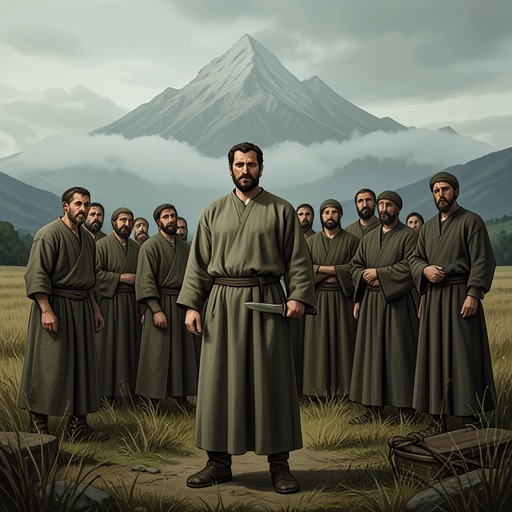
Blood Atonement Doctrine
Under the Banner of HeavenBlood Atonement Doctrine is a religious teaching described in the book as holding that certain grave offenses could be atoned for only through the sinner’s death. Its importance extends beyond the doctrine’s severe penalty: in the book’s account, it belongs to a broader contest over whether religious authorities or civil governments have the final say in matters of law and conduct.
Definition and Historical Teaching
The book traces the doctrine to nineteenth-century teachings by Joseph Smith and Brigham Young. Dan Lafferty learned that both had defended blood atonement, with Brigham Young teaching that some serious acts against Mormons could be rectified only by the sinner’s blood being shed. The account presents this as a belief about punishment and religious obligation, not as a detailed procedure for carrying out a sentence.
The doctrine is situated within a stark moral division between righteousness and wickedness. The book also describes Joseph Smith’s teaching that humanity belonged to one of two opposing churches, and his insistence that people were free to choose between the Lord and wickedness, though those who chose wrongly were deemed undeserving of sympathy. This framework helps explain how harsh religious penalties could be presented as matters of ultimate moral consequence rather than ordinary disputes.
Religious Authority and Civil Law
Blood atonement appears alongside the principle that the laws of God take precedence over the laws of men. The book presents this hierarchy as a source of conflict between religious claims and state authority. In Utah under Brigham Young, the Utah Territorial Legislature expanded the local probate courts’ powers; Mormon bishops often served as judges, and church members made up most juries. The resulting system allowed church influence to compete with federal jurisdiction, while federal officials complained that Brigham Young had turned the territory into a theocratic dictatorship.
The account also shows that this conflict was not confined to formal courts. In Colorado City, Rulon Jeffs’s sermons stressed total submission, and his teachings drew heavily on nineteenth-century writings by Joseph Smith and Brigham Young. He invoked Brigham Young’s warning that certain offenses carried a death penalty under God’s law. That rhetoric placed religious authority above ordinary standards of civil governance, even as polygamy remained illegal in Arizona and Utah and the community relied substantially on public services and funds.
Dan Lafferty’s Encounter with the Doctrine
Dan Lafferty encountered blood atonement through his independent study of early Mormon writings after adopting plural marriage. He understood the history of Mormon teaching as evidence that the modern Church of Jesus Christ of Latter-day Saints had abandoned divine principles in its effort to gain acceptance in American society. Blood atonement became part of this account of religious retreat, alongside his conclusion that God’s laws outranked human laws.
That conclusion connected his religious reading to his hostility toward government regulation. In discussions with his brothers, Dan argued that the government had exceeded its constitutional authority and cited scripture against licensing, taxation, and Social Security numbers. The book does not say that blood atonement alone produced these views; rather, it shows the doctrine within a wider self-directed fundamentalism in which religious authority and resistance to civil requirements reinforced one another.
Meaning and Limits in the Account
The book places blood atonement within a recurring struggle over who may define wrongdoing and impose consequences: church leaders, local religious institutions, or the state. Its reach in the narrative is therefore both doctrinal and political. The death penalty associated with the teaching gave religious claims a severe edge, while the asserted supremacy of divine law supplied a rationale for resisting civil authority.
The account does not treat every Mormon or every modern religious community as holding or applying the doctrine in the same way. Instead, it follows particular teachings and their later significance: Dan Lafferty’s study of nineteenth-century sources, Brigham Young’s use of religious law against the claims of civil authority, and Rulon Jeffs’s invocation of older teachings in Colorado City. These examples show how a doctrine rooted in religious history could remain consequential when later believers and leaders drew on it to define obedience, punishment, and the limits of government.