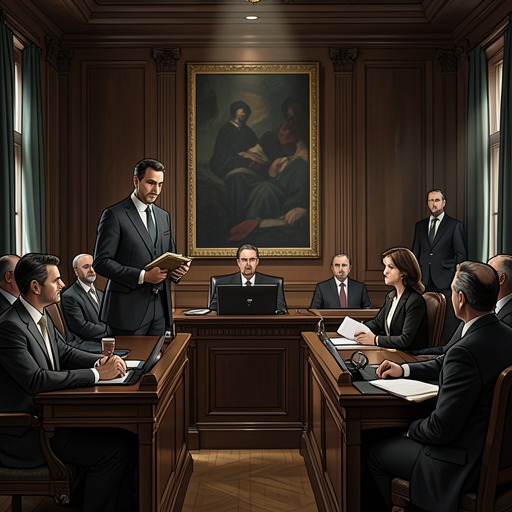
C. Jess Groesbeck
Under the Banner of HeavenC. Jess Groesbeck is a psychiatrist who testified for Ron Lafferty’s defense, connecting Lafferty’s mental condition to his wife Dianna’s departure and arguing that his delusions interfered with his ability to assess the case against him. His testimony placed a clinical interpretation of Lafferty’s beliefs at the center of a legal dispute over whether he could meaningfully face the charges.
Identity and Role
Groesbeck appeared as the first defense witness in the expert testimony described in the book. The defense called psychiatrists and psychologists to argue that Lafferty was mentally deranged; the prosecution planned to counter with its own experts, who considered him sane and responsible for his actions. Groesbeck’s testimony therefore formed part of a contested assessment, not a conclusion accepted by both sides.
Diagnosis and Explanation
Groesbeck testified that Lafferty had slipped beyond the bounds of sanity after Dianna took their children and left him. He described the resulting condition at different points as a schizo-affective disorder and a delusional disorder. In his account, Lafferty could not tolerate the loss, which precipitated the deterioration Groesbeck was asked to explain.
Groesbeck based his diagnosis in part on the character of Lafferty’s beliefs: they could not be changed through reason and were, in his view, so fantastic and far outside rational cultural acceptance that they qualified as delusions. He speculated that Dianna’s departure brought a total loss of self-esteem or self-image. Lafferty then compensated, Groesbeck argued, by constructing an unreal view of himself and the world.
Capacity to Face the Charges
Lead attorney Mike Esplin asked whether Groesbeck’s evaluations indicated that the disorders affected Lafferty’s capacity to comprehend and appreciate the charges. Groesbeck said that Lafferty could not realistically evaluate the state’s case. Even when he could hear some of the evidence, Groesbeck testified, Lafferty’s delusional system led him to believe that every piece of evidence against him had been planted. Groesbeck’s argument was thus not simply that Lafferty held unusual religious beliefs, but that those beliefs, as he understood them, distorted his grasp of the prosecution’s evidence and his own legal situation.
Legal and Narrative Significance
Groesbeck’s account gave the defense a causal narrative: Dianna’s departure preceded a collapse in Lafferty’s self-image, and that collapse was followed by a delusional worldview that impaired his ability to assess the charges. The testimony also shows how the case turned on the boundary between religious conviction and legally significant impairment. Other defense experts supported Groesbeck’s view, while prosecution experts were expected to argue the opposite; the book presents his diagnosis as testimony within that dispute, not as an uncontested finding.
The legal question surrounding Lafferty’s competence had consequences beyond the defense testimony. The Tenth Circuit later vacated his 1985 convictions, ruling that the trial court had used a faulty standard to determine competence: although Lafferty understood the charges and possible consequences, the court found that his paranoid delusional system prevented him from interpreting them realistically. Groesbeck’s testimony belongs to this larger conflict over how courts should evaluate a defendant whose religious beliefs and claimed obligations appear inseparable from his understanding of the law.