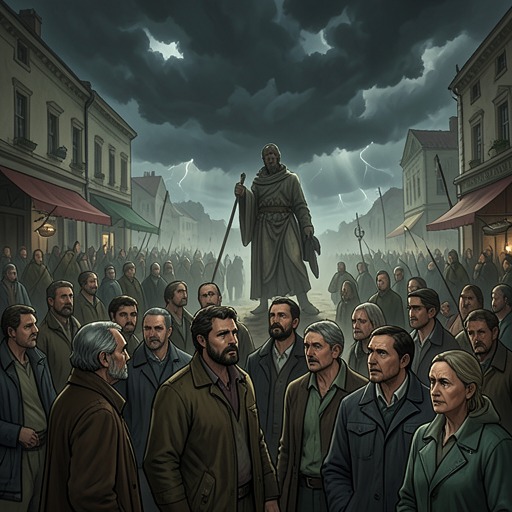
Colorado City–Hildale
Under the Banner of HeavenColorado City–Hildale stands in the account as both a physical community and a tightly governed religious world. Its residents’ daily lives were shaped by the United Effort Plan (UEP) and its prophet, Rulon Jeffs, whose authority extended from rules about media and family relationships to the conduct of municipal institutions. Yet the town is not depicted only as a system of control: DeLoy Bateman, who left the faith but continued living there, describes a community to which he remained deeply attached even as he rejected its religious claims.
Setting and attachment
From the edge of a park, Colorado City–Hildale appears beneath the steep face of Canaan Mountain, whose summit plateau DeLoy and his brother David used to visit as children. The mountain offered them a place that seemed beyond the religion’s reach. As an adult, DeLoy looked down from the same height toward the town where he had been born and raised. His position captures the tension that runs through the account: distance enough to question the community, but not enough to sever his connection to it.
DeLoy remained in the middle of town after leaving the Fundamentalist Church of Jesus Christ of Latter Day Saints. He no longer practiced plural marriage, and the second of his two wives eventually moved to St. George; her children stayed with him in Colorado City, and she visited them weekly. DeLoy also described the town’s residents as hardworking and strong, and considered it a good place to raise a family. His continued affection for the community existed alongside his knowledge of women’s reports of abuse and his recognition that some men in the priesthood had harmed their own daughters. His account holds attachment and criticism together rather than treating departure from the faith as a clean break from home.
Authority in daily life
Under Rulon Jeffs, the rules governing residents reached into what they could watch and read. Television, magazines, and newspapers were prohibited. DeLoy described a recurring cycle: some residents secretly bought satellite dishes in St. George or Cedar City, installed them out of sight, and watched television; after Rulon preached against the medium and warned of spiritual consequences, dishes appeared abandoned in the desert. For a few years, television use would recede, then gradually return until another crackdown. The discarded dishes made the conflict between official prohibition and private behavior visible in the landscape.
The limits extended beyond media. Residents were forbidden to have contact with people outside the UEP, including relatives who had left the religion. DeLoy’s brother lived only a few yards away, across a six-foot fence, but was not permitted to speak with him. DeLoy said that if his brother’s wife caught them talking, she could take the children, while Rulon could arrange for her to marry another man. A man who remained in the faith but lost his family was described locally as a eunuch. The fence thus marked more than a property boundary: it separated brothers whose closeness had been forged in childhood from contact prohibited by religious authority.
Rulon’s influence also reached municipal offices. The mayor, city employees, police force, and schools superintendent were described as answering to him. After a dog killed a child, an order prohibited dogs within city limits; young men were sent to collect the animals, which were then killed outside town. The episode shows how a religious decree could become a town-wide rule enforced through local action. Colorado City also received substantial public assistance: federal funds supported street paving, fire services, and water infrastructure, while a federally built airport south of the city served mainly the fundamentalist community. The account reports that 33 percent of residents received food stamps and that the town received eight dollars in government services for every tax dollar paid. Rulon justified this assistance as help provided by the Lord to his chosen people; fundamentalists called defrauding the government bleeding the beast and regarded it as virtuous.
Departure and family consequences
DeLoy’s departure followed a confrontation with Rulon. After telling the prophet that his accusations were lies, DeLoy concluded that a man who claimed continual communication with God could not have made those accusations if the claim were true. He decided to leave the Work, knowing that doing so would end the life he had known. When he missed the next weekly priesthood meeting, someone was sent to his home within a day to take his wives and children. Under UEP doctrine, wives and children belonged to the priesthood rather than to husbands or parents, and Rulon decreed that DeLoy’s family should be given to another man.
Both wives refused to leave him. Their decision defied the expectation that priesthood authority took precedence over family ties. The two spouses and all but the three oldest children consequently became apostates as well. The later change in the family’s circumstances—one wife moving to St. George while her children remained with DeLoy—shows that leaving the faith did not produce a single, permanent arrangement. Family relationships continued across the boundary between the community and the outside world, but under conditions shaped by the consequences of religious dissent.
Religious boundaries and contested law
Colorado City’s restrictions fit within a broader patriarchal structure described in the book. Men alone held priesthood and ecclesiastical authority, and prophets claimed the right to receive revelations governing how the faithful should live. The fundamentalists carried these principles of obedience and control further than the mainstream Church of Jesus Christ of Latter-day Saints. Within Colorado City, dissent was treated not simply as disagreement but as betrayal: a sermon by Warren Jeffs, Rulon’s son and heir apparent, characterized apostates as exceptionally wicked and aligned with Lucifer. Such teaching strengthened the boundary between the faithful and those who left, while helping make isolation from former members part of community discipline.
The book places this local order alongside earlier Mormon claims to religious and legal sovereignty, without making the histories identical. In Nauvoo, Joseph Smith headed a city-state with unusual powers granted by its charter and commanded the Nauvoo Legion. Later, in Utah Territory, Brigham Young’s government privileged divine law over federal law, while the Utah Territorial Legislature expanded local probate courts controlled by Brigham. These examples provide historical context for the recurring conflict between church authority, local governance, and national law. In Colorado City, the account brings that conflict down to the level of daily life: a media ban, a family’s separation across a fence, and a town whose public institutions answered to a religious leader.
A divided home
DeLoy’s eventual atheism deepened, rather than erased, the contradictions of his relationship with Colorado City. He had once found answers and an identity in the religion, and said that much of what he had learned and become came from it. He no longer believed in God or practiced plural marriage, but continued to wear the sacred garment because removing it felt wrong. His own explanation points to the power of habits formed through lifelong belonging: a person could reject the truth claims of the faith and still feel its imprint in ordinary practices.
The town’s significance in the account therefore lies in its double character. It is a place where religious authority could govern information, family membership, and public institutions, and where dissent could carry consequences for relatives as well as the dissenter. It is also DeLoy’s home, a community he continued to value despite his apostasy and his recognition of its harms. Colorado City–Hildale is presented neither as a mere symbol nor as a setting he simply escaped, but as the contested place where belief, family loyalty, social control, and personal history remained bound together.