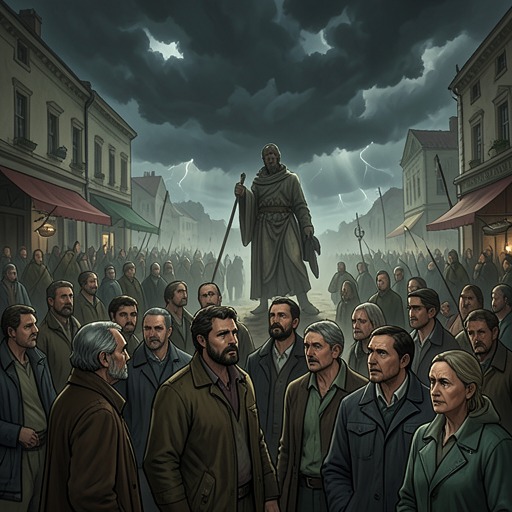
Haun's Mill Massacre
Under the Banner of HeavenThe Haun's Mill Massacre was a surprise attack on a Mormon settlement in Missouri on October 30, 1838, in which eighteen Saints were killed. Its significance extended beyond the immediate loss of life: the attack helped force Joseph Smith to abandon armed resistance, and its memory became part of a religious identity built around persecution, endurance, and chosenness.
Conflict before the attack
The massacre took place amid escalating conflict between Mormons and their neighbors. After an inflammatory report falsely claimed that Saints had killed fifty Missourians, Governor Lilburn Boggs ordered that Mormons be treated as enemies and expelled or exterminated if necessary. Joseph Smith had called for resistance, and members of his community had raided Gentile towns, taking food, livestock, and other property and burning about fifty homes. Missourians retaliated by destroying Mormon cabins. A skirmish left three Saints and one Gentile dead, while the false report helped intensify the crisis.
By late October, the Missouri Militia was acting against Mormon settlements. On the afternoon of October 30, three companies under Colonel Thomas Jennings approached Haun's Mill. About twenty-five Mormon families were working in the fields when approximately 240 troops appeared from the surrounding woods and opened fire. The scale of the force made the settlement's position immediately precarious: its commander recognized that the community was lightly armed and could not match the attackers.
The attack at Haun's Mill
The Mormon commander waved his hat and called for surrender. The militia did not stop firing. Residents scattered into nearby thickets, while a group of three boys and fifteen men sought shelter in the settlement's blacksmith shop. Its log walls had wide gaps between them, leaving those inside exposed. The attackers fired through the openings and then approached the shop, continuing to shoot at close range. The sequence turned the building meant as refuge into the place where much of the killing occurred.
After the firing ceased, the militia entered the shop and found ten-year-old Sardius Smith beneath the bellows. A militiaman, William Reynolds, killed him despite his youth. Sardius's younger brother had been shot through the hip but survived by remaining still among the dead. Eighteen Saints were killed in and around the blacksmith shop. The attack thus struck both the community's adult defenders and its children, and its victims included people who had sought shelter rather than continued the fight.
Joseph Smith and the surrender
Joseph Smith was not at Haun's Mill when the attack took place. He was sixteen miles away at Far West, overseeing the settlement's defense while roughly ten thousand Missouri troops surrounded it. He learned of the massacre the following night and fell into a deep depression. In the months before the attack, he had shifted between fighting back and seeking a peaceful compromise; the massacre changed the balance of that decision.
Concluding that a full-scale war would lead to the destruction of himself and his followers, Joseph sent five Mormons to negotiate. He instructed them to plead for peace. The Missouri general demanded that Joseph and six other leaders be handed over for treason charges, that the Mormons compensate Missourians for damaged or plundered property, surrender their weapons, and leave Missouri. Joseph accepted these harsh terms. He told the faithful at Far West that he would offer himself as a sacrifice to save their lives and the Church, presenting his surrender as a means of protecting the community from further loss.
Memory and historical significance
The massacre became a defining episode in the church's account of its experiences in Missouri. Persecution came to function as a test of faith and a mark of chosenness; the accumulated memory of trials was not simply a record of suffering but a resource through which members understood their collective identity. Haun's Mill gave that memory a concrete and devastating form. More than 160 years later, Mormons still spoke of the massacre with indignation.
That memory also had consequences beyond commemoration. During the 1857 crisis over the approaching federal army, church leaders and speakers recalled the killings and other episodes of violence and expulsion in Missouri and Illinois to strengthen resistance to outside authority. The past was retold as a warning that the Saints would not be driven out again. In this way, Haun's Mill belonged both to the history of a particular attack and to a recurring narrative through which later generations interpreted danger, solidarity, and the community's right to endure.