Joseph Smith
Under the Banner of HeavenJoseph Smith was the founding prophet of Mormonism, a religious movement whose claims rested on new scripture, continuing divine revelation, and his own authority to interpret God's will. His leadership turned a small new faith into an organized community with ambitious theological and political aims. The same emphasis on revelation that drew followers to him also created a lasting problem: once believers were taught to seek divine communication for themselves, no simple rule could prevent competing claims to God's authority. His doctrines, especially the secret introduction of plural marriage, helped shape the movement and intensified conflicts that outlasted him.
Identity and Religious Claims
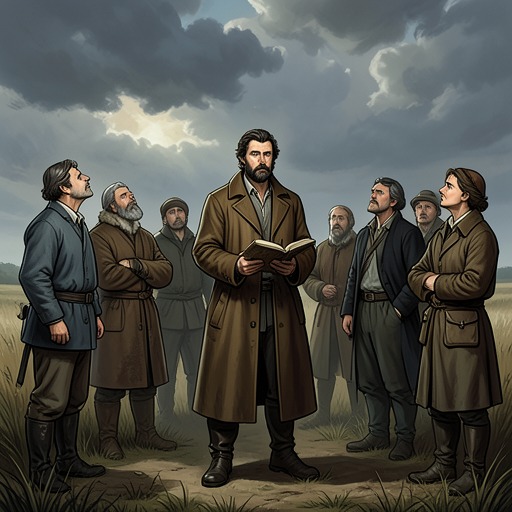
Smith presented the Church of Jesus Christ of Latter-day Saints as the restoration of the true church after what he called the Great Apostasy. In this account, established Christian traditions had departed from the original faith, and The Book of Mormon supplied a more complete history of God's dealings with humanity. Its stark division between the church of God and the church of the devil made religious belonging a matter of ultimate moral allegiance, not merely a choice among denominations.
The scripture's geography and sacred history were distinctly American. It described Jesus Christ appearing to people in the New World after his resurrection, and located the Garden of Eden in America. Smith's followers understood the continent not as a distant setting but as central to the divine plan, including the promised return of Christ. This American frame gave the new faith a sacred history of its own and made its claims of restoration inseparable from a vision of the land where that restoration would unfold.
Smith also encouraged adherents to seek personal communication from God. The possibility of receiving guidance directly, rather than only through established church hierarchies, became one of the movement's most appealing features. Yet it placed the prophet's authority in tension with the religious experience he had encouraged: if God might address every believer, a follower could claim revelation that challenged the prophet's own teachings.
Revelation and the Problem of Authority
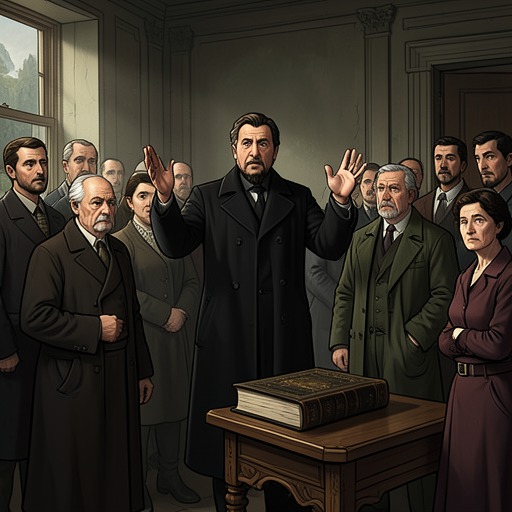
The institutional answer came early. In 1830, the year the church was incorporated, Smith declared that no one else was appointed to receive commandments and revelations for the church. The restriction distinguished private spiritual guidance from revelations governing doctrine and the institution, but it could not erase the popular appeal of direct access to God. Believers continued to heed personal revelations, including on theological matters, even when those claims conflicted with Smith's authority.
Smith's own religious authority was represented in the church's leadership title, President, Prophet, Seer, and Revelator. His career demonstrated how much that authority could rest on both institution and personal charisma. During the years in which Mormonism was competing with other new religious movements, Smith's force of personality helped his church retain followers where many rival movements faded. His adherents saw him as a prophet guided by God; the historical record also preserves disagreements and controversies that later idealized accounts could not entirely erase.
The tension between personal inspiration and centralized control became a continuing source of division. Since the church's founding, numerous Mormon sects have broken away, in part because individuals and groups continued to claim revelation beyond the institution's permission. Robert Crossfield, known as Onias, was one such later claimant: he said a revelation named him the true prophet and rightful leader of the church. His followers included Dan Lafferty. This later history shows how Smith's original invitation to seek divine communication could supply both the spiritual appeal of the movement and the means by which its authority fractured.
Expansion and Political Power
After hostile reactions to the new faith in the Palmyra region, Smith received a revelation in December 1830 directing his followers to move to Ohio. The following summer, another revelation identified northwestern Missouri as the gathering place for the Saints and the site of a future New Jerusalem. Smith instructed believers to assemble there. Their growing numbers, shared political behavior, land purchases, and limited interest in close association with non-Mormon neighbors heightened local suspicion. Their claim to be God's chosen people, entitled to establish Zion, further sharpened the conflict with residents who already lived in Jackson County.
Following his escape from jail in Missouri, Smith selected a site on the Mississippi River in Hancock County, Illinois, for Nauvoo. The settlement began on wet, difficult ground, but land was available on credit and the Saints organized its development. Within five years, more than fifteen thousand people lived in and around Nauvoo, making it Illinois's second-largest municipality. The city's growth represented the community's capacity to build a substantial center after expulsion, but it also concentrated civic and religious power under Smith.
Nauvoo's unusual charter gave the city extensive autonomy. Smith stood at the head of this theocratic principality, was officially installed as King, Priest, and Ruler over Israel on Earth, and commanded the Nauvoo Legion, a well-armed militia. He also sought authorization for a much larger fighting force and, in January 1844, announced his candidacy for president of the United States. These steps expressed an expansive view of his mission: he was not only organizing a church but seeking influence over the political order. Non-Mormon residents objected to the Saints' disciplined voting and to the prospect of a government in which Smith's religious authority shaped public life.
Plural Marriage and Final Crisis
Smith's theological innovations in Nauvoo included vicarious baptism for the dead and temple endowment rites. He also taught that God had once been a man and that human beings could become gods. Among these changes, plural marriage proved especially divisive. In 1842, The Peace Maker appeared in Nauvoo under the name Udney Hay Jacob, with Smith listed on its title page as printer. Dan Lafferty later concluded that Smith had written it, but most scholars cited in the book identify Jacob as its author. They nevertheless regard the pamphlet's publication by the church press, with Smith's name attached, as evidence that he endorsed its ideas. John D. Lee described it as a trial effort to prepare the community for celestial marriage.
The pamphlet's reception was hostile. Smith publicly disclaimed advance knowledge of its publication and denounced polygamy, although he had secretly practiced plural marriage. On July 12, 1843, he formally recorded a revelation that declared plural marriage a sacred covenant. The revelation remained secret and was not acknowledged by the church until 1852, eight years after his death. Between 1840 and 1844, Smith married about forty women; some were very young, and the book describes women being told that God commanded the marriage. The doctrine's concealment and Smith's conflicting public and private positions deepened the controversy surrounding his leadership.
Conflict intensified after Smith ordered the destruction of the Nauvoo Expositor. Fearing retaliation, he declared martial law on June 18 and mobilized the Nauvoo Legion. Governor Thomas Ford demanded that Smith, Hyrum Smith, John Taylor, and others surrender to face charges in Carthage, promising to protect them. Smith initially fled across the Mississippi River into Iowa with Hyrum, but returned to Nauvoo the next day after receiving a letter from Emma urging him to come back. He and Hyrum subsequently went to Carthage Jail. On June 27, 1844, a mob attacked the jail and killed both brothers. Smith was thirty-eight years old.
Succession and Continuing Legacy
Smith's death immediately left the church's leadership and its contested doctrines unresolved. Brigham Young was away from Nauvoo when the killing occurred and did not learn of it until nineteen days later. In his absence, anti-polygamy members sought to install a leader who would revoke the doctrine; the pro-polygamy apostles, including Young, sought a successor who would uphold it. Young's return and address to the Saints secured him the leadership, while other claimants, including Sidney Rigdon, represented competing paths for the church.
The murder trial brought no convictions. On the first anniversary of Smith's death, Young called for the Saints to seek divine vengeance, and church authorities introduced an Oath of Vengeance into the temple endowment. Its presence in the ritual endured until 1927, when it was removed after disclosure in the non-Mormon press provoked public and political criticism. The oath made the memory of Smith's killing an institutional obligation as well as a source of grief, while anti-Mormon violence and the burning of Mormon homes continued in Hancock County after the trial.
Smith's legacy therefore rests on more than the founding of a church. His charisma helped unite converts, and his revelations gave them a new scripture, a sacred American geography, and an expectation of direct contact with God. His assertion of exclusive prophetic authority sought to contain the consequences of that expectation, but it could not eliminate rival revelations. His expansive civic ambitions and secret plural-marriage teaching provoked opposition within and beyond the church. After his death, disputes over succession and doctrine carried those tensions forward, making his movement's founding prophet both its source of unity and the starting point for enduring division.