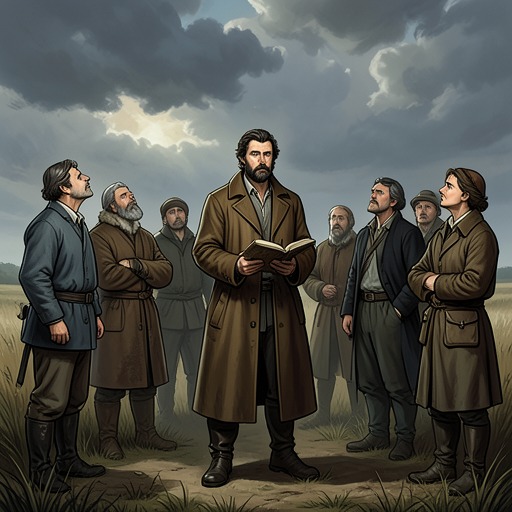
Joseph Smith III
Under the Banner of HeavenJoseph Smith III was the young son of Joseph Smith and, after his father’s death in 1844, the figure with the strongest hereditary claim to lead the Church of Jesus Christ of Latter-day Saints. He was too young to take up that claim: still short of puberty, he became the focus of a succession contest fought by adults over the future of prophetic authority and plural marriage.
Identity and the Stakes of Succession
Joseph’s claim mattered because leadership in the church carried more than ceremonial standing. Under Joseph Smith, Nauvoo had become a theocratic principality in which the prophet held extensive civic and military power. Joseph had even styled himself King, Priest, and Ruler over Israel on Earth. The question of who would inherit his authority therefore concerned both religious leadership and the direction of a community whose government and church were closely joined.
The crisis also exposed a conflict over plural marriage. Apostles including Brigham Young and Willard Richards wanted a successor who would uphold the doctrine, while the anti-polygamy faction sought to prevent its continuation. Joseph Smith III’s youth made his claim difficult to act upon, even as his descent from the dead prophet gave it unusual legitimacy.
The Succession Contest
In the immediate aftermath of Joseph Smith’s assassination, anti-polygamy leaders concentrated their efforts on Samuel H. Smith, the deceased prophet’s younger brother, rather than on Joseph Smith III, who had not yet reached puberty. Samuel appeared close to securing the position, but on July 30, 1844, he died abruptly. The account describes compelling circumstantial evidence that Hosea Stout, chief of the Nauvoo police and loyal to Brigham Young and the pro-polygamy apostles, had poisoned him; it does not present that allegation as a proven finding.
Samuel’s death cleared the way for Sidney Rigdon, another opponent of plural marriage, to make a last attempt to claim Joseph’s mantle. Rigdon obtained an appointment as guardian of the church, pending confirmation by a churchwide vote. That prospect changed when Brigham Young and the returning apostles reached Nauvoo on August 6, two days before the scheduled gathering. The assembly heard Rigdon and Young argue their cases on August 8, as the struggle over who would lead the church moved into public view.
Prophetic Authority and the Limits of the Claim
The contest took place within a faith that had long linked religious truth to continuing revelation. Joseph Smith had first encouraged members to seek personal guidance from God, then announced a revelation reserving church commandments and doctrinal revelations to himself. That restriction did not extinguish members’ belief in direct revelation, and competing claims to divine authority continued to contribute to divisions among Mormon groups. Joseph Smith III’s hereditary claim thus arose in a setting where succession was disputed not only through family ties and organizational position, but also through rival understandings of who could speak for God.
The account establishes Joseph Smith III’s importance at the opening of the succession struggle, but does not describe him taking part in its adult negotiations or establish that he became the immediate successor. His role in this episode is therefore sharply defined: the young son whose claim had the greatest dynastic force, but whose age left others to contest his father’s leadership in his place.