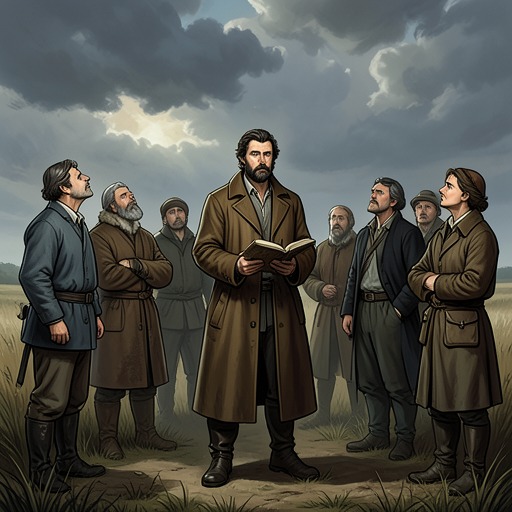
LDS Church's 1890 Abandonment of Plural Marriage
Under the Banner of HeavenThe LDS Church's 1890 abandonment of plural marriage was both a retreat from a doctrine long treated as sacred and a turning point in the church's relationship with the United States. Public renunciation did not immediately end the practice: church authorities quietly sustained it abroad and, for a time, within their own ranks. The later enforcement of the new policy helped transform the church, while those who rejected the change regarded it as a betrayal of the faith.
Doctrine and Competing Authority
Plural marriage had deep theological standing in the church. Joseph Smith's revelation on the subject was canonized as Section 132 of The Doctrine and Covenants, and presented the practice as a requirement for exaltation for those to whom the law had been revealed. The doctrine was formally codified in Nauvoo in 1843, though it remained secret and was not publicly acknowledged until 1852, eight years after Joseph Smith's death.
The conflict was not simply over marriage customs. In Nauvoo, Joseph Smith had headed a city with unusual sovereign powers; later, under Brigham Young, the Saints established a theocratic order in the Great Basin. Brigham Young argued that God's law took precedence over human law. Utah's Mormon-dominated legislature expanded local probate courts, which Brigham controlled, into a means of asserting local jurisdiction against federal authority. Mormon bishops commonly served as probate judges, and predominantly Mormon juries followed instructions from church leaders. The resulting contest concerned which authority—church, territorial, or federal—could define and enforce the rules governing the community.
Federal Pressure and Renunciation
The Utah War did not remove Brigham Young from power or end plural marriage. Instead, a succession of legal and legislative challenges continued. Their culmination was the Edmunds-Tucker Act of 1887, which disincorporated the LDS Church and transferred to the federal government church property valued above $50,000. Under this pressure, church leaders ultimately had little practical choice but to renounce the practice publicly.
In 1890 the LDS Church declared that it had relinquished plural marriage. The announcement marked a sharp change from its earlier defense of the doctrine as sacred and its resistance to federal efforts to suppress it. But the public statement and private conduct did not immediately coincide: leaders who had been reluctant to abandon plural marriage formally retreated while discreetly maintaining a path for its continuation.
Public Policy and Private Continuity
After the renunciation, church authorities quietly dispatched groups of members to establish plural-marriage colonies in Mexico and Canada. Some high-ranking LDS authorities also secretly continued taking multiple wives and performing plural marriages well into the twentieth century. The shift therefore unfolded in stages: public policy changed in 1890, but the practice persisted in concealed forms after that date.
The church's position eventually changed more decisively. Leaders adopted a pragmatic approach to American politics, rejected plural marriage emphatically, and began urging government agencies to prosecute polygamists. This reversal made the church an enforcer of a policy it had once resisted, rather than merely a religious body under pressure to comply. It also sharpened the distinction between official church membership and the separate communities that continued to defend plural marriage.
Transformation and Legacy
The book treats the policy change as a central reason the LDS Church became its modern, broadly accepted institution. As the church abandoned plural marriage, Mormons gradually ceased to be regarded as a marginal sect, and the LDS Church acquired the standing of a conventional faith—eventually becoming widely identified as a quintessentially American religion. That transformation came through accommodation to federal power, not through a simple disappearance of the doctrine or its adherents.
Mormon Fundamentalists interpret the same history in the opposite way. They regard the 1890 decision as an unforgivable compromise in which church leaders surrendered a crucial theological principle for political acceptance. Because they continue to treat Section 132 as authoritative, they see themselves as preserving what the LDS Church abandoned. The renunciation thus became more than a change in institutional policy: it established a lasting boundary between a church remaking its public identity and fundamentalist groups claiming continuity with its earlier commitments.