Mormon Exodus
Under the Banner of HeavenThe Mormon Exodus was the 1846–1847 departure of the Saints from Nauvoo and their migration west under Brigham Young. It was both a flight from mounting violence and an attempt to establish a refuge beyond the reach of hostile neighbors. The journey ended in the Great Salt Lake Valley, but its consequences reached beyond a new settlement: the ordeal strengthened the emigrants’ bond to one another and to their leader, while a camp along the route became the setting for the open disclosure of plural marriage to ordinary members.
Causes and Decision to Leave
By September 1845, violence in Hancock County had again made the Saints’ future in Illinois precarious. After Joseph Smith’s murder, anti-Mormon vigilantes had burned Mormon homes and farms; by September 15, forty-four residences had been destroyed. Mobs on both sides of the conflict contributed to a wider rampage of arson and plunder that destroyed more than two hundred homes. Governor Thomas Ford sent troops and a committee of dignitaries to negotiate a settlement, as the county appeared close to civil war.
Brigham Young made the departure itself part of the bargain. In a letter to the governor’s committee on September 24, he promised that, in exchange for a Gentile cease-fire, the Mormons would leave not only Illinois but the United States. The emigrants would depart the following spring, when prairie grass along their route could feed their animals. The Gentiles accepted the agreement on October 1. The temporary lull allowed the Saints to build wagons and gather supplies, turning a negotiated pause in the conflict into preparation for mass migration.
Young sought a homeland distant from established settlements and unattractive to Gentile settlers, where the church could live with less risk of persecution. After considering Oregon, California, and Vancouver Island, he and his counselors chose the sparsely inhabited deserts of the Great Basin, then part of Mexico. The destination reflected a practical calculation: distance and difficult terrain might provide the security that had proved elusive in Missouri and Illinois.
Departure and the Western Journey
The Saints had expected to remain in Nauvoo until warmer weather. That plan changed when a warrant was issued for Brigham Young’s arrest on charges of harboring counterfeiters. On February 4, 1846, the first group boarded flatboats at the Nauvoo dock, crossed the Mississippi River in near-freezing conditions, and landed in Iowa in the grip of winter. Their early departure launched the exodus before the season the leaders had originally intended.
The migration did not take all who had belonged to the church. In the months after Joseph Smith’s death, hundreds had already left, disillusioned by his murder and troubled by rumors about secret sexual practices among church leaders. Most, however, loaded what they could fit into wagons, abandoned other possessions to their enemies, and followed Brigham Young west. By May, more than six thousand Saints were moving through deep spring mud toward the Rocky Mountains.
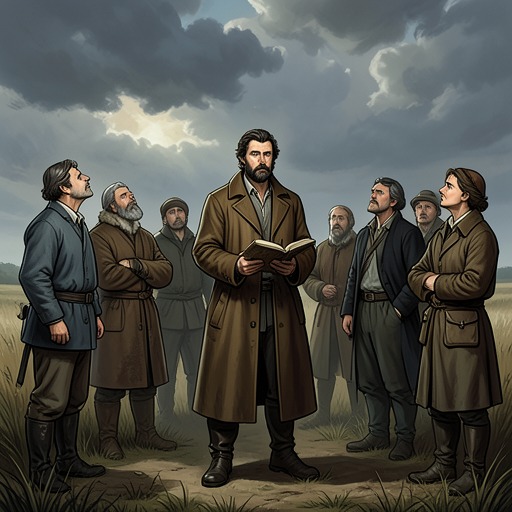
At Sugar Creek, nine miles beyond the western bank of the Mississippi River, the emigrants paused to regroup. There, in the snowbound camp, church leaders first shared the previously guarded doctrine of plural marriage openly with ordinary members. Only a handful of those who had first left Nauvoo knew that the doctrine was already practiced by their leaders. The disclosure made the camp a turning point in the journey: the migration carried not only people away from Illinois but also a religious teaching from an inner circle into the wider community.
The thirteen-hundred-mile trek brought severe hardship. Frostbite, diphtheria, scurvy, starvation, stillborn babies, tick fever, hostile Gentiles, and whooping cough afflicted the travelers. The whooping-cough epidemic killed dozens of young children, and more than six hundred Saints died during the first grim winter. The journey’s physical costs were therefore inseparable from its purpose: the emigrants sought safety and a lasting home, but reached that prospect through hunger, illness, loss, and exposure.
Arrival in the Great Salt Lake Valley
An advance party crested a ridge on July 21, 1847, and saw the Great Salt Lake glistening in the distance. The next morning, led by scout Porter Rockwell, the group descended the western slope of the Wasatch Range through Emigration Canyon. The valley offered a stark landscape, but its mountain streams provided water and the surrounding mountains formed a natural barrier. After surveying the area, the scouts returned to report their findings to Brigham Young and the other Saints.
Young arrived with the main company on July 24, weak from tick fever. Before sunset, the emigrants planted potatoes and diverted City Creek to irrigate them. They also began laying the foundation for a temple near the creek, at the center of the settlement that would become Salt Lake City. The date later became Pioneer Day, a recurring commemoration of the arrival. For the Saints, the valley was not simply the end of a long route: it was a place where they could begin building the capital of their religious community.
Consequences and Significance
The exodus reshaped the community that completed it. The account presents the arduous migration as a test that many did not survive and that, among the survivors, strengthened commitment to the church. Doubters, malcontents, and people of weaker faith were described as having been filtered out by the trials of the preceding years. The violence in Missouri and Illinois, followed by the shared hardships of the journey, forged a close bond among the first waves of Saints to reach Utah. Their loyalty to Brigham Young became, in the account’s formulation, unconditional.
That solidarity carried a political as well as a spiritual history. The migration had been organized in response to conflict with Gentiles and a negotiated promise to leave the United States; yet the refuge the Saints sought did not remain outside the expanding country for long. The United States acquired their new homeland after the war with Mexico, and Utah was annexed following the 1848 Treaty of Guadalupe Hidalgo. The journey therefore brought the emigrants to a new home without permanently separating them from the nation and government they had sought to escape.
The Mormon Exodus stands at once as forced departure, religious migration, and community-making ordeal. Its route connected the violence around Nauvoo to a settlement in the Great Basin; its losses and shared labor reinforced a collective identity; and its camp at Sugar Creek marked a change in what ordinary members knew about their leaders’ religious practice. The arrival in the valley closed the journey, but the society formed along the way carried its experiences of persecution, secrecy, sacrifice, and loyalty into its new home.