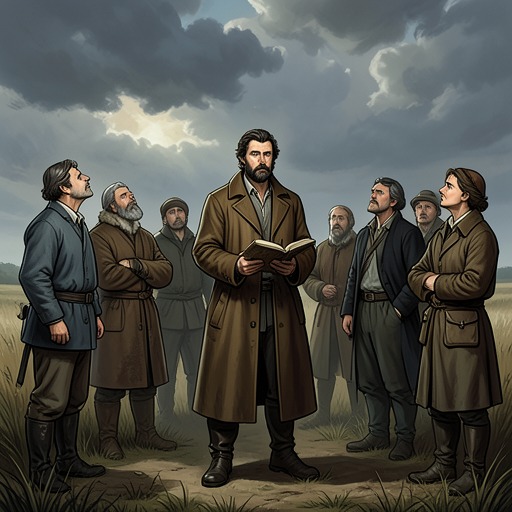
Mormon Pioneers' Arrival in the Salt Lake Valley
Under the Banner of HeavenThe Mormon pioneers’ arrival in the Great Salt Lake Valley in July 1847 ended a westward migration marked by disease, hunger, hostility, and death. The company did not simply reach a refuge: its first acts of cultivation and temple-building began the transformation of the valley into a new center for the Saints and, in the book’s account, the physical foundation for a Kingdom of God on earth.
The Migration West
The arrival followed the Saints’ departure from Nauvoo, where Joseph Smith had presided over a theocratic principality with unusual sovereign powers. The move west carried a community already accustomed to treating religious authority as a form of government, though the journey itself tested the group’s ability to remain together.
The 1,300-mile emigration was a severe ordeal. Frostbite, diphtheria, scurvy, starvation, stillbirths, tick fever, hostile Gentiles, and an epidemic of whooping cough marked the route; more than six hundred Saints died during the first grim winter. The migration’s costs were not incidental to its outcome. Those who survived the hardships reached the valley more devoted to the church, while the trials forged a close-knit community whose loyalty to Brigham Young the narrative describes as unconditional.
Finding a Place for Zion
An advance party reached the valley first. On July 21, 1847, its members crested a ridge and saw the broad waters of the Great Salt Lake glistening below. The following morning, with Porter Rockwell leading, they descended the western slope of the Wasatch through Emigration Canyon and entered the new Zion. The lake had no outlet and was saltier than the Pacific Ocean, but the party’s attention also turned to the land around it.
The valley floor was largely barren desert. Along its eastern edge, however, streams of clear snowmelt ran down from the Wasatch mountains, and the range itself offered a natural barrier against outsiders. After a two-hour survey of the immediate area, the scouts judged the valley a suitable place to build the capital of the Kingdom of God on earth. They rode back up Emigration Canyon to bring the news to Brigham Young and the rest of the company.
Arrival and First Acts
Brigham Young arrived with the main company on July 24, 1847, weak and aching from tick fever. The date later became Pioneer Day. Before sunset, the newcomers had planted potatoes and diverted City Creek’s water to irrigate them. Near the creek, they began laying the foundation of a temple, placing a sacred structure at the center of the settlement from its first day.
These practical acts gave the arrival its immediate shape: food production began alongside the construction of a religious center. The pioneers were not merely passing through a landscape they had selected for shelter. They were making it habitable and marking it as their own. The book presents this moment as the end of a much longer, seventeen-year journey from Palmyra and as the point at which the Saints had finally found a home.
Settlement and Its Legacy
The valley became more than a destination. Its water, mountains, and isolation made it a practical refuge; the pioneers’ decision to establish a capital there also gave their religious community a territorial base. The hardships of the migration intensified the bonds of the surviving group and strengthened its loyalty to Brigham Young, so that arrival brought both a place to settle and a more cohesive body of believers.
In the ensuing Deseret period, that religious authority took institutional form. Because Utah remained a territory, federal courts were supposed to hold legal power, but the Mormon-dominated Utah Territorial Legislature expanded local probate courts, which Brigham controlled. Mormon bishops commonly served as judges, and church members dominated juries whose verdicts followed instructions from church leaders. The settlement of the valley thus stands in the narrative both as the achievement of a persecuted migrating community and as the beginning of a local order in which church authority and civil government became closely intertwined.