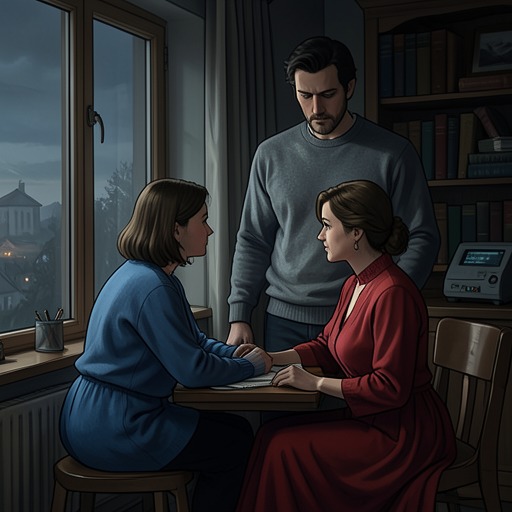
Penelope Weiss
Under the Banner of HeavenPenelope Weiss is a close friend of Dianna Lafferty and an important witness to the change in Dianna’s marriage to Ron Lafferty. Her recollections establish how admired their relationship had been before Ron embraced Dan Lafferty’s fundamentalist teachings, then record the financial strain and domestic reversals that followed. Weiss’s account matters because it makes the transformation legible not as an abstract religious turn, but as a rupture in a marriage that friends had regarded as exceptionally happy.
Identity and Perspective
The evidence presents Weiss chiefly through her relationship with Dianna and her testimony about the Laffertys; it provides little detail about Weiss’s own life. She was close enough to Dianna to remember the marriage from the perspective of a friend, and to recount what Dianna told her during the family’s crisis. Her account therefore combines personal observation with information conveyed in confidence, rather than offering a comprehensive biography of either spouse.
Weiss also recalls how people around the couple received news of what happened later. When her daughter heard of Ron and Dan’s involvement in the events, she could not believe it. The reaction reflected the strength of the Laffertys’ earlier reputation: young women who knew the couple had looked to their marriage as an example. Weiss’s recollection preserves that contrast between public admiration and the later upheaval.
The Marriage Before the Change
Weiss remembered a marriage that had seemed happy for sixteen and a half years. Ron and Dianna lived with their six children in Highland, Utah, where Ron held a place in local civic and church life. In 1982, he was a city councilman, served as first counselor to the bishop in the local Church of Jesus Christ of Latter-day Saints congregation, and led youth activities. These public roles accompanied a family life that acquaintances considered unusually stable.
For Weiss, the marriage was not merely respectable from a distance. She describes it as one that other people envied, and remembers her daughter’s disbelief when told that Ron had become involved with Dan’s movement. The astonishment is a measure of how complete the apparent reversal seemed to those who had known the couple. Weiss’s testimony sets the earlier relationship as the baseline against which Ron’s later conduct toward Dianna is judged.
Financial Pressure and Vulnerability
The change unfolded amid severe economic pressure. Ron had taken on two demanding construction projects: a four-unit apartment complex financed with a bank loan, and a house for his family that he was building himself. He worked on these projects after his regular job, but the costs strained the family’s finances. A regional recession then deepened the danger. Ron and Dianna fell behind on loan payments, money for groceries and the children’s clothes became scarce, and the bank had prepared papers to take their home.
Weiss described Ron as overwhelmed by the prospect of losing what he had spent years building. Dianna tried to reassure him that they could begin again, as they had before, but he could not accept the loss. She later told Weiss that he would break down and cry. In Weiss’s account, this moment of vulnerability helps explain the circumstances in which Dan’s religious message gained force; it does not erase Ron’s choices, but shows how spiritual promises arrived alongside material desperation.
Dan’s Influence and the Domestic Reversal
Dan’s teaching offered Ron a different interpretation of that crisis. He persuaded Ron that material loss could be spiritually desirable and that Ron had a higher religious calling. Weiss recalled that Dan predicted Ron would become president and prophet of the Church, with Dan as his first counselor and the other Lafferty brothers in supporting positions. Ron left his job, further unsettling the family’s already precarious finances. He also began rejecting ordinary civic markers of participation, including his driver’s license and his vehicle’s license plates.
The turn was also visible in the household’s daily routines. Soon after Ron adopted Dan’s version of fundamentalism, he expected Dianna to follow rules drawn from The Peace Maker. Weiss remembered visiting and finding Dianna making butter by hand from a gallon of cream because Ron wanted the household to do so. The example was modest in itself, but it signaled a new pattern: expectations that had once seemed alien to their marriage were becoming commands within it.
Weiss described Ron’s treatment of Dianna as a sharp departure from the considerate husband he had been. In her view, he had once treated Dianna with exceptional kindness; after the change, he became harsh and expected her to serve him. The contrast is central to her account. The new religious discipline did not remain a matter of belief or public identity: it reorganized the work and authority of the home, and placed Dianna under pressures that friends could see.
Dianna’s Resistance and Weiss’s Role
Dianna recognized the change and tried repeatedly to reach Ron. Weiss said she had never seen a woman work harder to save a man: Dianna stayed up late trying to reason with him and sometimes complied with demands in hopes of keeping his trust and bringing him back. That accommodation had limits. When she believed a demand was wrong, she refused it. Weiss’s account thus records not only Ron’s transformation but Dianna’s continuing efforts to preserve the relationship without surrendering her judgment entirely.
Weiss serves as both witness and interpreter of this period. She connects the public image of a close, admired marriage with the private pressures that emerged as Ron’s beliefs changed; she also situates those pressures amid the recession, the threat of losing the family home, and Dan’s promise of a divinely appointed future. The evidence does not give Weiss a later role in the family’s story or a complete account of what became of her friendship with Dianna. Her contribution is more specific: she preserves the before-and-after contrast and the practical details through which the change entered everyday life.