Provo
Under the Banner of HeavenProvo is more than a setting in the Lafferty story: it is where family work, religious discussion, prophetic authority, and legal resistance repeatedly occupy the same places. The family home and chiropractic office became a forum for the brothers’ political and religious arguments, then a gathering place for Robert Crossfield, known as Onias, and his School of the Prophets. Later, a Provo courtroom brought Dan Lafferty and Ron Lafferty face to face after years of estrangement. The city’s significance lies in this convergence of ordinary family and professional spaces with increasingly consequential claims to authority.
Family, Home, and Work
After completing chiropractic training, Dan Lafferty returned to Utah and worked with his father, Watson Lafferty Sr. The family had sold its farm and bought a house in old downtown Provo, where Watson Lafferty Sr. operated a chiropractic practice from a basement office. In 1981, when the Church of Jesus Christ of Latter-day Saints sent Watson Lafferty Sr. and Claudine Lafferty abroad on a two-year mission, Dan and his younger brother Mark Lafferty agreed to run the practice in their parents’ absence. Mark had graduated from the Los Angeles College of Chiropractic six months after Dan.
Working together renewed a closeness the brothers had shared since childhood. Their conversations between patients increasingly turned to religious doctrine and the government’s reach into people’s lives. Dan’s experiences with licensing, taxes, and government regulation supplied immediate subjects for these discussions; he came to treat political questions as inseparable from religious ones. He used scripture to argue against requirements such as licenses, taxes, and Social Security numbers, presenting them as forms of government control. The office was thus both a workplace and a setting where Dan developed arguments that his brothers would hear and, in several cases, take up.
The discussions sometimes expanded beyond the two brothers. Dan recalled that on days when patient schedules unexpectedly left them time to talk, younger brothers would arrive without warning. Dan, Mark, Watson, Tim, and Allen were usually present; Ron, six years older than Dan and long a father figure to his younger brothers, was notably absent. These informal gatherings made Provo a site where family relationships and a developing religious-political movement overlapped. What began in intervals between appointments became more regular and more focused on polygamy and principles advocated in The Peace Maker.
A Meeting Place for Onias’s Movement
In the early 1980s, after leaving Idaho, Onias moved to a small town outside Provo. His arrival in the area brought the Lafferty brothers’ existing interests into contact with a competing claim to prophetic authority. Onias had declared himself the true prophet and rightful leader of the LDS Church; his revelations and pamphlets promised a restoration of religious order. The brothers regarded him as an ally in their effort to return the church to what they understood as the righteousness of Joseph Smith’s founding vision.
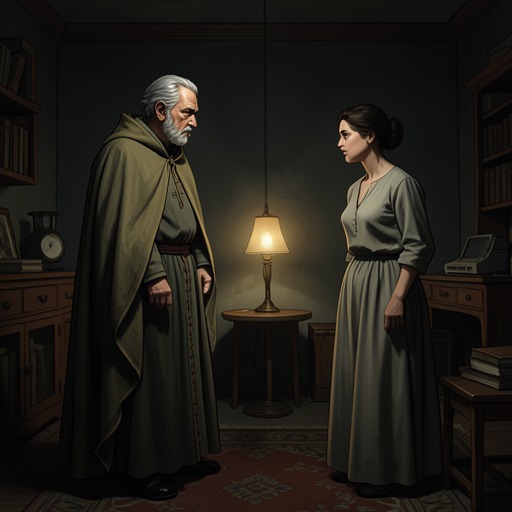
The Laffertys helped turn that affinity into organized activity. They printed, folded, collated, addressed, and mailed more than fifteen thousand of Onias’s pamphlets to LDS leaders around the country, completing the work in two weeks. By early 1984, the School of the Prophets met weekly, usually in the upstairs part of Claudine Lafferty’s Provo home, above the family chiropractic clinic. The same domestic and professional setting that had hosted the brothers’ private discussions now housed a formal religious gathering. Provo became the movement’s practical base: a place for meetings, the production of literature, and the establishment of local leadership.
Onias’s revelations gave the brothers’ work a sacred interpretation. In January 1984, he received a revelation describing the Lafferty brothers as an elect people and chosen seed. Six weeks later, another revelation directed him to appoint Ron bishop of the School’s Provo chapter. The appointment placed Ron in a recognized position of authority among people who already looked up to him. The location therefore mattered not simply because meetings occurred there, but because Provo was where the brothers’ labor, Onias’s revelations, and Ron’s new office came together.
Public Conflict and Religious Community
The family’s arguments against government authority also took a public form in Provo. After Dan’s legal disputes escalated, he was tried in justice court and represented himself, making constitutional arguments that the judge said the court could not hear. When the judge held him in contempt, Dan’s brothers and other supporters caused a disturbance in the courtroom, declaring the judge, prosecutor, and court clerk under citizen’s arrest. Dan challenged the judge in the name of Christ to do justice or be struck down. The episode brought the brothers’ religious language and their rejection of government authority directly into a local court.
The protest did not change the outcome of the case. Dan was sent to state prison for a forty-five-day psychiatric evaluation and then transferred to the county jail to serve a thirty-day sentence. The confrontation nonetheless marked a turn in the local story: convictions worked out in family discussions were now being acted out in a public institution, with legal consequences for Dan and a highly visible show of support from his brothers.
The Provo family home also became the setting for the School of the Prophets’ meetings and for the arrival of new followers. Pamela and David Coronado first met Onias and the Laffertys at a meeting in the Lafferty home. Pamela, raised in a traditional Mormon family in Provo, had questioned the direction of the church after serving as a missionary in France; she and David joined Onias’s movement in early 1984. David had been born in Colonia LeBaron, and his family had left Mexico amid violence connected to the LeBaron clan. Their entry into the movement shows how the Provo gathering drew people with different histories into the same religious circle.
Return to Provo and Narrative Significance
Provo recurs later as a place of legal proceedings and family encounter. In August 1995, during the hearings preceding Ron’s retrial, both Ron and Dan were brought into Judge Steven Hansen’s Provo courtroom. They greeted each other cordially; it was their first conversation in eleven years, since they had been confined together in the Utah County Jail. The brief exchange did not erase the estrangement between them. By then, Dan believed Ron was an agent of Satan who intended to kill him, a belief connected to an earlier incident in which Dan said Ron had crept toward his bunk while they shared a cell.
Across these episodes, Provo’s function is both physical and structural. The basement clinic and family home provided the setting for the brothers’ discussions and the School’s meetings; the courtroom later brought their beliefs into contact with legal authority and made their fractured relationship visible. The city links the formation of a movement to its consequences without making those developments separate from family life. In the book’s account, Provo is the place where private conviction becomes organized practice, where religious leadership is assigned, and where long-running conflict returns to public view.