Religious Extremism and Faith-Based Violence
Under the Banner of HeavenReligious Extremism and Faith-Based Violence names the book’s central warning: religious devotion can become a force for brutality when certainty is treated as moral proof and the voice of God is made to outrank ordinary judgment. Dan Lafferty’s conviction that he had been assigned a divine task stands at the starkest point of that argument, but the book also traces less immediately visible forms of power: restrictions on information and family ties, vows of vengeance, and rituals that bind a community together. Its concern is not that faith inevitably produces violence, but that sacred authority can make cruelty seem righteous and doubt seem like disobedience.
Certainty and the zealot
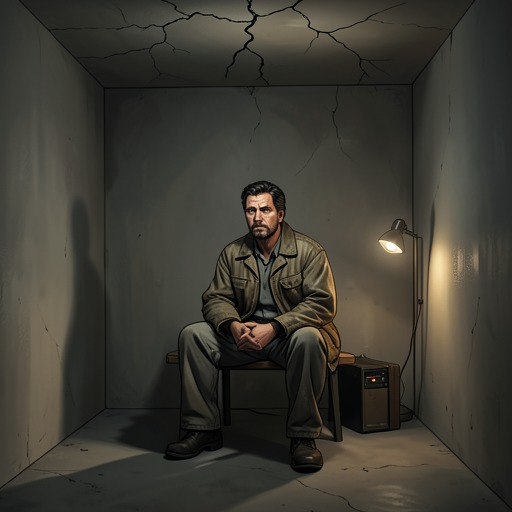
Dan Lafferty presents himself as having been devoted to God and the Kingdom of God since childhood. He says he believed God intended the deaths of Brenda Lafferty and her infant daughter, Erica Lafferty, and understood his role as carrying out a revelation received by his brother, Ron Lafferty. In his account, the feeling of being led through the act and the belief that refusal would offend God leave no room for ordinary moral hesitation. The book emphasizes that Dan expressed no remorse or shame, making the gap between piety and harm—not a lack of religious commitment—the question it asks readers to confront.
The book’s broader explanation is psychological and social rather than a claim that every believer is dangerous. It describes extremism as an absorbing pursuit: a promise of reward may matter less than the purpose and certainty the obsession itself supplies. As the zealot’s perspective narrows, doubt gives way to self-assurance and the perceived sins of other people can become fuel for rage. In that condition, religious conviction may be especially powerful because an appeal to divine authority can overrule common sense. Dan’s actions serve as the book’s vivid example of what can follow when that authority is treated as unquestionable.
The argument also refuses to confine faith-based violence to one religion or country. The book places Dan among zealots from different traditions and periods, and observes that religiously motivated violence long predates modern terrorist movements. Its purpose, it says, is to shed light on people like Dan—not to excuse them, but to investigate the roots of brutality and what those roots reveal about faith. That framing makes understanding a form of scrutiny: the question is how belief can become a justification for harm, not whether the harm should be excused.
Authority, isolation, and obedience
The portrait of Colorado City under Rulon Jeffs shows how control can operate without a single act of spectacular violence. Members are forbidden to watch television or read newspapers and magazines; people who secretly obtain satellite dishes may discard them after a sermon warns that the practice endangers their souls. The cycle repeats: private access returns gradually, followed by another crackdown. The sequence shows both the force of prohibition and its limits. Members attempt to comply, yet the forbidden outside world remains attractive.
Information control is joined to social separation. Residents are forbidden contact with people outside the United Effort Plan, including relatives who have left the religion. DeLoy Bateman, himself an apostate, lives near his brother David, but says David cannot speak with him without risking the loss of his family. Under the doctrine DeLoy describes, wives and children belong to the priesthood and may be reassigned. When DeLoy stopped attending a weekly priesthood meeting, someone was sent within a day to take his wives and children; both wives refused to leave, and most of the children became apostates with him. Authority here reaches into information, kinship, and the conditions of belonging, while a person’s departure can threaten the family left behind.
The book locates these practices within a wider patriarchal structure shared, in its account, by the mainstream Church of Jesus Christ of Latter-day Saints and the Fundamentalist Church of Jesus Christ of Latter Day Saints, though the latter carries such controls further. Men hold priesthood and ecclesiastical authority, and prophets’ revelations are presented as determining even the faithful’s daily conduct. Women are assigned the work of serving husbands, bearing children, and raising them within the faith. The principle that debate ends when a prophet speaks turns dissent into a challenge to religious order, rather than a possible response to harm. Debbie Palmer’s growing difficulty in distinguishing God’s will from the commands of self-proclaimed prophets marks a countercurrent: responsibility for her life and children leads her to question the authority she had been taught to trust.
Sacred community and collective memory
The book also shows religion creating solidarity, not only enforcing compliance. More than ten thousand people gather each summer for the Hill Cumorah Pageant, a large outdoor production staged at the site associated with Joseph Smith’s recovery of the gold plates. The Church of Jesus Christ of Latter-day Saints presents the spectacle as a means of conversion, yet more than 95 percent of attendees already belong to the church. For many, the event functions chiefly as a gathering at a place of origin, where shared testimony and celebration renew a sense of belonging. Its orderliness and scale reveal the attractive, cohesive side of collective religious life; the book sets that communal energy beside its discussion of obedience and exclusion.
Historical memory can likewise organize both loyalty and reprisal. After Joseph Smith and Hyrum Smith were murdered, the defendants in the subsequent trial were acquitted. On the first anniversary of Joseph’s death, Brigham Young declared that God and his people should avenge the blood of the church’s servants. Church authorities then introduced an Oath of Vengeance into the temple endowment ceremony. Participants pledged to pray for vengeance and to teach that obligation to their descendants; the oath remained part of the ceremony until 1927, when its disclosure to the non-Mormon press provoked public and political criticism. The episode shows how a community’s account of persecution could be carried forward as a sacred, intergenerational obligation.
Revelation, law, and the book’s argument
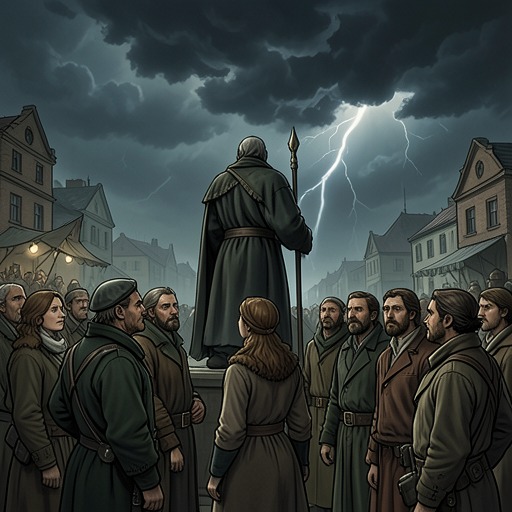
The tension between religious and state authority appears in both historical and modern settings. In Nauvoo, Joseph Smith stood at the head of a city with unusual sovereign powers granted by its charter. He led the Nauvoo Legion and sought still greater military power before announcing his presidential candidacy. The episode makes the political reach of religious authority concrete: Nauvoo was not merely a settlement, but a theocratic principality in which civic and sacred leadership converged.
Dan Lafferty’s own path to fundamentalism involved a different conflict with government. In discussions with his brothers, he argued that citizens should not need licenses, pay taxes, or accept a Social Security number, using The Book of Mormon to support his view that government exceeded its proper reach. His study of Mormon history also convinced him that the Church of Jesus Christ of Latter-day Saints had abandoned plural marriage under federal pressure. These beliefs helped place him in opposition to modern church and government authority, although his later claim that God commanded murder is presented as his justification, not as an established religious teaching.
A further account of revelation’s authority appears in the story of John Taylor’s meeting with trusted followers. After reporting a revelation affirming plural marriage, Taylor bound those present to defend the principle with their lives, liberty, and property. He warned that some would be ostracized or killed, and authorized several men to perform celestial marriages and ordain others to do the same. The book notes that the meeting’s authenticity has been disputed by Church of Jesus Christ of Latter-day Saints authorities. Its place in the argument lies in the way a claimed revelation could establish obligations and a continuing community beyond the boundaries of official church authority.
Across these cases, violence and coercion emerge not as identical phenomena but as points along a wider examination of sacred certainty and power. A pageant can renew fellowship; an oath can preserve grievance; a prophetic order can govern intimate life; and a claimed divine command can be invoked to justify murder. By placing these distinct consequences side by side, the book asks how belief acquires the force to override doubt, individual responsibility, and the claims of other people. Its answer is not that faith alone determines conduct, but that when authority becomes absolute and moral limits are subordinated to it, the possibility of terrible harm is no longer remote.