Restriction on Who May Receive Church Revelation
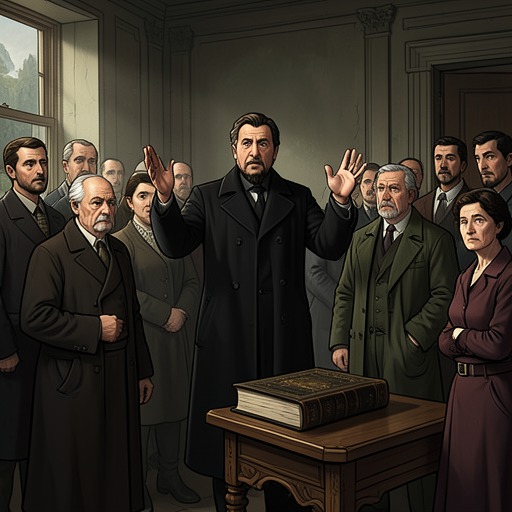
Under the Banner of HeavenRestriction on Who May Receive Church Revelation is the effort to distinguish the prophet’s authority to direct the church from other members’ claims to hear God. In the account of Mormonism, Joseph Smith encouraged personal revelation and then restricted who could receive commandments for the church. The conflict never disappeared: the appeal of direct divine guidance kept generating challenges to ecclesiastical control and, over time, new sects and rival claims to leadership.
Revelation and the Problem of Authority
From its inception, Mormonism treated revelation not merely as private inspiration but as a source of religious truth and institutional authority. The Church’s supreme leader bears the title President, Prophet, Seer, and Revelator, reflecting the expectation that its doctrines and direction derive from continuing divine communication. Joseph Smith initially encouraged members to seek impressions from God to guide their lives, distinguishing the new faith from churches in which religious truth was filtered through established hierarchies.
That invitation created an institutional problem. If members could receive revelations directly, they might hear instructions that contradicted Joseph’s, and the book presents this possibility as a threat to his control over the community. In 1830, the same year the Church was incorporated, Joseph announced a revelation limiting the receipt of commandments and revelations for the Church to himself. The measure claimed a boundary around church governance; it did not erase the broader promise that individuals could communicate with God.
A Restriction That Could Not Close the Door
Members continued to heed what they understood as divine guidance, including on theological matters, despite the restriction. The account emphasizes the weakness in trying to settle a religious dispute through institutional authority alone: when a believer regarded a message as God’s, the prophet’s contrary instruction might carry less weight. The competing claims did not amount only to disagreements over interpretation; they could challenge who was entitled to define doctrine and direct the faithful.
Robert Crossfield’s experience illustrates the conflict. In 1975, he received a commandment identifying him as Onias, the true prophet and rightful leader of the Church of Jesus Christ of Latter-day Saints, and assigning him the task of setting the Church in order. His claims did not win acceptance from leaders of the United Effort Plan. The leader of the Creston polygamists excluded him from prayer meetings, and Crossfield was expelled from the organization. He later moved to Idaho and then, in the early 1980s, to a town outside Provo, Utah. The episode shows how a competing revelation could become a direct challenge to an existing institution—and how that institution could answer by denying the claimant a place within it.
Splintering and Contested Succession
The tension between personal revelation and authorized leadership provides context for the recurring formation of new Mormon groups. The book estimates that about two hundred schismatic sects had split from Joseph Smith’s original religion since 1830, with further divisions continuing. The United Effort Plan communities in Colorado City and Creston, as well as the followers of Onias, are presented as examples of that continuing pattern.
Disputes over succession could produce divisions even within fundamentalist communities. After John Y. Barlow died in 1949, Joseph Musser became the movement’s leader, but a series of strokes left him debilitated. In 1951, Musser appointed Rulon Allred as his second elder and heir apparent, against the expectations of those who believed LeRoy Johnson should succeed him. After Musser’s death in 1954, the movement divided: Johnson led the larger group that remained in Short Creek, while Allred led the Apostolic United Brethren in the Salt Lake Valley.
A later transition in Colorado City repeated the pattern. When LeRoy Johnson died in 1986, Rulon Jeffs assumed leadership, but Marion Hammon’s supporters disputed his right to succeed. Nearly a third of the community left and formed the Second Ward, while the original congregation became known as the First Ward. Each side treated the other as religiously illegitimate. The succession dispute demonstrates that recognized authority depended not simply on a claim to revelation, but also on whether a community accepted the person who claimed the mantle.
From Prophetic Claim to Community Rule
Within the United Effort Plan, the right to direct the faithful was tied to extensive authority over everyday life. The account describes men alone as holding priesthood offices, including the office of prophet, and prophets as the only people authorized to receive revelations determining how the faithful should conduct themselves. It also says that this patriarchal arrangement existed in both the mainstream Church and the Fundamentalist Church, though fundamentalist communities took its controls further.
In Colorado City under Rulon Jeffs, his directives reached beyond doctrine. Residents were forbidden to watch television or read newspapers and magazines, and they were barred from contact with outsiders, including relatives who had left the United Effort Plan. The prohibitions were enforced in cycles: after a sermon warning that members’ eternal souls were endangered by television, people discarded hidden satellite dishes; after two or three years, dishes gradually reappeared. The recurrence reveals both the reach and the limits of rule imposed from above.
The consequences also reached into family life. When DeLoy Bateman stopped attending a weekly priesthood meeting, a representative was sent within twenty-four hours to take his wives and children, whom United Effort Plan doctrine treated as belonging to the priesthood rather than to husbands or parents. Both wives refused to leave, and they and all but the three oldest children became apostates along with him. The episode makes the stakes of prophetic authority concrete: a dispute over religious allegiance could determine a family’s status and whether its members remained together.
The rule’s significance therefore lies in its unresolved contradiction. Institutional leadership sought to reserve church-directed revelation to the prophet, while the faith’s own revelatory tradition made direct access to God compelling. The restriction could define who officially spoke for the Church, but it could not prevent believers from making rival claims, nor guarantee that members would accept the resulting hierarchy.