Revelation from God
Under the Banner of HeavenRevelation from God is the book’s central means of establishing religious truth, authorizing leaders, and directing private life. It is also a recurring source of conflict: when individuals claim access to divine instruction, their revelations may challenge the very hierarchy that defines who is entitled to speak for God. From Joseph Smith’s early encouragement of personal guidance to later schisms and Ron Lafferty’s increasingly consequential revelations, the concept binds religious authority to the problem of who can recognize, interpret, and enforce a divine command.
Revelation and Institutional Authority
The official title of the supreme leader of the Church of Jesus Christ of Latter-day Saints identifies him as President, Prophet, Seer, and Revelator. That title reflects a tradition in which religious truth and ecclesiastical authority are understood to come through continuing revelation. In the book’s account, the promise of communication from God is not incidental to Mormonism’s organization: it is one of the grounds on which prophetic leadership rests.
Joseph Smith initially emphasized that believers should seek personal impressions from God to guide their lives. This emphasis distinguished his teaching from churches that filtered divine instruction through established institutions, and it proved compelling to followers who valued direct access to God. But the principle created an institutional difficulty. If members could receive revelations for themselves, then a revelation that contradicted Joseph’s might claim equal divine authority. The question was not simply whether God spoke, but how the church could decide whose account of that speech governed its members.
In 1830, the same year the church was incorporated, Joseph Smith announced a revelation restricting the receipt of commandments and revelations for the church to himself. The rule sought to secure his authority over doctrine, but it could not erase the appeal of personal revelation that he had already encouraged. Some believers continued to heed revelations concerning both religious questions and personal matters, even when those claims ran against the prophet’s institutional restriction. The book connects this unresolved tension to the continuing emergence of splinter groups: the source of authority was understood to be divine, yet access to that source could not be made exclusive simply by declaring it so.
Revelation as a Changing Religious Program
The book also presents revelation as a force through which Mormon belief changed over time. By the mid-1840s, Joseph Smith had received 133 commandments important enough to be recorded in The Doctrine and Covenants. The accumulating revelations marked a substantial development from the religion practiced at its founding. Among them, the 1843 revelation later canonized as Section 132 introduced the new and everlasting covenant of plural marriage. The book emphasizes the broad consequences of that commandment: it nearly fractured the church, contributed to the circumstances surrounding Joseph Smith’s death, and continued to reverberate in American society.
For Dan Lafferty, revelation and scripture belonged to a larger world of absolute religious authority. His self-directed study led him to regard the Church of Jesus Christ of Latter-day Saints as having gone astray when plural marriage was abandoned in 1890. He treated The Book of Mormon, The Peace Maker, the United States Constitution, and the Declaration of Independence as sacred texts whose divinely inspired language should be followed literally. In this outlook, revelation did not invite open-ended interpretation; it stood alongside scripture and founding documents as an authority whose words admitted no allowance for ambiguity or circumstance. The result was a sharply divided moral world, in which the faithful understood themselves to possess truth and regarded those outside it as its opponents.
Onias and the Rival Claim to Prophetic Office
The history of Robert Crossfield, known as Onias, demonstrates how a revelation can make an explicit claim to institutional authority. In a 1975 commandment, Crossfield received the name Onias and was told that he was the true prophet and rightful leader of the Church of Jesus Christ of Latter-day Saints, appointed to set the church in order. The claim placed the leaders of the United Effort Plan, including LeRoy Johnson, in a subordinate position: they were supposed to take direction from Onias. The Creston leadership rejected that authority and excluded him from its prayer meetings. He was expelled from the United Effort Plan, moved first to Idaho, and later settled near Provo, Utah.
The dispute was not only about whether a message had come from God. It concerned how a revelation became recognized authority, and whether an established religious community would accept a competing prophet’s claim. The book places Onias’s followers among the many movements to emerge from Mormonism’s continuing disagreement over personal inspiration and institutional control. Their existence underscores the instability of a system in which divine revelation is treated as definitive, while the identity of its authorized recipient remains contested.
The School of the Prophets and Ron Lafferty’s Revelations
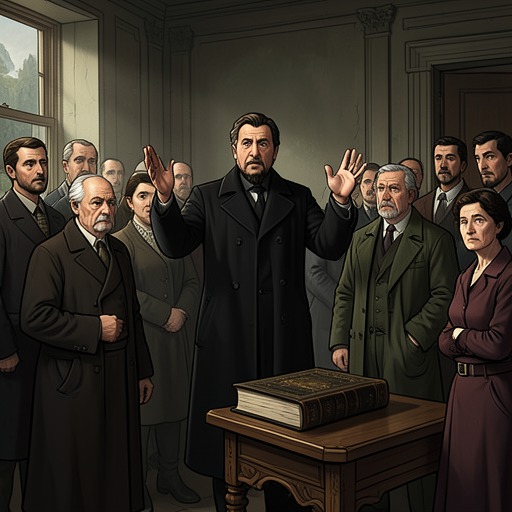
In early 1984, Onias’s School of the Prophets met weekly, usually at the Provo home of the Lafferty brothers’ mother, upstairs from the family chiropractic clinic. The brothers helped establish the school by printing, folding, and mailing more than fifteen thousand of Onias’s pamphlets to Church of Jesus Christ of Latter-day Saints leaders. Onias then received revelations identifying the brothers as a chosen people. Six weeks after an earlier revelation about them, he was instructed to appoint Ron Lafferty bishop of the school’s Provo chapter. The appointment gave Ron an official position within a community organized around learning to receive and interpret revelation.
On February 24, Ron became the first of Onias’s students to receive a commandment from God. He sat at a computer borrowed from Bernard Brady, closed his eyes, and typed as he felt prompted by the spirit. He received further revelations on February 25 and 27. Dan, who had not experienced revelation in the school, watched his brother’s practice with fascination. The messages did not all arrive in the same way: Ron sometimes received them a word at a time, sometimes in whole phrases, and sometimes held them in memory before writing them down.
Prompted by Onias’s instruction, Ron received approximately twenty revelations during February and March. Some were typed on Brady’s computer as they came; others were retained in his memory before he committed them to print. In late March, he recorded the most disturbing one by hand on yellow legal paper. It described several people as obstacles to God’s work and commanded that they be removed in rapid succession. The revelation thus turned the school’s practice from instruction in divine communication into a claim that a command received through one student authorized action against named individuals. Its significance lies not only in its content, but in the authority Ron attributed to it and the way its language presented a human decision as God’s command.
Revelation, Obedience, and Religious Schism
Across the book, revelations operate within communities where obedience to prophetic authority is taught as a defining religious duty. In the United Effort Plan, male leaders hold the priesthood, and prophets alone are authorized to receive revelations determining how believers should live. That principle reaches into gender roles and everyday conduct, while dissent from religious authority is treated as a threat to faith. The tighter the community’s controls on who may speak for God, the more consequential—and potentially disruptive—a competing claim to revelation becomes.
The deaths of successive leaders expose the fragility of authority that depends on a prophet’s standing and succession. When LeRoy Johnson died in 1986, Rulon Jeffs assumed leadership, but Marion Hammon’s followers contested his right to inherit the mantle. Nearly a third of the community left and formed a rival church called the Second Ward. Each side condemned the other as apostate, making rival claims to religious legitimacy part of the separation itself. After Joseph Musser’s debilitating strokes, his appointment of Rulon Allred as second elder likewise provoked resistance from supporters of LeRoy Johnson, whom John Y. Barlow had specified as successor. After Musser’s death, the movement divided: Johnson led the larger group that remained in Short Creek, while Allred became prophet of the Apostolic United Brethren. These disputes show that revelation and prophetic authority do not prevent division; they can furnish the terms in which division is justified.
The concept therefore carries a double meaning. Revelation promises immediate access to divine truth, but religious institutions also depend on limiting who may interpret that truth for the group. Joseph Smith’s restriction, Onias’s competing commission, and Ron Lafferty’s claims each make that tension visible in different ways. The book treats revelation neither as a simple guarantee of truth nor as an empty formality: it is a powerful claim whose consequences depend on who makes it, which community recognizes it, and what actions are taken in its name.