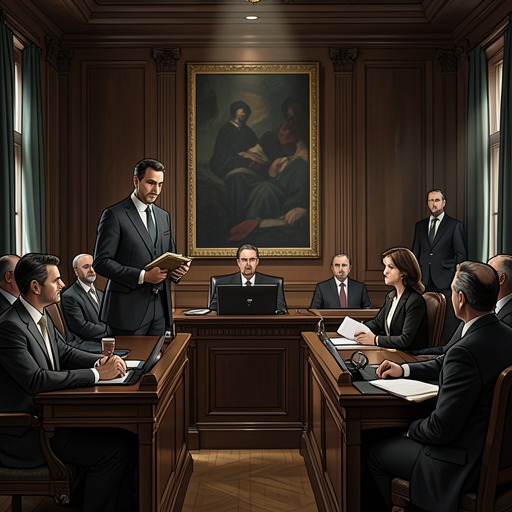
Ron Lafferty Murder Trial
Under the Banner of HeavenRon Lafferty’s 1985 murder trial turned on a collision between criminal responsibility and religious authority: although his lawyers sought to argue that mental illness had affected his actions, Ron refused a defense that he believed would amount to an admission of guilt. A jury convicted him of first-degree murder and sentenced him to death; years later, an appeals court set aside the convictions because the original competence determination had used a faulty legal standard.
Background and Defense Strategy
Ron’s trial began in April 1985, almost four months after Dan Lafferty was sentenced to life imprisonment for the murders of Brenda Lafferty and her baby, Erica Lafferty. Before Ron’s trial, psychiatrists and psychologists had concluded that he was mentally competent. His court-appointed attorneys nonetheless hoped to reduce the charges to manslaughter by arguing that mental illness had affected him when he and Dan committed the murders.
Ron would not authorize that strategy. He told Judge Bullock that accepting a plea bargain or a mental-illness argument seemed to him an admission of guilt, and he would not make one. His decision narrowed the defense: his lawyers could not present their planned case that his religious beliefs and mental state warranted reducing the charges.
Trial and Verdict
With Ron refusing the proposed defense, his attorneys canceled plans to call several witnesses. The only defense witness ultimately called was his mother, Claudine Lafferty. She cried on the stand and testified that she had not known Ron and Dan had discussed killing Brenda and Erica in her presence, a claim the book contrasts with those earlier conversations.
The jury deliberated for two hours and forty-five minutes before finding Ron guilty on all charges, including two counts of first-degree murder. Unlike the jury in Dan’s case, it imposed capital punishment. Ron was sentenced to die and chose execution by firing squad rather than lethal injection.
Conflicting Accounts and Later Review
Accounts of what Ron and Dan disclosed during their drive toward Nevada later differed. Dan said that he described the killings to Ricky Knapp and Chip Carnes and made clear that he, not Ron, had wielded the knife. At a later trial, however, Carnes testified that Ron—not Dan—had told the men about the murders during the drive, and recalled Ron describing his own actions against Brenda. The competing recollections did not alter the 1985 verdict, but they became part of the record surrounding the brothers’ roles.
After Ron’s conviction, a new team of attorneys appealed to the U.S. District Court and the Utah Supreme Court, both of which rejected the appeals. In 1991, the Tenth U.S. Circuit Court of Appeals vacated the convictions. The appellate judges agreed that Ron understood the charges and their possible consequences, but concluded that his paranoid delusional system prevented him from interpreting them realistically. Because the original court had used a faulty standard to determine competence, the state would have to decide the question again under accepted legal criteria and, if it wanted to continue prosecuting him, try him anew.
Legal Significance
The appeal made the case more than a dispute over the jury’s verdict. It exposed a difficult distinction between understanding what one is charged with and being able to engage with the charges realistically. The appellate court was especially concerned that Ron believed divine law excused him from human law; it treated that belief as relevant to whether he could stand trial, not as a substitute for deciding guilt.
The ruling also raised questions beyond Ron’s case. Utah Solicitor General Jan Graham warned that the decision might affect the prosecution of other violent crimes inspired by religious belief, including the possibility that religious fanatics could be shielded from prosecution. The trial’s legacy therefore lay both in its capital verdict and in the subsequent legal challenge over how courts should assess competence when religious delusion shapes a defendant’s understanding of the law.