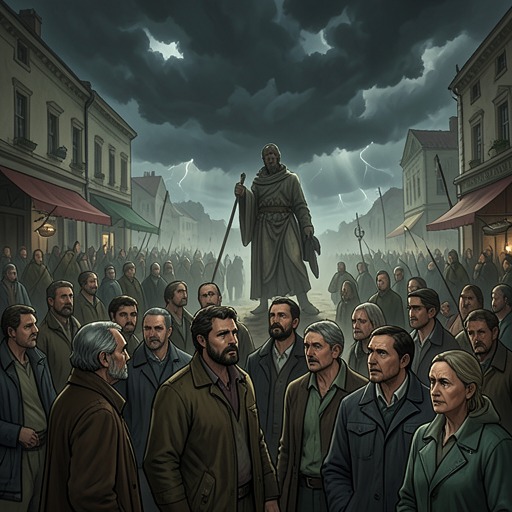
Rulon Jeffs
Under the Banner of HeavenRulon Jeffs was the prophet and leader of the Fundamentalist Church of Jesus Christ of Latter Day Saints (FLDS), whose followers in Colorado City and Bountiful, British Columbia, treated his authority as both spiritual and governing. For more than fifteen years, many believed he was the Lord’s anointed emissary, the one mighty and strong, and would live forever. His death in 2002 made the contradiction between prophetic expectation and ordinary succession impossible to avoid, while placing the leadership in the hands of his son Warren Jeffs.
Identity and religious authority
Rulon’s position belonged to a succession tradition that traced priesthood authority through a line of prophets. In Colorado City and Bountiful, family portraits commonly presented Joseph Smith, Brigham Young, John Taylor, John W. Woolley, Lorin C. Woolley, John Y. Barlow, LeRoy Johnson, and Rulon as successive bearers of divinely granted authority. Followers understood that line to continue from Rulon to Warren after Rulon’s death, although other fundamentalist communities recognized different prophetic lineages.
This succession operated within a religious culture that placed continuing revelation at the center of church leadership. Joseph Smith had first encouraged individual members to seek direct impressions from God, then restricted the authority to receive commandments concerning church doctrine to himself. The resulting tension between personal revelation and institutional control remained a source of schism. Rulon’s leadership represented one organized claim to prophetic authority within that divided movement, not a universally accepted settlement of who held the priesthood keys.
Leadership in Colorado City
Rulon became leader after LeRoy Johnson, known as Uncle Roy, died in 1986 at the age of ninety-eight. Johnson, like Rulon, had been expected by followers to live forever. His death brought a challenge to Rulon’s claim of succession: supporters of Bishop Marion Hammon rejected the transition, and nearly a third of the community left together to establish the Second Ward across the highway. The two congregations denounced one another as apostates and warned of the other’s damnation. The split showed how a community organized around prophetic authority could fracture when the identity of the rightful prophet was disputed.
Under Rulon, that authority extended beyond religious teaching. DeLoy Bateman described restrictions on television, magazines, and newspapers, as well as a ban on contact with people outside the United Effort Plan (UEP), including relatives who had left the faith. Secret television use recurred despite the prohibition: after Rulon preached against it and warned that viewers endangered their souls, satellite dishes were dumped in the desert; after a few years, concealed dishes began appearing again. The cycle revealed both the reach of the rules and the limits of enforcement. Members could try to comply, evade the restrictions, and return to prohibited habits before the next crackdown.
Rulon’s authority also shaped the consequences of departure. According to UEP doctrine described by Bateman, wives and children belonged to the priesthood rather than to their husbands or parents and could be reassigned. When Bateman stopped attending the weekly priesthood meeting, Rulon sent someone to take away his wives and children and decreed that they should be given to another man. Both wives refused to leave, and most of the children joined Bateman in leaving the faith. The episode made the costs of disobedience concrete: a leader’s religious judgment could reach into the household, while the family’s response could in turn challenge his command.
Family, mortality, and succession
At his death, Rulon was three months short of his ninety-third birthday. He left an estimated seventy-five wives and at least sixty-five children. His authority and family life were closely intertwined with the community’s belief that the prophet would not die, so his passing created more than a vacancy in church leadership. Residents had to reconcile a long-held conviction of his immortality with the physician’s declaration that he was dead.
Warren Jeffs moved swiftly to take control. Forty-six at the time, he was the second son of Rulon’s fourth wife and had already been running the church during his father’s prolonged illness, functioning as prophet in all but name. Yet the transition did not reproduce the affection many followers had held for Rulon or Johnson. A sibling described Rulon and Johnson as warm and loving, while characterizing Warren’s approach as fear-driven and demanding constant, perfect obedience. Many First Ward members had hoped that the ninety-five-year-old Fred Jessop would succeed Rulon; speculation followed that Jessop’s supporters might eventually break away. Their expectation that Warren might not remain in power long suggested that the succession question was still unsettled.
More than five thousand people gathered in Colorado City four days after Rulon’s death, including fundamentalists and visitors from Canada and Mexico. The funeral brought the community together in public mourning, but could not resolve the anxiety about what would follow. The scale of the gathering stood beside the uncertainty of the new order: Rulon’s followers could honor the prophet who had led them while wondering whether his successor would command comparable loyalty.
Narrative significance
Rulon’s leadership illustrates the double force of prophetic authority in the book: it can organize a community around a shared sacred history, yet it can also make family, information, and civic life subject to religious command. His succession from Johnson had already produced a major division; his own death renewed the possibility of another. The belief that he would live forever magnified the rupture, turning mortality into a test of both collective faith and institutional continuity. In the end, the transition to Warren did not simply replace one leader with another. It revealed the difference between inheriting the office and inheriting the affection on which a prophet’s authority may also depend.