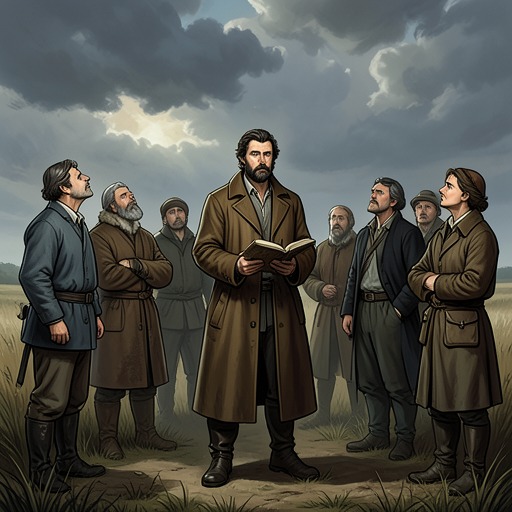
Sidney Rigdon
Under the Banner of HeavenSidney Rigdon emerged as a serious contender to lead the Church of Jesus Christ of Latter-day Saints after Joseph Smith’s death, but his brief appointment as guardian did not survive the return of Brigham Young and the apostles. The succession struggle turned on both timing and competing claims to authority: Rigdon had support within the anti-polygamy faction, yet he could not persuade the assembled Saints that he was their chosen leader.
Position in the Succession Crisis
Joseph Smith’s assassination left the church without its founding prophet while much of the Quorum of the Twelve Apostles was away. Samuel H. Smith, another anti-polygamy candidate, died as efforts were underway to install him. In the aftermath, Rigdon made a last-ditch attempt to secure Joseph Smith’s mantle before Brigham Young and the other apostles could return to Nauvoo.
Rigdon gathered support from others in the anti-polygamy faction and maneuvered to be appointed guardian of the church. The appointment was not yet final: it awaited confirmation by a vote at a special churchwide gathering scheduled for August 8, 1844. His claim therefore depended on a narrow interval between his appointment and the return of the apostles.
The Public Contest in Nauvoo
Brigham Young and the apostles arrived in Nauvoo on the night of August 6, interrupting the effort to establish Rigdon as Joseph Smith’s replacement. Two days later, the faithful assembled to hear Rigdon and Young each explain why he should lead the church.
Rigdon spoke for ninety minutes, arguing his case with passion, but did not persuade the Saints that God had clearly chosen him. Young addressed the same gathering afterward. Accounts of his speech described a resemblance to Joseph Smith in voice and manner, which many attendees interpreted as the mantle of the dead prophet passing to Young. The contrast was decisive: Rigdon’s extended argument failed to secure the assembly, while Young’s address won broad support. Young became the church’s second president, prophet, seer, and revelator.
Authority and the Stakes of the Contest
The succession struggle unfolded within a religious tradition that placed divine revelation at the center of both belief and leadership. Joseph Smith had encouraged Saints to seek personal impressions from God, then restricted who could receive commandments for the church to himself. The tension between individual revelation and centralized authority helps explain why succession was more than a question of office: rival leaders had to persuade believers that their claim carried legitimate religious authority.
The account identifies Rigdon with the anti-polygamy faction and presents his bid as an effort to replace Joseph Smith before the apostles returned. It does not describe a separate revelation underpinning Rigdon’s claim. His documented route to leadership was instead organizational and public: he secured a provisional appointment, assembled factional support, and addressed the churchwide gathering.
Outcome and Historical Significance
The account considers how different the church’s history might have been if Young’s return had been delayed by thirty-six hours. It speculates that Rigdon might then have taken control, that the Saints might not have settled the Great Basin, and that church polygamy might have ended before becoming established. These are counterfactual possibilities, not events that occurred.
Rigdon’s failed bid nevertheless marks a pivotal branch in the succession crisis. His appointment showed that Joseph Smith’s death opened space for competing leadership claims; the gathering on August 8 closed that opening in Young’s favor. The outcome shaped the church’s subsequent direction, while leaving Rigdon remembered in this episode as the contender whose claim was overtaken by the apostles’ return and a decisive public test of support.