The Book of Mormon
Under the Banner of HeavenThe Book of Mormon is the sacred text Joseph Smith said he translated from gold plates, and the founding scripture of the Church of Jesus Christ of Latter-day Saints. In the account traced here, its authority rests on a claimed ancient record and divine translation; its consequences extend into religious identity, public controversy, and later arguments about obedience to revelation. The book’s stories and commandments could inspire faith, but they could also be read as direct and binding instructions for action.
The plates and the translation
The book’s origin story begins with a physical object: a volume of metal pages said to have been hidden for fourteen hundred years. Joseph described its pages as engraved in Egyptian characters and joined by three rings. Later, nineteen witnesses would attest that they had seen the plates; eight signed a joint statement saying they had handled them and observed the engravings. These testimonies made the plates more than a private element in Joseph’s account: they were presented as material evidence of an ancient record, even as its translation depended on divine assistance.
Moroni had given Joseph interpreters, described as divinely endowed spectacles for understanding the unfamiliar writing. Joseph dictated his translation to Martin Harris, who served as a scribe. After two months, they had completed 116 pages. Moroni then took back both the plates and the spectacles, while Joseph permitted Harris to borrow the manuscript to show his skeptical wife. The pages disappeared. The account says that Joseph was devastated when Harris confessed their loss; the suggestion that Harris’s wife destroyed them is presented as the prevailing view, not as an established fact. The missing manuscript thus became an early rupture in the work: the translation seemed to have ended before the book could be completed.
In September 1828, after Joseph had prayed and expressed contrition, Moroni returned the plates, but not the spectacles. Joseph resumed translating with a chocolate-colored, egg-shaped stone he had found while digging a well in 1822. He placed it inside an upturned hat, bent over it, and dictated what appeared to him, with the plates nearby. Emma Smith initially served as scribe during this renewed work, and others later shared the task. Joseph worked at a reported average of about 3,500 words a day; by the end of June 1829, the translation was complete. The contrast between the metal plates and the stone concealed in a hat is central to the account’s translation narrative: the record is described as an ancient physical artifact, while the act of rendering it into scripture proceeds through a method of visionary dictation.
Publication and public reception
Joseph sought an unusually large first printing for a self-published book by an unknown figure: 5,000 copies. He proposed a price of $1.25 each, about twice what most local wage earners made in a day. The printer demanded $3,000 in advance, beyond what Joseph could raise. Joseph presented the expense to Harris as a divine command, accompanied by a warning of destruction to Harris and his property if he refused. Harris had already lost his marriage, in the account, amid his involvement with the translation and the conflict it caused with his wife. He nevertheless agreed to sell his farm to pay the printer.
Nine months after the translation was finished, the 588-page book went on sale in a brick storefront in downtown Palmyra. On April 6, 1830, just over a week later, Joseph formally incorporated the Church of Jesus Christ of Latter-day Saints. The close timing joined text and institution: the translated record was not merely one religious work among others, but the new church’s sacred foundation and guiding scripture. Yet public reception was hostile as well as hopeful. The first review, published in the Rochester Daily Advertiser on April 2, four days before the church’s incorporation, denounced the book as fraudulent and blasphemous. Rumors about the so-called golden Bible and Joseph’s reputation as a charlatan intensified hostility in the Palmyra region. In December 1830, a revelation directed Joseph to move his followers to Kirtland, and a later revelation designated northwestern Missouri as the place where the Saints should gather and build a New Jerusalem.
An American sacred history
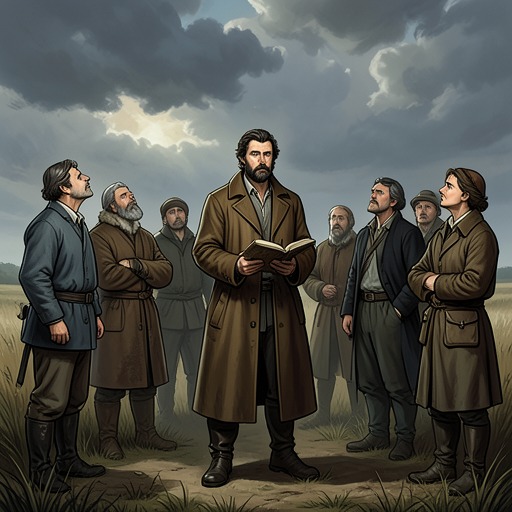
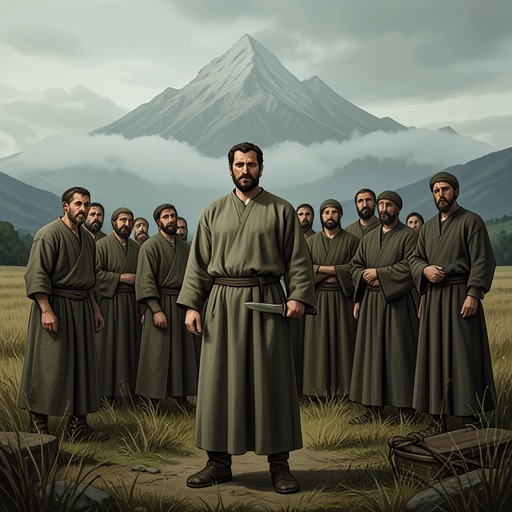
The narrative of The Book of Mormon begins with Lehi, a Hebrew leader who leaves Jerusalem with his followers six hundred years before the birth of Christ, shortly before the final Babylonian conquest. His family reaches North America by boat. Lehi favors his youngest son, Nephi, and bequeaths leadership to him; after Lehi’s death, the resulting family division develops into a conflict between Nephites, led by Nephi, and Lamanites, associated with his brother Laman. The book’s account describes the Nephites as righteous and fair-skinned and represents the Lamanites’ dark skin as a curse for impiety. That racialized distinction is part of the text’s moral and political story, not simply a description of its setting.
After the resurrection, Jesus Christ visits the peoples of the Americas and teaches both groups. For several hundred years they live together as Christians, but the Lamanites’ return to unbelief and idolatry renews the division, and conflict escalates. The book’s geography and sacred history make the American continent central to its religious imagination: the Americas are where Christ appears to a chosen people, where the plates are delivered to Joseph, and, according to a revelation Joseph receives, where the Garden of Eden had been located. Joseph’s followers were taught to understand themselves as God’s Elect and as participants in events leading toward the Last Days and the Second Coming of Christ. The book therefore supplies not only an account of ancient inhabitants but a sacred past that places America within an imminent divine future.
Continuing revelation and later readings
The book introduces a religious world in which divine communication does not end with one translation. God continues to issue commandments and revise or replace revealed principles; these revelations are collected in The Doctrine and Covenants. The account describes continuing revelation as a crucial tenet of the religion and notes that The Doctrine and Covenants has in some respects surpassed The Book of Mormon in consequence for Latter-day Saints. The two scriptures therefore occupy related but distinct places: one presents the ancient record and the founding translation, while the other gathers later revelations that guide the church.
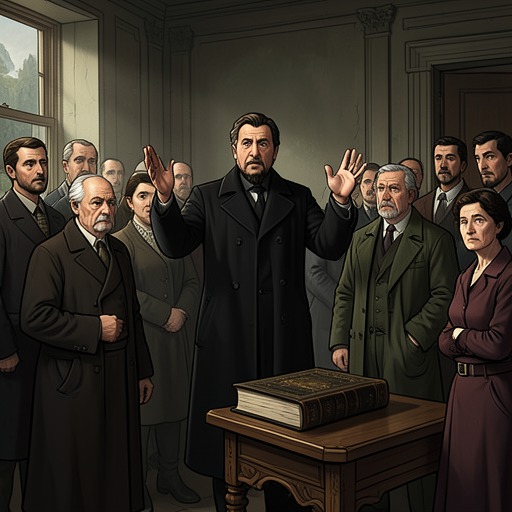
The book also becomes a source of authority in Dan Lafferty’s movement toward Mormon fundamentalism. His interest in plural marriage and historical Mormon teaching led him to blood atonement, a doctrine associated in his studies with Joseph Smith and Brigham Young, and to the principle that divine law takes precedence over human law. A separate political dispute helped turn those readings into a wider program: after authorities shut down the family’s home sandwich business over licensing and tax requirements, Dan connected his anger at government regulation to a passage in The Book of Mormon about the duty to secure good government. He concluded that political and religious questions could not be separated.
Dan came to place The Book of Mormon alongside The Peace Maker, the United States Constitution, and the Declaration of Independence as texts whose divinely inspired sentences possessed absolute authority. His approach treated their language literally, as commands that admitted little room for ambiguity or circumstance. The book’s story of Nephi and Laban became especially consequential. Dan and Ron considered Nephi’s hesitation and eventual killing of Laban as a precedent for obeying a command that appeared to require violence. Dan also had a revelation likening him to Nephi and calling him an obedient son; his brother Mark later said that this comparison made Dan willing to do whatever he believed God commanded. The book thus functions in the account both as scripture and as a template through which later believers interpret their own roles. Its significance lies partly in that gap between a narrative about divine command and the absolute authority readers may assign to its language.