The Chosen People
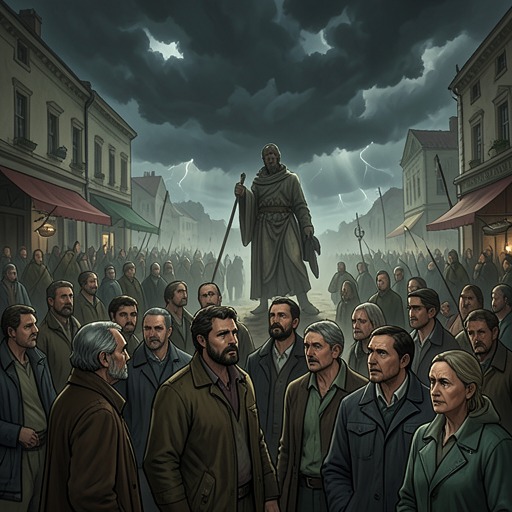
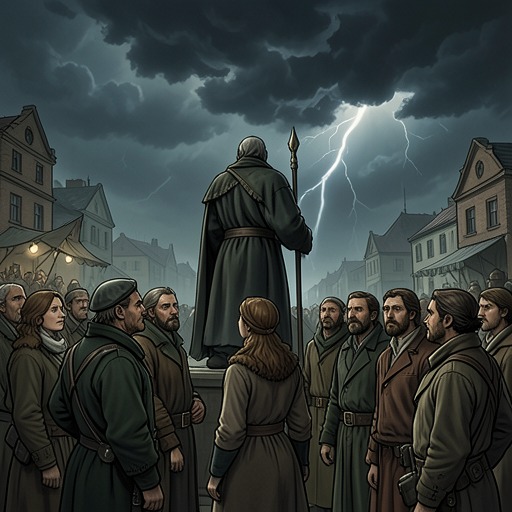
Under the Banner of HeavenThe Chosen People is the belief that a community has been specially selected by God and entrusted with a sacred purpose. In the book, this identity is both a source of belonging and a boundary between insiders and outsiders: it can inspire a promised religious society, but it can also make dissent appear sinful, political exclusion righteous, and a former member more suspect than a stranger. Its consequences depend on who defines membership and what authority that membership is used to support.
Sacred identity and divine inheritance
The idea is present in the religious world of Joseph Smith, where believers were taught that their community had recovered the true faith and was destined for a special role. The Book of Mormon presents religious allegiance through a stark division between the church of God and the church of the devil. That framing offers converts a clear account of where truth resides, while making religious difference more than a disagreement: it becomes a test of which side a person belongs to.
In the 1830s, the belief acquired a geographical and political expression. Followers of Joseph Smith gathered in Jackson County, where they understood the land as a divinely appointed inheritance and themselves as God’s chosen people. Their claim was not simply that the area would make a suitable home; it carried the conviction that their settlement fulfilled divine purpose. As their numbers grew, they purchased land through church funds, favored commerce with fellow believers, and voted as a bloc under Joseph Smith’s direction. To local residents, these practices suggested that the newcomers intended to shape regional life around their own religious authority. A newspaper warning that Mormons might eventually fill county offices registered that political fear; to the Saints, meanwhile, settlement in the promised land expressed a religious right.
This conflict shows how chosen status could turn an ordinary dispute over land, commerce, and political influence into a contest over moral legitimacy. The Saints were willing to welcome converts, but their division of humanity into those who accepted God’s plan and those who rejected it left little room for sympathy toward dissenters. A revelation calling Missouri the Saints’ inheritance and their enemies’ land made the divide explicit. The same belief that bound the migrants together thus sharpened the opposition between the gathered community and its neighbors.
Authority, obedience, and community boundaries
At Nauvoo, chosen identity was reinforced by a tightly governed religious settlement. Joseph Smith’s followers looked to him to determine how they should serve God, while their status as God’s chosen people was affirmed through his leadership. In this arrangement, membership offered certainty and collective purpose, but decisions about religious duty rested with an authority empowered to speak for the community. The book emphasizes the danger of treating guilt and innocence as matters of belief rather than evidence: once the community’s moral categories are accepted as decisive, those outside its favor can be cast as threats before their actions are judged.
The pattern appears in later fundamentalist settings as well, though with distinct leaders and circumstances. In the Fundamentalist Church of Jesus Christ of Latter Day Saints community, men held priesthood authority, and prophets alone were understood to receive revelations directing the faithful’s lives. The rule that a prophet’s decision ended debate made obedience a religious duty, not merely a preference for order. Women’s expected roles were correspondingly defined around serving husbands, bearing children, and raising them within the faith. The belief in a chosen community was therefore joined to a particular structure of authority: the group’s sacred status supported obedience to leaders who claimed to interpret God’s will.
In Colorado City, Rulon Jeffs’s authority extended beyond preaching. Members were forbidden to watch television or read newspapers and magazines, and contact with people outside the United Effort Plan was restricted, including contact with relatives who had left. DeLoy Bateman, raised in the faith and descended from prominent fundamentalist families, described how television bans drove people to hide satellite dishes, discard them after sermons, and secretly acquire them again later. The cycle illustrates a tension between enforced separation and ordinary human desire: prohibition could strengthen the boundary while also making forbidden outside life more attractive.
Chosen status could also be invoked to justify accepting help from the government regarded as wicked. DeLoy said Rulon Jeffs taught that public assistance came from God’s way of providing for his chosen people. Fundamentalists used the phrase bleeding the beast for defrauding the government and treated it as virtuous. Here the community’s special standing reversed the usual moral meaning of taking public resources: what might otherwise be condemned as fraud could be represented as divine provision. The belief did not merely distinguish the group from outsiders; it supplied a religious explanation for how members might deal with them.
Apostasy and the cost of leaving
The boundary around the chosen community became especially severe when a member departed. In Colorado City, apostates were taught to be more wicked than Gentiles or members of the mainstream Church of Jesus Christ of Latter-day Saints. DeLoy’s break with Rulon Jeffs began after he challenged the prophet’s accusation against him. He concluded that a man who claimed continual communication with God had nevertheless made a false charge, and decided to leave the Work. His absence from the next weekly priesthood meeting was followed within a day by an attempt to take his wives and children away: according to the community’s doctrine, they belonged to the priesthood and could be reassigned to a supposedly worthier man.
That outcome did not proceed as the leader intended. Both of DeLoy’s wives refused to leave him, and all but his three oldest children became apostates with him. Their decision exposed a conflict between the collective claim of religious authority and the family loyalties that authority sought to control. DeLoy’s brother David remained inside the community, although the two had raised each other after their father became disabled. They lived only yards apart, separated by a fence, but David was forbidden to speak with him. DeLoy said that if David’s wife caught him talking with an apostate, she could take the children, leaving David in the community without his family. The idea of chosen membership thus imposed consequences not only on those who left but also on relatives who stayed.
The threat of spiritual ruin could make departure appear almost unthinkable. Debbie Palmer recalled being warned that people who abandoned the faith would be cast into darkness and reduced to lives of degradation. For a time, she believed that this was what happened to everyone who left Bountiful. As she became less able to reconcile the conduct of religious men with divine righteousness, she began questioning where God’s will ended and human authority began. Her eventual decision to take responsibility for herself and her children shows how the chosen-community framework could be challenged from within: doubt did not arrive as a rejection of family or morality, but as a refusal to attribute human-inflicted pain to God.
Belonging, exclusion, and unequal recognition
The book also shows how the meaning of membership can shape how victims are treated by institutions outside a religious community. Ruby Jessop, born into the fundamentalist community, was forced as a teenager into a marriage she did not want and later tried to escape. Her sister Flora reported that Ruby had been taken, but a deputy accepted church leaders’ explanation that the girl was on vacation. When state child-welfare officials later arranged an interview, Ruby spoke in the presence of an alleged abductor, said that everything was fine, and was returned to members of the faith. She subsequently gave birth as a teenager, and no one outside Colorado City heard from her after the summer of 2001.
Activist Lorna Craig contrasted Ruby’s treatment with the rescue and prosecution efforts in the case of Elizabeth Smart, also fourteen when abducted. Craig argued that Ruby’s lifelong formation within the community made her plight less visible to officials, and connected the unequal response to the community’s ability to operate with impunity. In Colorado City–Hildale, she noted, the mayor, police, and judge were themselves polygamists obedient to the prophet. The comparison underscores a painful paradox: being born into a group that understands itself as chosen can mean that a child’s community membership is treated as a reason to defer to its authorities, even when that child needs protection from them.
A recurring moral division
The chosen-people idea recurs across very different settings, from the early Mormon migration to Nauvoo and Jackson County, and from Colorado City’s controlled religious community to Dan Lafferty’s individual religious commitments. These cases are not interchangeable, but each gives membership moral force by distinguishing those understood as faithful from those represented as enemies, apostates, or servants of evil. Dan’s strict reading of religious and political texts placed him within a world of absolute authority and fixed divisions between the righteous and the wicked. The continuity lies not in identical doctrines or outcomes, but in the power of an all-encompassing boundary to make a group’s interpretation appear beyond ordinary dispute.
The belief can sustain solidarity under pressure and give adherents a sense of purpose larger than themselves. But when leaders claim exclusive authority to determine who belongs, and leaving is treated as betrayal of God rather than a personal decision, the promise of belonging becomes a means of control. In the book, the decisive question is not simply whether a community sees itself as chosen, but what that conviction permits its leaders and members to do to outsiders, dissenters, and one another.