Utah State Prison
Under the Banner of HeavenUtah State Prison enters the narrative as both the concrete setting of Dan Lafferty’s confinement and the counterpoint to his expectation that he will one day be released by divine intervention. At the prison’s Point of the Mountain site near Draper, the maximum-security unit contains him for decades after his conviction. The account returns there for an interview in November 2001, when his captivity has become a sustained condition rather than a brief aftermath to the crimes for which he was convicted.
Setting and Conditions
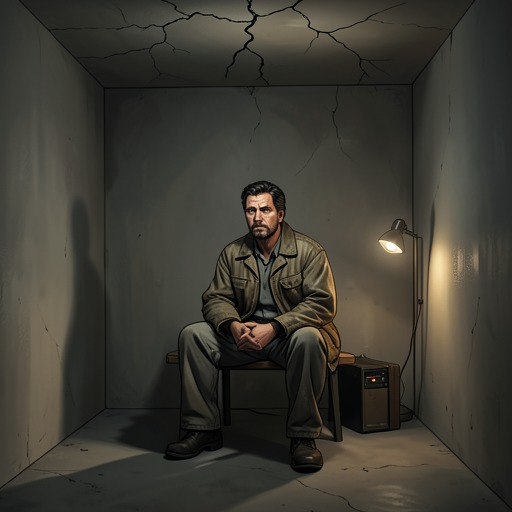
On January 15, 1985, immediately after the judge decreed that the remainder of Dan’s life would be spent in captivity, he was taken to the state prison at Point of the Mountain. A corrections officer cut his hair and shaved his whiskers. By the time the narrative describes him nearly seventeen years later, he has not cut his hair or shaved since that initial prison grooming. His beard, gathered with rubber bands, reaches his belly; his white hair falls across the back of his orange prison jumpsuit. He is fifty-four, with crow’s-feet at the corners of his eyes and notably pale skin. These details register the passage of years in custody through visible change, while also marking the contrast between the youthful quality the narrator notes in his face and the length of his sentence.
The account also specifies the material restraints of the maximum-security unit. Dan wears handcuffs, and chains connect his shackled ankles to a steel ring set into the concrete floor. Cheap rubber flip-flops are his footwear; a crude spider-web tattoo crosses the crook of his left elbow. These are presented as particulars of his appearance and confinement, not as a separate account of prison policy. Dan cheerfully calls the unit “my monastery,” a label that recasts an imposed place of custody in religious terms. The contrast is central: the prison confines his body, but he interprets his stay through a framework of faith and anticipated deliverance.
Dan Lafferty’s Confinement
The prison follows the court’s judgment that Dan will spend the rest of his life in custody. His account of guilt does not align with the ordinary meaning of the conviction. Before and for more than a decade after it, he maintained that he was innocent of the murders of Brenda Lafferty and Erica Lafferty. When arrested in Reno in August 1984, he told officers that he had committed no homicide. He continues to insist that he has committed no crime, while not denying that he killed Brenda and Erica; he explains the apparent contradiction by treating his actions as God’s will rather than a crime. The prison sentence therefore represents not only confinement but a direct collision between a legal judgment and Dan’s religious interpretation of what he did.
That collision does not resolve during the account. Dan regards himself as having led a righteous life and expects that he will not remain in maximum security much longer. He anticipates the Last Days and believes that the trumpet announcing them will precede his release and entrance into the Kingdom of God. The expectation stands against the described realities of prison life, including strip searches, prison food, and razor wire. The book leaves the distance between his certainty and his continuing imprisonment unresolved; the prison’s importance lies partly in making that unresolved contrast visible over time.
Other Prisoners and Events
The prison also links Dan’s story to Mark Hofmann, identified as his cell mate. Hofmann had lost his faith while serving as a missionary in England but concealed his atheism after returning to Utah, presenting himself as an exemplary Latter-day Saint. He later became a skilled forger, producing false historical documents that brought him substantial sums from collectors. When he believed investigators were close to exposing some of his forged Mormon documents, he set off pipe bombs in October 1985 to divert them, killing two people. The narrative notes that many of his forgeries were meant to discredit Joseph Smith and Mormon history, and that the LDS Church bought more than four hundred fraudulent artifacts. These details establish the very different histories and convictions brought together by the cell: Dan’s professed certainty and Hofmann’s concealed disbelief are placed within the same institutional setting.
Another prison episode concerns Ron Lafferty. On December 29, while Dan had been taken from the cell for questioning, Ron hanged himself from a towel rack. Dan says that Ron would have died if Dan had returned even a few minutes later. By the time paramedics arrived, Ron was not breathing and had no pulse; he survived after being taken to hospital. The episode shows that the prison setting encompasses the brothers’ strained and dangerous circumstances as well as Dan’s own sentence. Dan later interprets Ron’s survival as something whose meaning he has come to understand at least partly, but the account does not present that interpretation as an explanation established by the prison or by other evidence.
Narrative Role and Significance
The author visited Dan at Point of the Mountain in November 2001, in the maximum-security unit. The first interview lasted most of an afternoon; Dan then answered many follow-up questions in long, detailed letters. The author also reviewed thousands of pages of transcripts from the three trials and numerous hearings that determined the guilt of Dan and his brother Ron. The prison thus serves as the site of direct interviews and correspondence, while the legal records supply a parallel account of how the brothers’ cases were decided. Together, these materials let the narrative place Dan’s own explanation beside the judgments and proceedings that keep him confined.
The setting’s meaning is consequently more than geographical. Point of the Mountain is where a sentence imposed by a court becomes the daily condition of a man who continues to expect release through sacred events. Its concrete details—the prison jumpsuit, restraints, cell, and the years marked in Dan’s uncut hair—keep that expectation tied to an enduring physical reality. The maximum-security unit is at once Dan’s self-described monastery, the site of the author’s sustained inquiry, and the place where the consequences of his actions remain present rather than concluded.