
The Architecture of Lilith’s Hell
UnforgivenThe Crossroads setting reveals how Lucifer turns ordinary deprivation into a personalized prison that can be endured but not escaped.
increasing Bearing strength in each event
 decreasing
Bearing strength in each eventdecreasingA Town in a Loop
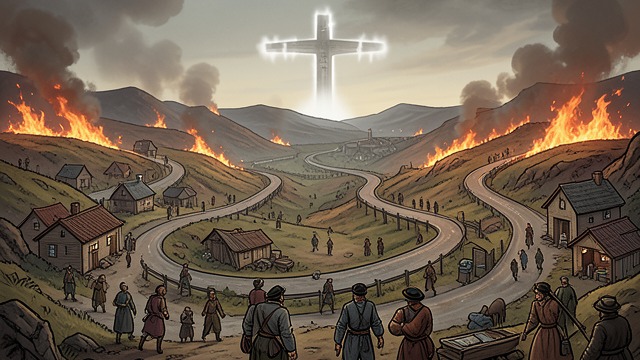
A Town in a Loop
Boundaries made visible
Cam discovers that the roads circle back on themselves and that burning hills enclose the town. From above, Crossroads is not a normal community but a contained space with no apparent route out.
The shape of entrapment
The geography gives physical form to Lilith’s lack of agency. The residents move through familiar routines, unaware that their world is bounded by Lucifer’s design.
Everyday Deprivation
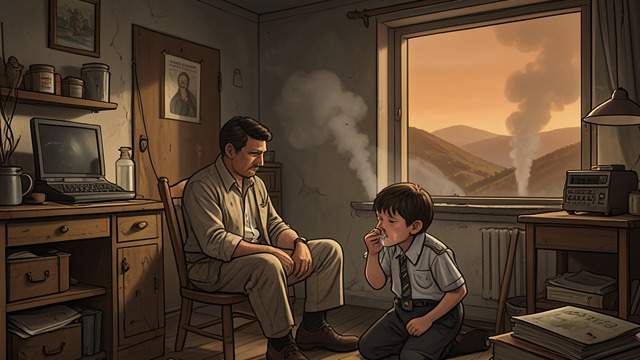
Everyday Deprivation
Poverty as constant pressure
Lilith’s household lacks stable food, water, and money for Bruce’s care. Smoke from the hills worsens his breathing while school provides humiliation rather than escape.
Hell without spectacle
The setting’s cruelty comes through repeated ordinary frustrations instead of constant supernatural violence. Its realism makes Lilith believe her suffering is simply the inevitable consequence of being poor and unwanted.
Lives Rebuilt as Torment
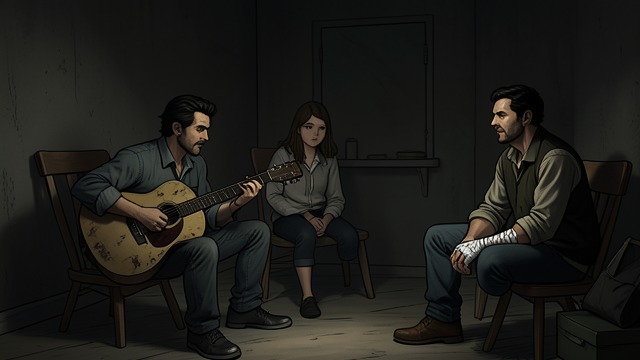
Lives Rebuilt as Torment
Personalized repetitions
Lucifer shows Cam Hells where Lilith becomes a starving musician, a performer in hardship, or a girl trapped in other forms of deprivation. Each setting is tailored to make beauty appear briefly and then disappear.
Pain carried without memory
Lilith does not consciously remember these lives, but their accumulated emotional force shapes her bitterness. The cycle demonstrates how suffering can shape a person even when its history has been deliberately obscured.
Adaptation as a Risk
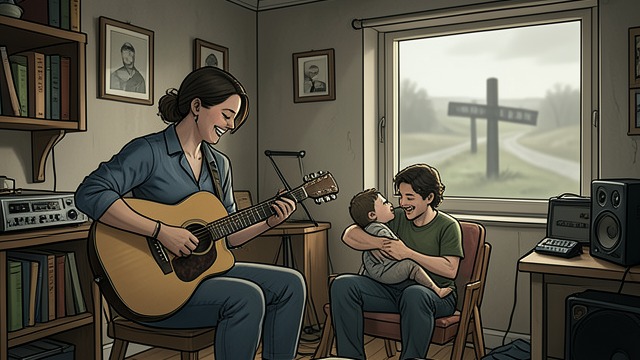
Adaptation as a Risk
Happiness inside the prison
Lilith begins to enjoy her band, reconnect with her mother, and celebrate Bruce’s recovery. Lucifer argues that a happier Lilith no longer needs Cam to save her.
Survival is not consent
Cam recognizes that her adaptation is a strength, not proof that the Hell is harmless. Her capacity to build a life inside confinement challenges Lucifer’s assumption that he controls the meaning of every experience.
The Globe Left Behind

The Globe Left Behind
A world reduced to an image
Cam and Lilith return to the food court and see the ruins of Crossroads inside a snow globe. The place that had felt like all of Lilith’s reality becomes one bounded object among many.
Distance from the old prison
Lilith asks whether she is dreaming, while Cam tells her that she has awakened. The image preserves the loss but also shows that the couple is no longer trapped inside its boundaries.
When Cam surveys Crossroads from above
During Lilith’s first school days
When Lucifer shows Cam the other snow globes
Four days before prom
After Cam and Lilith return to Aevum
