Lilith's cracked guitar
UnforgivenLilith's cracked guitar is a salvaged instrument whose visible damage becomes inseparable from its sound, its history, and Lilith's emergence as a performer. A dark orange Martin 000-45 with a crack slanting down its body, it moves from the private refuge where she writes and plays alone to performances in which music connects her with Cam and the rest of her band. The guitar is not merely a tool she uses: its flaw is something she accepts, protects, and ultimately carries into public view.
The instrument and its flaw
The guitar had been thrown away by someone on Lilith's street. Her family had little money for food, so she could not afford to be particular about an instrument; still, she did not regard this one as a mere fallback. She believed the crack enriched its sound. That conviction makes the damage part of the guitar's value rather than a defect to be corrected. Lilith even describes the balance between the instrument and its crack as just right, imagining that only when the damage overtook the guitar would it become worse.
She treats the instrument with a protectiveness that reflects how much it means to her. At Rattlesnake Creek, she places its case in the customary crook of a tree trunk before settling among the leaves. When Cam later picks it up, Lilith protests: it is her most prized possession, and no one else touches it. Her attachment is practical as well as emotional; the guitar is a scarce possession she has made her own, and its unusual condition is part of what she values about it.
Solitary refuge and musical possibility
At Rattlesnake Creek, the guitar gives Lilith a way to inhabit a place she considers beautiful even though she knows no one else who shares that judgment. Playing it makes her feel as if an invisible hand were smoothing her rough edges and as if she were surrounded by friends she does not have. The instrument offers no literal companionship, but it gives her a means to imagine and feel one through sound. Her playing is both a private comfort and the beginning of a wish for someone who might understand her musical taste.
That wish takes shape in a song that begins before Lilith has fully formed it: her sorrow melds with the guitar, and she sings without noticing when she has slipped into the music. When she stops, someone behind her applauds. The episode establishes a pattern the guitar carries forward: music that begins in solitude can reach another person, even before Lilith has decided to share it. The crack, which might have made the instrument seem damaged or inadequate, is instead associated with a sound she considers richer.
From guarded possession to performance
Cam first responds to the guitar by asking whether Lilith fears making its crack worse. He then calls her song a revelation, clarifying that he means the crack in the instrument. His attention joins the two features Lilith keeps distinct but values together: her emerging songwriting and the guitar's visible damage. When he later takes the instrument and strums it, Lilith is startled because he has crossed a boundary around her prized possession. Yet she is also mesmerized by the beauty of what he plays. The music sounds familiar to her, though she cannot place its source, and Cam suggests that it needs a female vocalist.
At a later performance, that guarded relationship to the guitar meets the pressure of a watching crowd. Lilith is caught in stage fright while people snicker and someone photographs her. Cam jumps from the stage, opens the silver clasps of her case, and raises the guitar. He puts it into Lilith's hands and eases the strap over her shoulder, carefully keeping it from catching in her long red hair. The gesture does not erase her fear or make the crowd kinder; it returns the instrument to her at the moment she must decide whether to play. Cam also takes her journal, then encourages her to imagine being alone at sunset. Lilith leans back toward the microphone and performs Exile.
The song reveals a connection she had not yet recognized. It is a version of the melody Cam had hummed as he left Troy, and Lilith still knows it. With the guitar in her hands and her voice onstage, an old musical thread becomes evidence that something of their love story remains alive. The guitar thus accompanies a change in the meaning of performance: what began as solitary expression becomes a public act that can carry memory as well as song.
The guitar in an ensemble
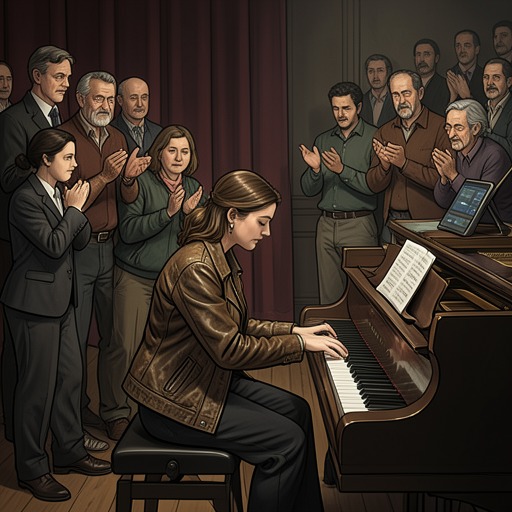
The instrument returns as Lilith takes the stage at prom. She feels its weight across her chest beneath the light fabric of her gown, counts in, and begins with a slow, sad riff before the song opens up. Cam's guitar finds hers, and their playing becomes a shared performance rather than a private exchange. Lilith is no longer afraid; she is living a dream that had once seemed impossible to reach.
During the performance, Lilith's mother and brother dance apart from the crowd, while the audience cheers and she turns from the microphone to play. After the bridge she reaches for the microphone again, and Cam joins her on the last verse with harmonies they have never practiced. When Lilith stops playing before the final couplet, Jean, Luis, and Cam stop with her, and the audience screams louder. The scene places the guitar inside a musical relationship among performers and listeners: it remains Lilith's cherished possession, but its sound now participates in an ensemble.
Across these scenes, the crack does not disappear, and the instrument is never presented as needing repair before it can matter. Its damaged surface and valued sound hold together the central contrast in its story: Lilith begins by playing for the companionship music lets her imagine, then brings that same guitar into moments of risk, recognition, and collective performance. The object links her solitary creative life to a wider circle without ceasing to be unmistakably hers.