Lilith's lyre
UnforgivenLilith's lyre is both a musical instrument and the focus of an early moment of intimacy between Lilith and Cam. Hidden in a hollow tree and tuned by ear, it gives Lilith a way to share music on her own terms: Cam can listen, but he cannot reproduce what she plays. His request to learn turns the performance into a promise of another meeting.
Identity and place
Lilith retrieves the lyre from inside the hollow trunk of an enormous carob tree, after leading Cam to a bank of irises beside a curving river. The hiding place and the ease with which she finds and tunes the instrument make it part of a familiar routine. Cam can see that she tunes it every day; her command of the lyre is not a sudden display for him, but a practiced part of her life.
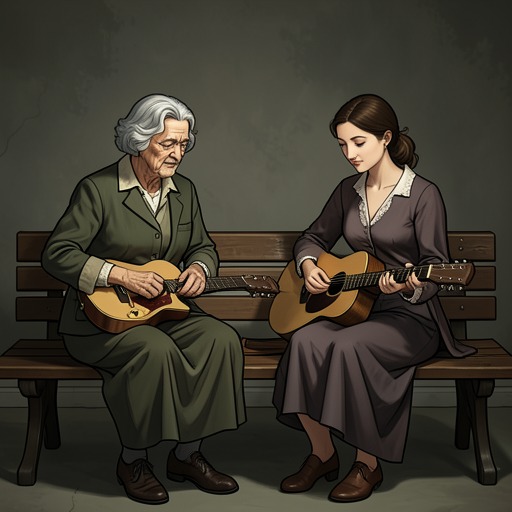
The scene sets the lyre apart from the guitar Lilith plays elsewhere. That guitar is a dark orange Martin 000-45 with a crack slanting down its body, salvaged from someone’s trash because her family cannot afford a better instrument. The lyre is likewise presented through its use rather than through status or expense: the text gives no maker or material, but shows Lilith handling it with fluency. In both cases, her musicianship matters more than an instrument’s perfection. The cracked guitar’s flaw seems to enrich its sound to her; with the lyre, her practiced touch brings the music to life.
Music as performance and disclosure
Cam asks Lilith to play, and she agrees on the condition that he listen. She tunes the lyre by ear and plays notes that seem to curl and entwine, their movement echoing the bends of the river. As she plays, the melody takes on words, and she sings a sad love song. The performance draws Cam’s attention away from the concerns occupying him: for that interval, the song is what matters.
The lyre therefore does more than accompany a voice. Its music becomes the means by which Cam encounters something he cannot readily explain or possess. He wonders whether Lilith made the song there among the irises, whether its melody or lyrics came first, and who inspired it. Those questions register his fascination, but the scene does not answer them. The song’s origin remains with Lilith; Cam receives its effect without being granted its story.
That distinction becomes physical when Cam lifts the lyre from her hands. His fingers are clumsy, and he cannot make anything remotely as beautiful as the music she has played. The difference is not simply between a silent instrument and a sounding one: it is between Lilith’s practiced ability and Cam’s inability, at this moment, to enter her musical language. His admiration is sharpened by the gap between what he has just heard and what he can produce himself.
The lyre and their developing bond
After hearing the song, Cam asks whether Lilith has had her heart broken, hoping to hide his jealousy. The question places the sadness of the music beside the possibility of a personal wound, but Lilith does not confirm that interpretation. Leaning close and looking toward his lips, she says that no one has broken her heart yet; she then strums a bright chord and jokes that no one has broken her lyre either, although a girl cannot be too careful. The instrument’s vulnerability becomes a playful echo of her own guardedness.
Cam responds by asking Lilith to teach him to play. His request gives the encounter a next step: instead of treating the music as a performance he has merely witnessed, he asks for continued time with her and a chance to learn. Lilith answers that something tells her he already knows how to play, then tells him to meet her there the following night, when the moon returns to the same place in the sky. The lyre thus helps turn listening into an invitation and a scheduled reunion.
Significance
The scene makes musical skill a form of relationship. Lilith chooses what to play, controls the lyre, and sets the terms on which Cam may approach her music: he must first listen. Cam’s awkward attempt to play exposes the limits of admiration alone, while his request for instruction makes him a prospective participant rather than simply an audience. Lilith’s invitation keeps that possibility open without suggesting that he has already mastered the instrument or earned a deeper confidence.
The lyre also concentrates a tension between song and explanation. Cam hears a sad love song and immediately wonders about heartbreak and inspiration, but Lilith answers through a joke and a bright chord rather than an account of the song’s meaning. Music lets her communicate powerfully without making the source of the song fully available to him. In this exchange, the lyre is not only a vessel for an emotion; it is the instrument through which Lilith decides how much to reveal, and through which a shared practice begins to become imaginable.