
Bubby’s Life Between Survival and Care
Unorthodox: The Scandalous Rejection of My Hasidic RootsThis thread follows Bubby from Holocaust survival and lasting grief through a life of practical care, constrained choices, and the quiet recognition she offers her granddaughter.
increasing Bearing strength in each event
 decreasing
Bearing strength in each eventdecreasingA Survivor’s Unspoken Loss
A Survivor’s Unspoken Loss
The family she lost
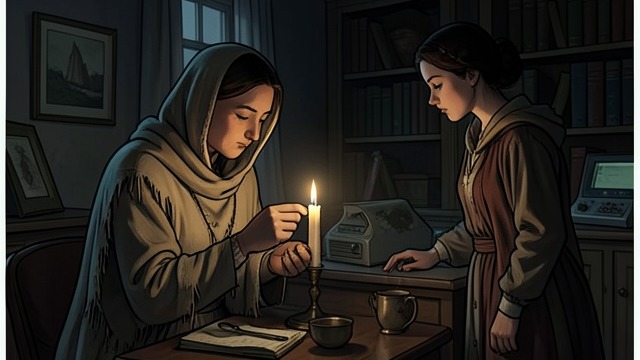
Bubby survives the Holocaust while nearly all of her relatives are murdered. The scale of that loss remains present in her life, though she rarely tells Devorah the full story and instead lights memorial candles for the dead.
Her silence is not evidence that the past has ceased to matter. Devorah senses how grief has narrowed Bubby’s willingness to connect, as though emotional attachment carries the risk of another unbearable loss.
Survival becomes obligation
Bubby and Zeidy understand their survival as carrying a responsibility to bring up children and preserve Jewish life. For Bubby, however, that inherited purpose exists beside the private memories she can seldom articulate.
The contrast between her quiet grief and the family’s frequent religious explanations for suffering shapes Devorah’s understanding of her grandmother. Bubby is not merely a keeper of tradition; she is a person living with the cost of having survived when so many others did not.
Care Through Food and Work

Care Through Food and Work
The kitchen as refuge
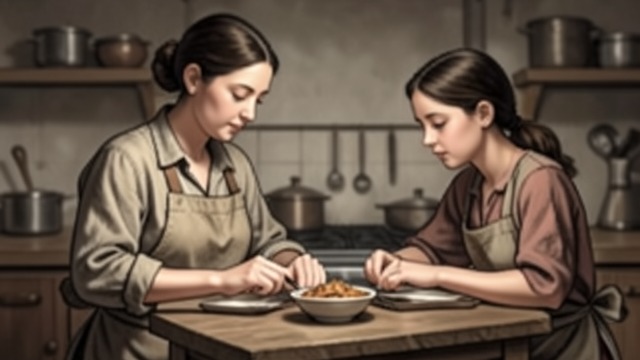
Bubby expresses affection chiefly through practical care: preparing meals, offering sweets, and making sure Devorah has eaten. Her kitchen becomes the place where relatives gather and where Devorah feels safest from the confusion of the wider household.
Bubby’s cooking creates warmth and continuity in a life structured by rules and criticism. Devorah remembers the smells and routines in detail, because they provide an emotional language more reliable than praise or physical affection.
Generosity within scarcity
Although Bubby makes abundant food, the household is shaped by Zeidy’s thrift and an insistence on saving leftovers. Devorah experiences both the comfort of her grandmother’s labor and the hunger, guilt, and secrecy that accompany food in the family.
Bubby’s care is generous but limited by the social order around her. She can feed and comfort her granddaughter, yet she rarely has the authority to determine how Devorah is raised or what she is allowed to know.
An Intelligence Without Authority
An Intelligence Without Authority
Quiet recognition
Devorah sees Bubby as more intelligent and open-minded than the family gives her credit for. Unlike others, Bubby does not readily decide that Devorah is defective or disobedient, and she gives the girl a rare feeling of being accepted as she is.
Their closeness is real but understated. Bubby does not often ask about school or invite direct emotional conversation; her support appears more in small gestures, shared kitchen work, and the respect she shows Devorah’s presence.
Power constrained by marriage
Bubby’s own history shows the limits of that understanding. After Zeidy asks her to shave her head in response to a new religious rule, she protests, questions the authority behind the demand, and eventually complies under pressure.
She later tells the story as if the change was easy, but Devorah suspects that the reassurance is partly meant for Bubby herself. The episode exposes a life in which discernment and resistance do not necessarily translate into power over one’s circumstances.
The Mother Who Remained Behind
The Mother Who Remained Behind
A home shaped by absence
When Devorah’s mother leaves the community, Bubby becomes one of the people who help raise the abandoned child. Devorah’s memories of her mother are fragmentary, and the family’s account of the separation gives Bubby a central role in the life that follows.
Bubby offers a dependable household and daily care, but she cannot make the loss disappear. Her efforts also unfold within the authority of Zeidy and Chaya, who determine Devorah’s schooling, religious environment, and eventual marriage prospects.
Love without control
Bubby’s bond with Devorah is marked by tenderness that cannot override the family’s power structure. She can listen, feed, and quietly respect the girl, but she does not possess the authority to protect her from every decision made on her behalf.
That limitation gives their closeness a bittersweet character. Devorah finds in Bubby a rare ally, while also recognizing that affection alone cannot undo the constraints governing either woman’s life.
An Elderly Woman at the Edge
An Elderly Woman at the Edge
The changed household
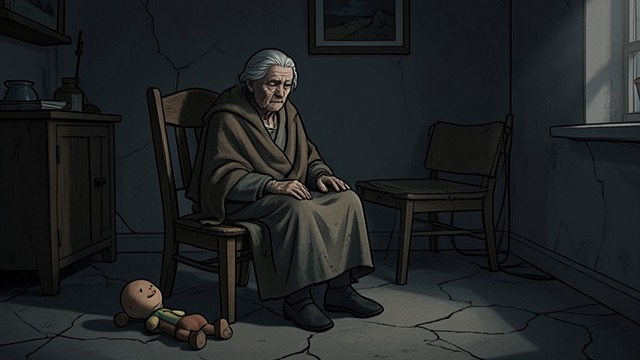
When Devorah visits near the end of her time in the community, she finds that Bubby has aged substantially. The vibrant grandmother of her childhood now moves slowly and seems more disoriented, while the once-familiar family home is deteriorating around her.
The visit unsettles Devorah because the people and place she had imagined as permanent are visibly changing. Her sense that she may leave is joined by grief for a childhood home and a grandmother she cannot restore to the strength she remembers.
A bond carried forward
Devorah does not describe Bubby as a figure who solves her predicament. Rather, Bubby’s influence persists in the safety she once provided and in the example of a woman whose intelligence and warmth survived within a restrictive life.
As Devorah prepares to leave, that relationship becomes part of what she carries rather than a reason to stay. Her later independence does not erase her attachment to Bubby; it makes the tenderness of their limited, imperfect connection more visible.
Before and during World War II, before Devorah’s childhood
During Devorah’s childhood in Williamsburg
During Devorah’s childhood and adolescence
After Devorah’s mother leaves, when Devorah is a young child
When Devorah returns to Williamsburg in March 2009
