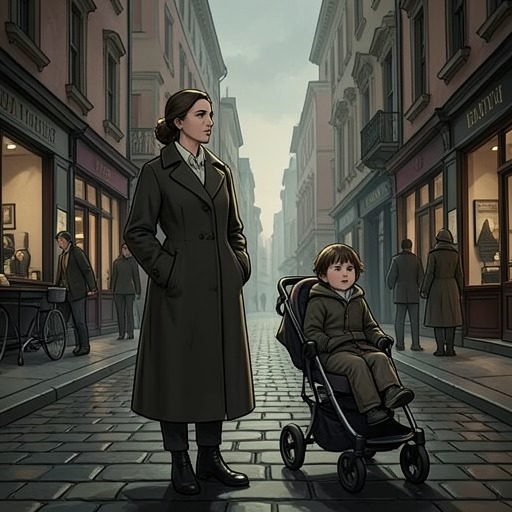
Birth of Yitzy
Unorthodox: The Scandalous Rejection of My Hasidic RootsYitzy’s birth turns a pregnancy already tied to Devorah’s hopes for a different future into a medical emergency and a bodily awakening. The delivery is not an uncomplicated arrival into motherhood: it leaves her startled by the intensity of labor, uncertain of her connection to the baby, and newly resolved to fight for change.
Background and Medical Decision
At a routine appointment, Dr. Patrick taps Devorah’s knee with a small metal hammer and sees her reflex jump. After measuring her blood pressure at 135 over 85, she decides it is time to deliver the baby. Devorah has been thinking about what might come after the birth: because women’s work in the Hasidic community is poorly paid, she has promised herself to pursue a degree that could lead to nursing or teaching and give her child a better life. Before she can begin researching how to persuade Eli to let her study, the decision is taken out of her hands by the need to go to hospital.
At St. Luke’s–Roosevelt Hospital, a doctor explains that the admission is for preeclampsia, which poses a danger to the baby. She describes it to Devorah as the body reacting to the baby as though it were a threat, and says labor will be induced because the pregnancy has progressed far enough. Medication will be given through the cervix while Devorah sleeps; Pitocin will follow in the morning, with an epidural available once contractions become painful. The explanation gives the delivery a clear medical cause and timetable, but Devorah remains a nineteen-year-old patient in a room where another woman assumes she is older and praises her for starting a family early. Devorah reads the remark as judgment rather than encouragement.
Labor and Delivery
Twenty-four hours later, Dr. Patrick wakes Devorah with the announcement that it is time. Eli cannot touch her under the rules governing contact with his wife during ritual impurity, so a male nurse holds one of her legs. The contrast unsettles Devorah: she wonders how the arrangement protects purity when a man she does not know is looking at her most private area, while her husband must remain apart. The scene makes the rules of bodily separation immediate, not abstract; even during labor, the regulation defines who may support her and how.
Then comes the physical force of the birth. Devorah feels an immense pull in her abdomen, as though her insides are being drawn out; the baby’s sudden passage leaves her stomach collapsing and knocks the breath from her. When Dr. Patrick asks whether she wants to see the baby or wait until he has been cleaned, Devorah chooses to wait. The glimpse of the wet, squirming newborn is more than she can bear at that moment. Eli is already beside the crib, looking between the doctors, while Devorah tries to hold on to the overwhelming sensation before it fades.
Meeting the Baby
The placenta is brought out and set on a table. Dr. Patrick asks Eli whether he wants it, explaining that some Jewish families bury it; Devorah shakes her head no when he looks to her. The Talmud calls the placenta the tree of life, both for the branching pattern on its surface and for its part in sustaining a child. To Devorah it looks repellent on the tray, and the couple does not take it home. Her response sets the immediate, physical aftermath of birth against the religious meaning attached to it: she is aware of the tradition, but does not want to carry this object with her.
The baby arrives wrapped in clean blue blankets, with tiny blond curls darkened by moisture and golden skin. Eli tears up; Devorah is calm. For the first hour she talks to the child about anything and everything, while his dark eyes remain fixed on her face. Yet conversation does not immediately produce recognition. She cannot quite connect the tiny person in her arms with the baby who had moved inside her, and feels as if he has been arbitrarily placed in her care. Months earlier she had giggled when limbs bumped against the walls of her uterus; now she wonders why she does not feel maternal love. She talks partly in the hope that words will persuade herself, the baby, and everyone around her that she is in love.
Aftermath and Narrative Significance
The delivery’s importance lies partly in the gap between what Devorah thinks motherhood should feel like and what she actually experiences. Her first response is not instant emotional certainty but bewilderment and distance. That uncertainty does not erase the physical bond of pregnancy; rather, she tries to make sense of how the body that held the baby can now seem separate from the stranger in her arms. The scene preserves that unsettled beginning instead of smoothing it into a conventional portrait of immediate maternal attachment.
The birth also becomes a decisive memory in Devorah’s account of her five-year marriage. She later wonders whether the moment when the baby left her body was the only time in those years she felt fully alive. As its force recedes, she recognizes it as a wake-up call that makes her begin fighting again. The immediate aftermath offers no simple emotional resolution: when a nurse notices that Devorah is not contracting properly, she massages her abdomen to start the process, kneading the loose flesh. Birth is therefore both an arrival and a demand placed on Devorah’s body, while its remembered intensity becomes part of her explanation for the changes that follow.
The account is presented as memoir, with an explicit note that names and identifying details have been changed and that some events have been compressed, consolidated, or reordered to protect people and preserve narrative continuity. The birth is thus recounted not only as a medical episode but as an experience whose significance Devorah understands more fully in retrospect: a physical shock, a difficult first encounter with her child, and a point from which renewed resistance becomes possible.