Devorah and Eli’s wedding
Unorthodox: The Scandalous Rejection of My Hasidic RootsDevorah and Eli’s wedding is both a communal rite of passage and a turning point in Devorah’s understanding of what marriage will demand of her. Its carefully ordered ceremonies make her a bride in the eyes of the community, while her private discomfort complicates the transformation: the wedding’s promise of a new life rests on a bodily and marital role she has only recently been made to confront.
From Discovery to the Wedding Day
Five days before the wedding, Devorah’s first immersion in the mikvah places her within the preparations expected of a bride. The ritual setting is private but institutionally supervised: she and Chaya travel without a male driver who might know why they are going, enter through a side alley, and are admitted through a metal door after ringing a bell. The attendant inspects Devorah before the immersion. Devorah tries to contain her distress, keeping her body tense and her expression controlled; afterward, she completes the prescribed immersions and blessings. The ceremony establishes the religious threshold she is expected to cross, but her response is not a simple embrace of its meaning.
That unease reaches further back. Before the wedding, Devorah has been sent to search for her mekor, a discovery that forces her to recognize that her body has a sexual purpose. She recalls having grown up in Williamsburg sheltered from subjects associated with sex and accustomed to thinking of people as spiritual beings carrying souls. The new awareness divides her sense of herself into a before and an after: she had been a girl, and now she is a girl with a mekor. In retrospect, she connects her resistance to this change with the unhappiness that followed and with the first strains that eventually tore the marriage apart. The wedding therefore begins under the shadow of an expectation that has become newly physical and difficult for her to accept.
Public Ceremony and Communal Roles
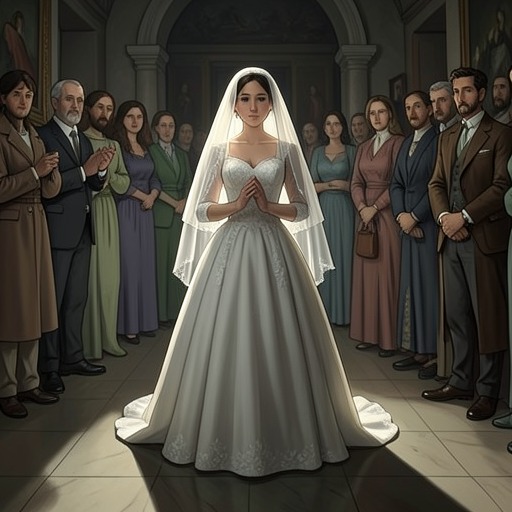
On the wedding morning, Devorah fasts, holds a book of psalms, and mouths prayers for people in need of guidance and salvation. Her appearance is transformed for the occasion by professional makeup, an unusual experience for her, while the wedding gown and its rhinestone-trimmed sash make her ceremonial role visible. The wedding hall is housed in the boys’ school on Bedford Avenue. Devorah sits on a white wicker bridal chair as Bubby arranges her skirt, and classmates returning from summer vacation and other guests approach to congratulate her. The gathering is also a public display: the young women are dressed to be seen by matchmakers, and Devorah maintains the welcoming smile expected of the bride.
Her family’s positions in the room reveal another dimension of the event. Bubby sits beside her, tearful but smiling. Devorah’s mother remains at a distance, looking disoriented while Chaya holds her arm. Chaya had promised that her mother would not be allowed to make a scene; in practice, this also means that mother and daughter do not approach one another. The wedding assembles a large community around Devorah, yet it does not erase the separation within her family.
The ceremony proceeds through distinct changes of status. Zeidy carries the cloth used in the badeken, after which Devorah cannot see until the chuppah ceremony is over. A blessing asks that she be fruitful and multiply. Eli, dressed in a new black satin coat and mink shtreimel, joins her beneath the canopy. Devorah is led in seven turns around him, then stands beside him while still veiled. When the marriage blessing is pronounced, Eli places a wedding band on her finger; the breaking glass signals the close of the ceremony, and they leave together for the yichud room. These actions make the marriage public and formal, even as Devorah experiences the day through restricted sight, prescribed movement, and closely observed custom.
Privacy, Dress, and the Wedding Celebration
The yichud room is designated as the couple’s first private, unsupervised space, though it is only symbolic: they do not lock the door, and the sheitelmacher enters to arrange Devorah’s wig and veil. Eli gives her diamond earrings selected by his mother. When he leans toward her, Devorah asks him to wait because someone could come in. The exchange captures the narrowness of their privacy: the newly married couple are alone in name, but the room remains subject to interruption and the rules of the occasion.
The sheitelmacher places Devorah’s hair beneath a white lace cap and secures the wig over it. Marriage thus changes not only Devorah’s public status but also the rules governing the visibility of her natural hair. Eli is taken away for photographs, and Devorah finishes the meal by herself, struggling to eat. The scene contrasts the abundance of wedding display—the gown, jewelry, veil, and wig—with her difficulty taking part in the meal and her attention to simply getting through the day.
The celebration continues late into the night. Guests take turns dancing with Devorah, lift her onto tables, and guide her through human tunnels; she keeps up a smile as the music continues. After most guests leave, the mitzvah tanz brings the extended family together. Devorah holds one end of a black gartel while relatives take turns holding the other, and a wedding poet praises family members in rhyming verses. The final dance with Eli is deliberately restrained: they stand two arm-lengths apart and touch only fingertips, maintaining modesty while the gesture signifies their marriage. Devorah keeps her head down, anticipating that they might laugh if they meet each other’s eyes. The formal close comes with relief at the music’s end and the departure of the guests.
Aftermath and Significance
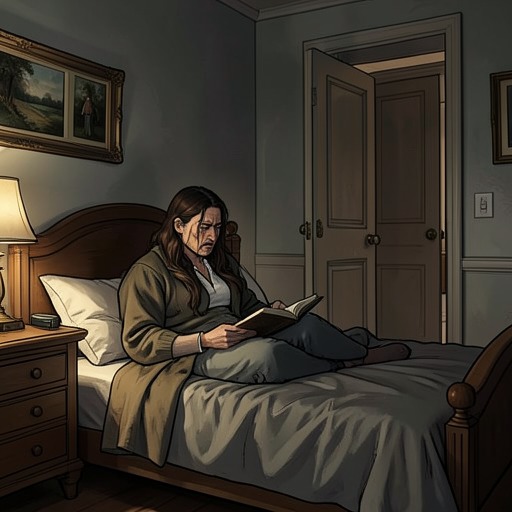
When Eli’s parents drive the couple home, the ceremonial image gives way to the practical effects of the day. As soon as the door closes, Devorah removes her shoes and begins taking off the elaborate dress, whose stiffness has made movement difficult. She washes the styling products from her hair and sees her reflection in the mirror, but turns away from it. The contrast between the public bridal presentation and this solitary, subdued return home marks the limits of the wedding’s promise: the ceremony has changed her status, but it has not resolved her discomfort with the role that status entails.
The transition continues after the marriage and, later, after the birth of Devorah and Eli’s son. Following two days of recovery, Eli drives Devorah to the new-mothers’ home in New Square, where she is to stay for two weeks. This later separation from her newborn is not part of the wedding ceremony, but it shows the continuing force of communal arrangements in her married life. Read alongside Devorah’s retrospective account of her bodily awakening, the wedding is not presented as a uncomplicated romantic culmination. Its rituals give the marriage a public and religious form; the private unease that precedes them remains unresolved, and Devorah identifies that conflict as an early source of the relationship’s eventual breakdown.