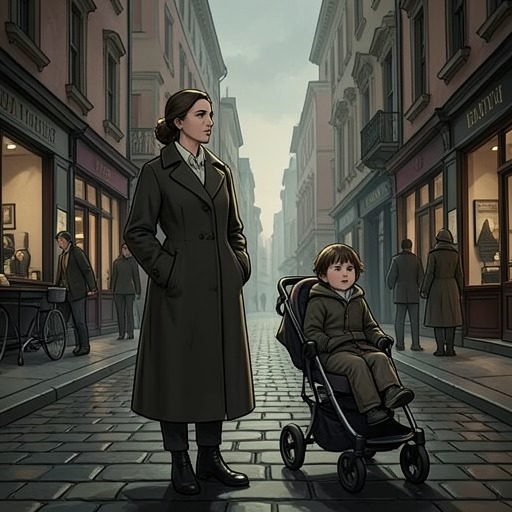
Move to Airmont
Unorthodox: The Scandalous Rejection of My Hasidic RootsThe move from Williamsburg to Airmont is a practical response to an approaching birth and a decisive attempt by Devorah to gain space and independence. The new home promises distance from cramped quarters, neighborhood scrutiny, and the sense that even married life in Williamsburg remains under communal observation; its rural setting gives her a different kind of freedom, though not an escape from every constraint.
Causes and Decision
Devorah decides she cannot raise a child in the couple’s Williamsburg apartment: it is too small for a crib or toys. Her wish for a backyard and trees is shaped by her own childhood in a private brownstone with a garden, a contrast she remembers against the housing projects where most of her friends lived. The coming baby makes the apartment’s limitations immediate, but the decision is also rooted in her exhaustion with a neighborhood where gossip and watching eyes make privacy feel impossible. Even a discreet outing with Eli, such as going bowling, risks attracting notice.
She sees that marriage has not delivered the freedom she had hoped for. In Williamsburg, she feels that a grown woman remains subject to the same scrutiny she experienced as a child. Eli, too, is uncomfortable with Brooklyn’s cramped conditions, having grown up where people were more spread out. Devorah turns these shared frustrations into a plan, repeatedly reminding him that his two-hour commute will take time away from the baby. She also points out that his brothers and sisters live upstate and that nothing obliges them to stay where they are. The move begins as her sustained effort to make change seem less like a risk and more like a practical choice for their family.
Finding a Home and Leaving
Eli consults his brother Aaron, who enthusiastically lists reasons to move and knows of an available apartment he can help them obtain at an excellent price. When Devorah and Eli visit it, she is not pleased with its condition. She accepts the compromise because she expects to find a better place later and is already glad at the prospect of leaving Williamsburg. The apartment’s shortcomings matter less, for the moment, than the change of setting it makes possible.
By the time Devorah tells Aunt Chaya, the boxes are already halfway packed, though she still feels she should formally notify her. Aunt Chaya responds with apparent approval, suggesting that moving to Monsey could be a good idea. Devorah hears some uncertainty in the response but also an openness she had not assumed. She expects that in Airmont, a small town just outside Monsey, she will be far from everyone’s attention and able, for the first time, to live independently.
The New Setting and Its Consequences
The couple’s new apartment is on the ground floor of a ranch-style house on a small dead-end street just off the New York State Thruway. The setting eases Devorah’s city-bound restlessness in an unexpected way: the nighttime traffic and constant chirping of crickets soothe her. She loves the country and cannot imagine returning to the city’s prying eyes and confining rooms. The move thus changes more than the family’s address; it gives her a daily experience of space that contrasts with the close surveillance she associates with Williamsburg.
The rural setting also changes the practical demands of daily life. Devorah walks along Route 59 to shop, but as her pregnancy advances she worries about whether she will be able to keep walking everywhere. Knowing that some women in Monsey drive, she decides to take driving lessons and persuades Eli that she could help on long road trips. She keeps her pregnancy from her instructor, Steve, because he makes derogatory remarks about Hasidic women as baby machines. To conceal her queasiness, she wakes early to get the vomiting over with before he arrives. The move brings greater physical and social distance from Williamsburg, but this episode shows how she still manages what others know about her, and how pregnancy remains a fact she must negotiate in ordinary encounters.