“We are the hoard!”
Vainqueur the Dragon“We are the hoard!” is the defining rallying cry of Victor Dalton’s improvised defense speech: a slogan that fuses Vainqueur Knightsbane’s gold, the lives of his followers, and the survival of the village into one threatened collective. Its decisive importance lies in that transformation. What begins as a desperate appeal built from borrowed cartoon rhetoric becomes a functioning instrument of solidarity, command, and power.
Origin in a Desperate Defense
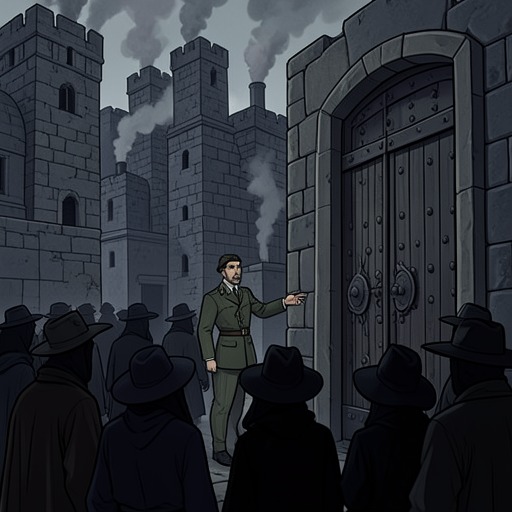
Victor Dalton adopts the expression during an emergency in which the defenders are isolated. Messenger pigeons have largely been shot down, no relieving army can be expected for hours, and the approaching force is much larger than the local defenders. Victor recognizes that the scouts are only the advance element and that a prolonged battle cannot be won. The practical objective is therefore delay: the defenders must hold until Vainqueur Knightsbane destroys the enemy’s flying fortress and throws the invading army into disorder.
This situation gives the phrase its immediate pressure. Victor cannot offer certainty of victory, reinforcements, or a favorable calculation of strength. Instead, he reframes the stakes. The invaders threaten not only Vainqueur Knightsbane’s wealth but also the defenders’ lives, sheep, and coins. By placing material possessions and living beings in the same account, Victor speaks in the language of the hoard while making the hoard include the people who protect it.
From Vainqueur Knightsbane’s Hoard to a Collective
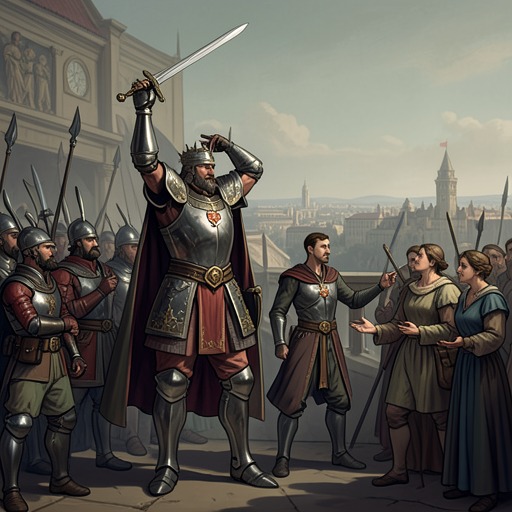
Victor’s speech presents the Emperor’s hoard as more than gold. He tells the minions that it is also them, then asks whether they will flee in humiliation or send the attackers back to nowhere. He invokes the earlier War of the Hoard as proof that the same opponents have already been defeated. The expression “We are the hoard!” consequently performs several acts at once: it names the community, defines its common interest, and declares that defending Vainqueur Knightsbane’s property is inseparable from defending the defenders themselves.
The wording also marks a shift in ownership. Vainqueur Knightsbane’s hoard is initially associated with his private accumulation and imperial authority, but Victor’s plural pronoun turns that possession into a collective identity. The minions are no longer merely expendable servants standing before an enemy; rhetorically, they are the treasure. Their survival becomes the material form of the hoard’s survival, while their resistance becomes an act of self-preservation rather than simple obedience.
Improvisation and Immediate Effect
Victor’s oratory is knowingly improvised. The narration identifies it as desperate material based on cartoon speeches he watched on Earth, not as a carefully prepared doctrine. Yet the speech succeeds precisely because it supplies emotional clarity where military certainty is unavailable. The minions answer him by repeating “We are the hoard!”, and the cry spreads through the defenders as a shared declaration rather than remaining Victor’s personal line.
Other responses reveal the slogan’s comic elasticity without weakening its practical effect. Yellow the Kobone adds that the enemy will meet their “dooooooom,” while Malfy contributes a battle cry for his local monopoly. Allison and Charlene, described as among the sanest citizens, offer only tentative support, emphasizing the absurdity of the scene even as the larger group embraces it. The phrase can therefore contain imperial loyalty, economic self-interest, melodrama, and reluctant civic participation at the same time.
Victor closes the sequence by ordering the defenders to follow his command and fight “For the hoard!” This shorter variant functions as the operational form of the larger identity statement. “We are the hoard!” says what the group is; “For the hoard!” tells it what to do. The two expressions convert belonging into obedience and obedience into coordinated resistance.
The Slogan as a System-Enabled Command
The speech produces a literal game-mechanical consequence. Once the minions answer Victor’s declaration, the Rally Minion skill activates and raises all minions’ stats by one stage. The phrase is therefore not merely inspirational language or comic propaganda. Within the Class System, successful leadership and collective morale can become measurable combat strength. Victor’s speech changes the defenders’ emotional condition, their willingness to act, and their statistical capacity in the same sequence.
The resulting power is followed by selective promotion. Victor identifies ten gnolls and every member of the Kobold Rangers except Red as eligible for evolution, touches them, and announces that they are receiving a pay raise. The reward language extends the hoard’s economic logic into personnel management: advancement is presented as compensation, while transformation visibly enlarges the fighting force. The newly evolved gnolls become three-meter-tall, monstrous, emaciated humanoids with skull-like faces, ashen skin, and red eyes burning with bestial fury. Thus the cry leads directly into an altered military formation, linking rhetoric, hierarchy, payment, and bodily change.
Broader Meaning in the Class System
The expression belongs to a world in which identity is repeatedly formalized through levels, classes, perks, and thresholds. Vainqueur Knightsbane gains a level in the Noble class through his ego and dragon bloodline, while Victor Dalton gains the Monster Squire class by becoming the chief enforcer of a mighty dragon. Later, fearless leadership against superior opponents grants Victor seven Monster Squire levels and the Monster Lifeforce (Red Dragon), Monster Rider, and Monster Insight perks. These rewards make the slogan’s leadership function part of a continuing system in which conduct creates status and status creates further power.
That system also imposes limits. Victor eventually reaches the level-30 class ceiling and can gain no additional levels until using a Crest; experience gains fall to zero, although special deeds can still grant perks. Against that background, “We are the hoard!” illustrates the importance of deeds that exceed ordinary advancement. The cry does not simply express loyalty to a dragon. It demonstrates that command, courage, and collective mobilization can generate consequences even within a rule-bound progression system.
The expression also contrasts with disbelief about the Class System itself. Icefang rejects the idea of a system that grants power and money, demanding that it appear before him. When the invisible text seemingly does appear, his rant stops and the surrounding characters fall silent while Vainqueur Knightsbane smirks. The phrase’s effectiveness likewise depends on a system that many characters do not fully understand: its meaning is social and rhetorical, but its final confirmation is mechanical. The story repeatedly places grand declarations beside notifications, stat increases, and class ceilings, making the battle cry both parody and executable rule.