Adventurer Guild
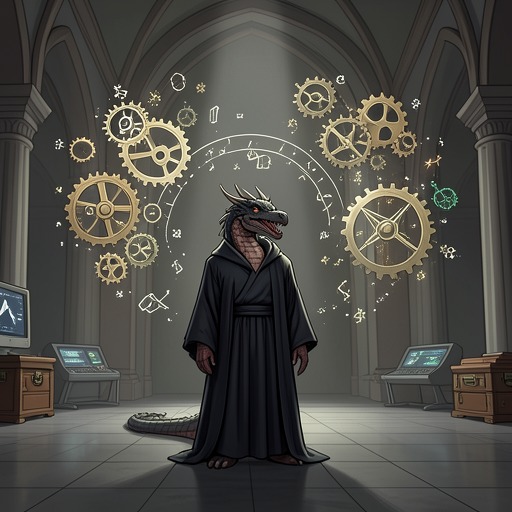
Vainqueur the DragonThe Adventurer Guild is the recognized institutional gateway through which adventurers receive legitimacy, pursue quests, and claim the associated rewards. Its decisive importance lies in the way it is compelled to expand beyond its human-centered assumptions: what begins as an organization serving conventional adventurers becomes a vehicle for recognizing Vainqueur Knightsbane’s monster empire, protecting V&V, and inaugurating an era in which dragons and other monsters can operate as adventurers without abandoning their own political identity.
Nature and Administrative Function
The Guild’s practical world is defined by quests, fees, rewards, contracts, and the classification of those who undertake dangerous work. Its reach extends into commercial activity as well as combat. When Vainqueur orders Victor Dalton to sell monster parts, waste meat, and corpses rather than give them away, the proposed shop is presented as an enterprise built around the same adventuring economy of monsters, loot, and usable remains. The Guild therefore forms part of a wider system in which violence produces resources and those resources can be converted into money, status, or political leverage.
That system is also shaped by the Class System. Vainqueur gains a level in the Noble class through his ego and dragon bloodline, while Victor gains the Monster Squire class after becoming the chief enforcer of a mighty dragon. Later, Victor earns seven additional Monster Squire levels for leading monsters against superior opponents, together with the Monster Lifeforce (Red Dragon), Monster Rider, and Monster Insight Perks. These developments show how adventuring is not merely a profession administered by the Guild; it is connected to a rule structure that translates service, leadership, and victory into measurable advancement. The level-30 class ceiling, however, demonstrates that advancement is not unlimited: further progress requires a Crest, while experience gains become zero even though special deeds can still grant Perks.
Expansion into Monster Society
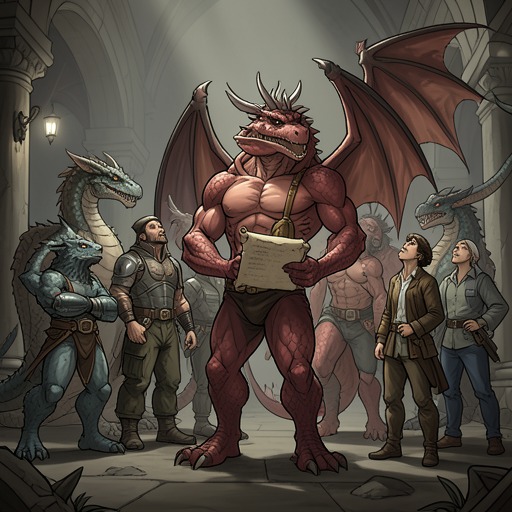
The Guild’s human-centered limits are repeatedly challenged by Vainqueur’s organization. During the recruitment for war against Furibon, Victor Dalton reports one hundred kobold applicants, along with a troll, a dryad, and a golem whose class levels exceed twenty. Vainqueur insists that he does not discriminate among creatures, although his declaration that every creature remains equally inferior to him turns institutional inclusion into one of his characteristic exercises in dragon arrogance. The scene nevertheless establishes a new recruitment model: monsters are not simply targets, obstacles, or emergency food, but applicants with classes, levels, abilities, and a place in an organized campaign.
The War of the Hoard gives this transformation a formal military and narrative shape. Furibon appears as the enemy who possesses something belonging to Vainqueur’s master, and the conflict is framed as a war whose closing principle is that Furibon must die. The Guild’s adventuring logic is thus absorbed into a larger struggle over treasure, loyalty, and territorial authority. Monster adventuring is no longer an eccentric individual pursuit; it becomes a collective enterprise involving recruitment, command, equipment, and a stated political cause.
Legal Recognition and Political Bargaining
The Guild’s most consequential transformation occurs through negotiation with King Roland Gardemagne. Vainqueur refuses to pay taxes, guild fees, or any other charge on the treasure he claims to have earned through quests. The King immediately accepts a permanent exemption for V&V, declaring that the company will be free from all fees normally applied to adventurer companies. When Charlene objects that the local chapter still needs funding, the King answers that the Kingdom will support it, linking the Guild’s local survival to Gardemagne’s diplomatic relationship with the new Ishfanian government.
The same negotiation turns Vainqueur’s adventuring power into state legitimacy. With Ishfania’s army destroyed and Maure dead, the territory is vulnerable to competing claims from the Eversun Empire, Barin, or Prydain. King Roland therefore proposes a treaty under which Gardemagne recognizes Vainqueur’s claim as Emperor of Ishfania and treats it as an official adventurer state. Vainqueur retains the benefits of the Adventurer Guild while ruling the territory as he wishes, and in return promises that the two countries will never take arms against each other and will unite against outside threats. The Guild becomes more than a professional association: it supplies the institutional bridge by which conquest can be translated into recognized sovereignty.
Vainqueur’s acceptance is motivated partly by class security. He realizes that recognition will preserve his Emperor class, and interprets the treaty as tribute rather than as a reciprocal political obligation. This mismatch between the King’s diplomatic calculation and the dragon’s acquisitive interpretation captures the Guild’s unusual position. It can regularize power, but it cannot fully control the meanings its members assign to law, reward, sovereignty, or obligation.
Dragons and the Adventurer Company System
The decisive institutional precedent is established when Icefang challenges the existence of the Class System. He argues that a system granting power and money cannot be real, but reacts visibly when it appears before him. Nostredame explains that awareness of the system and the stat requirements for beginner classes are sufficient to take the first level. Once the system’s accessibility is demonstrated, dragon adventuring becomes reproducible rather than unique to Vainqueur.
The political consequence follows immediately. King Roland orders Charlene to accommodate the dragons if they wish to create their own adventurer companies under Gardemagne’s auspices. The Guild is instructed to oblige, on the grounds that the world contains enough would-be Maures and unclaimed rewards, and that dragons willing to deal with such threats are useful allies. The order carries one explicit boundary: dragons may not eat quest givers. This condition reveals the Guild’s method of institutional adaptation. It does not demand that monsters become human; it creates a narrow behavioral rule that allows radically different beings to enter the same administrative framework.
Vainqueur interprets the development as the beginning of a new era of dragon adventuring, crediting himself with inspiring it just as Grandrake supposedly invented princess hunting. The claim is boastful, but the institutional change is real. Through the Guild, dragon identity, class progression, military service, and territorial rule can coexist within an officially recognized adventurer structure.
Commercial and Civic Consequences
The Guild’s expansion is accompanied by a broader monster economy. Nethermart, the first fiendish magic-item shop in Outremonde, opens in a six-floor ivory-draped building in northern Murmurin. The shop sells weapons to monsters and mortals, permits customers who cannot pay in coins to place their souls as collateral, and offers a thirty-percent weapons sale to celebrate the coming war with Maure. Although Nethermart is not itself the Guild, its business model reflects the same institutional environment: adventuring creates demand for equipment, war produces customers, and monster society develops commercial forms that serve both combatants and civilians.
The Guild also exists amid Vainqueur’s private systems of command and reward. He loans Victor Dalton wearable treasure because he wants to keep his chief of staff safe and healthy, pays him eight gold coins after a corpse sale while deliberately redefining the promised tenth as one one-tenth, and assigns him paperwork, class planning, and the training of kobolds. These exchanges show how official adventuring structures intersect with dragon lordship. The Guild offers formal recognition, but daily operations still depend on personal hierarchy, improvised contracts, and Vainqueur’s possessive understanding of labor and treasure.
Institutional Significance
The Adventurer Guild represents the book’s most flexible form of legitimacy. It begins from a conventional economy of quests and fees, yet survives by absorbing beings its original categories cannot comfortably contain: kobolds, trolls, dryads, golems, dragons, and an emperor whose company receives a permanent fee exemption. Its rules do not erase the differences between humans and monsters; instead, they make those differences administratively negotiable.
The Guild’s significance is therefore double-edged. It restrains monster adventurers through requirements such as the prohibition against eating quest givers, but it also grants them access to rewards, companies, political protection, and state recognition. By the end of the relevant arc, the organization has become a platform for institutional innovation. Vainqueur’s boast that he has inspired dragon adventuring is comic because he frames a structural transformation as personal glory, yet the Guild’s willingness to recognize dragon companies confirms the underlying historical shift: adventuring is no longer exclusively human territory.