Apotheosis
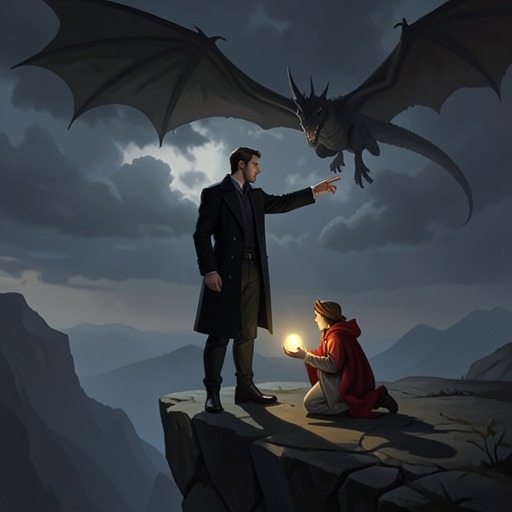
Vainqueur the DragonApotheosis is the terminal transformation promised by the Class System, in which a being reaches the highest levels of development, becomes a god, and attempts to pass beyond ordinary life. It gives the book’s leveling mechanics their ultimate horizon: power is not merely accumulated for survival, wealth, or combat, but can culminate in literal divinity. At the same time, the system makes that promise brutally restrictive, placing ceilings, rare breakthrough items, and a final ordeal between ambition and godhood.
Definition and Progression
Apotheosis becomes available only after the combined level of a person’s classes reaches 100. Victor Dalton explains that multiple classes may be pursued, but all of them together remain subject to a total level cap of 100; at that point, the individual advances into the God class and becomes a true deity, though further growth is no longer possible. The system therefore treats godhood as both a reward and a terminal condition: it is the highest advancement, but also the end of ordinary leveling.
The route toward that destination is difficult even before the final trial. As total level rises, acquiring additional levels becomes progressively harder, regardless of how accessible a particular class’s entry requirements may be. Greater advancement requires greater challenges, so Apotheosis is tied not simply to time or repetition but to escalating deeds and dangers. Vainqueur Knightsbane responds to this information with characteristic grandiosity, declaring that he will reach level 100 while expecting Victor Dalton to reach level 99, turning a cosmic possibility into a personal boast and a shared objective.
The Level Ceiling and Valhalla
The progression system imposes an earlier barrier at level 30. When Vainqueur Knightsbane reaches that ceiling, the system stops granting additional experience and sets experience gains to zero. Special deeds can still produce perks, but ordinary advancement cannot continue until the character uses a Crest. A Crest breaks the level 30 ceiling, while a Heroic Crest is required for the later level 60 ceiling. These objects are powerful and rare, making the path to Apotheosis dependent on scarce external means as well as personal achievement.
Once the relevant ceilings have been broken, advancement can continue to level 99. That level opens access to Valhalla, described as the final challenge and the stage at which Apotheosis may be attempted. The distinction matters: reaching the numerical threshold does not itself guarantee godhood. Valhalla is a proving ground beyond routine leveling, and its survivors are measured by whether they can endure the ultimate test rather than merely accumulate statistics.
Only twelve creatures are said to have survived Valhalla and emerged as the deities of Outremonde. This small number gives Apotheosis a sharply selective character. Divine status is not a common promotion available to every successful adventurer; it is the outcome of an ordeal that has eliminated almost everyone who attempted it. The system’s promise of universal progression thus ends in an exceptionally narrow passage, where the language of levels gives way to survival, transformation, and mythic selection.
The System as a Machine of Identity
The early operation of the Class System shows how Apotheosis is prepared long before the final threshold. Vainqueur Knightsbane gains a level in the Noble class through his ego and dragon bloodline, while Victor Dalton gains a level in Monster Squire after becoming the chief enforcer of a powerful dragon. Later, Victor earns seven additional Monster Squire levels for leading monsters to victory against superior opponents, along with the Monster Lifeforce (Red Dragon), Monster Rider, and Monster Insight perks. The system converts behavior, status, loyalty, and battlefield success into formal changes of identity.
This mechanism makes godhood the culmination of a broader process in which the characters are continually reclassified. Their roles are not fixed descriptions but executable categories that produce statistics, perks, authority, and new possibilities. The system can even be invoked by challenge: when Icefang demands that it appear before him, the invisible interface manifests, confirming that awareness of the system and the required beginner-class statistics are sufficient to begin participation. Apotheosis therefore belongs to a world where identity can be quantified, unlocked, and publicly contested through visible advancement.
The rules also expose an ironic tension between achievement and self-image. Vainqueur Knightsbane treats levels as proof of superiority and expects the system to validate his view of himself as the apex of creation. Yet the system rewards a variety of actions, including service, command, and dealings with monsters, rather than dragon pride alone. Apotheosis consequently promises to elevate characters beyond their former categories while preserving the comic gap between what they believe they deserve and what the system actually recognizes.
Debts, Rewards, and Divine Economics
The prospect of godhood is embedded in the book’s economy of favors and obligations. Vainqueur Knightsbane lends Victor Dalton equipment because the dragon cannot wear it himself and wants to keep his reliable minion safe, but the loan is framed as extravagant generosity rather than an unconditional gift. Victor’s service likewise produces advancement: his promotion to chief of staff and living signature accompanies a Monster Squire level, and his leadership later earns seven more levels and several perks.
The same logic extends to death and resurrection. After Victor Dalton’s revival on Outremonde, the goddess Miel explains that mortals paid a generous church donation for the service. The payment enables his return, but it does not erase the structure of debt surrounding his relationship with Vainqueur Knightsbane. Vainqueur calculates that Victor owes twelve million, five hundred forty-five thousand, one hundred thirty-three gold coins, in addition to the life debt associated with raising him as his chief of staff. Even the promise of becoming gods is therefore expressed through accounts, reimbursement, and labor.
This economic framing makes Apotheosis both grand and satirical. Divine ascent sounds like the release of the soul from material limitation, yet the characters approach it through contracts, equipment loans, fees, and accumulated obligations. The system’s highest reward does not abolish worldly calculation; it magnifies the book’s recurring contrast between cosmic stakes and intensely practical concerns about hoards, payment, and ownership.
Narrative Significance
Apotheosis functions as the farthest goal in the book’s adventure-and-leveling structure, combining an ascension plot with the procedural logic of the Class System. Every new class, perk, combat victory, and breakthrough contributes to a visible ladder whose top is already named. Because the rules specify the total level, the intermediate ceilings, the required Crests, and the twelve survivors of Valhalla, godhood is not an undefined fantasy but a structured possibility with measurable conditions and a known history of extreme failure.
The concept also preserves uncertainty. The system explains what must be reached and identifies Valhalla as the final challenge, but the evidence does not make Apotheosis routine or secure for any particular character. Vainqueur Knightsbane’s boast establishes aspiration, not fulfillment. The distance between his confident declaration and the rarity of surviving Valhalla supplies the concept’s central dramatic tension: the characters can speak of godhood as if it were the next item on a plan, while the world’s rules mark it as an almost impossibly selective transformation.