Battle of Castle Murmurin
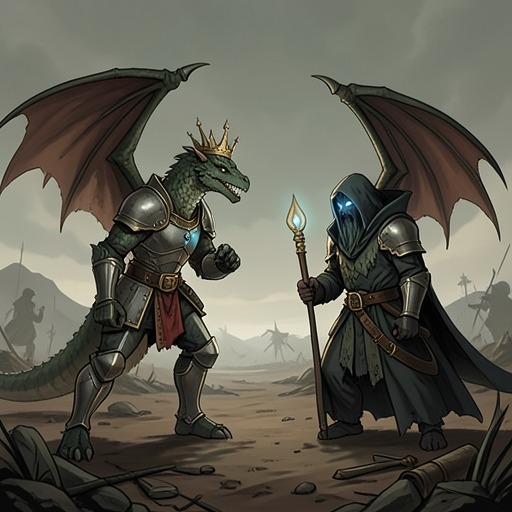
Vainqueur the DragonThe Battle of Castle Murmurin, also known as Furibon’s Defeat or the Siege of Castle Murmurin, is the confrontation that turns Vainqueur Knightsbane’s campaign against Furibon from a raid into a conquest. Vainqueur does not merely defeat the lich’s defenders: he tears through the castle’s architecture, resists an attempt to control him, survives a battle with Furibon’s greatest undead creation, and uses Victor Dalton’s knowledge of phylacteries to prevent the lich from escaping in any immediate form. The battle ends with Furibon’s soul imprisoned in the Killer Scythe and Castle Murmurin claimed as Vainqueur’s dungeon, making victory simultaneously martial, personal, territorial, and mechanical within the Class System.
Causes and Background
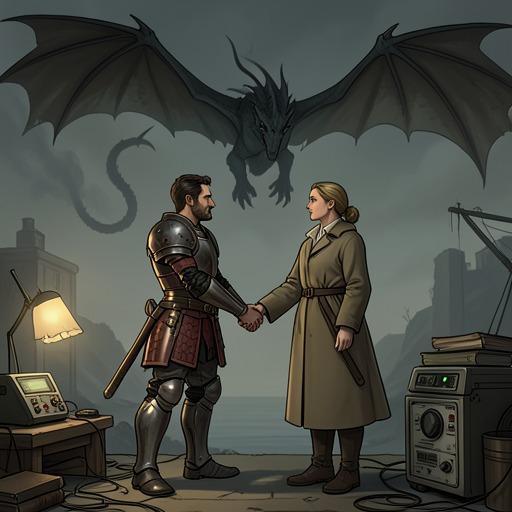
Vainqueur’s objective is inseparable from the castle itself. Furibon has made Castle Murmurin his stronghold, and Victor Dalton—the dragon’s chief of staff and living signature—is being held inside it. The assault therefore combines rescue with revenge and acquisition. Vainqueur’s language frames the outcome in terms of wealth: after Furibon is sealed, he declares that the lich’s evil will no longer “befoul my wealth.” The phrase reveals the dragon’s characteristic ability to translate even a life-or-death confrontation into the language of property and hoard protection.
The attack begins with a direct magical breach. Vainqueur activates [Spell Purge], causing the magical barrier around Castle Murmurin to blink out of existence. He then crash-lands on the statues guarding the approach, destroys them, throws the fiends defending the entrance into the lava, and releases two werewolf minions before ordering Croissant to trigger the traps. The command that Croissant should die if necessary exposes the hierarchy governing the assault: Vainqueur treats expendable minions as tools, while the minions’ protest gives the siege its comic resistance without reducing its danger.
Breach and Confrontation
When the entrance proves inconvenient, Vainqueur adopts what the narrative calls the dragon way. He turns invisible, charges through the wall, and continues through successive barriers, collapsing portions of the ceiling and stamping on fiends and skeletal warriors. His advance is not a technical infiltration but a redesign of the castle by force. The walls, floors, defenders, and future architecture all become part of the same act of possession.
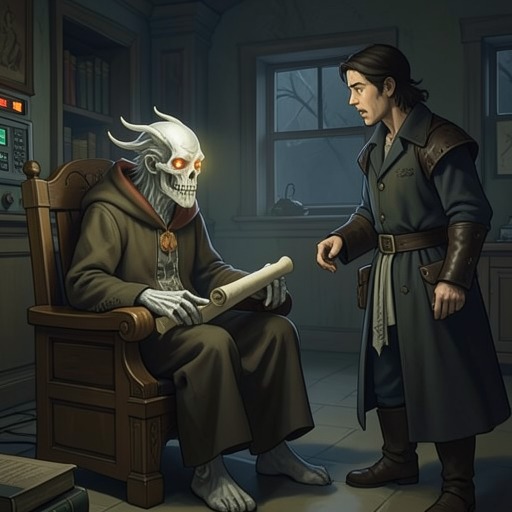
The charge ends in a large, dark throne room illuminated by ghostly candelabras. Six steel statues stand beside ancient, ruined tapestries, while Victor hangs in chains from a ceiling that is barely holding together. Victor’s relief at the sight of the collapsing wall establishes the rescue’s immediate value: the destruction that endangers the castle is also the destruction that brings his master to him. Opposite them, Furibon waits on his throne as Vainqueur’s personal and ideological enemy, presented as a lich whose bitterness is directed against the rich and wealthy.
Furibon attempts to control the terms of the encounter by unveiling the Black Beast of Murmurin, an undead hound-shaped abomination formed from white fossilized flesh stitched together and armored in black stone. The creature is smaller than Vainqueur but large enough to challenge him, with an eyeless mouth filled with venomous teeth. Furibon orders Vainqueur and the monster to fight for his entertainment, converting the rescue scene into a spectacle controlled by the captor.
That control fails when Furibon tries to enthrall Vainqueur and use him to trigger the beast’s rage. The [Enthrall] ailment is negated by [Hunter’s Resolve], and Vainqueur’s will proves stronger than the lich’s spell. Instead of obeying, he circles the undead creature and approaches Furibon for a surprise attack, insisting that he has trained for three days. The moment is both tactical and comic: Vainqueur’s preparation is absurdly brief by ordinary heroic standards, yet the Class System and his dragon’s confidence make it meaningful.
Reversal of the Battle
Furibon’s frustration becomes a weapon against him. Vainqueur’s taunt successfully applies the [Berserk] status, leaving the lich too angry to cast spells. While Furibon is distracted, Vainqueur unleashes a great fireball with a defiant “Surprise attack!” The projectile destroys the throne and most of the wall behind it, incinerates Furibon’s robes, and blasts his bones apart, sending his torso into one of the steel statues. The system marks the [Witch Burning] Perk as super-effective, translating the personal clash into a confirmed mechanical advantage.
The attack does not immediately end the battle. Furibon’s mastery of magic allows him to evade Vainqueur’s attempts to trample and bite him, and the dragon’s growing fury makes the confrontation resemble a humiliating game of pursuit. Furibon boasts that brute strength cannot match his magic, his command of time, and his triumph over death. The boast is interrupted by the creature he created: the Black Beast of Murmurin catches Furibon from behind in its jaws.
Victor Dalton and Chocolatine have turned the lich’s own monster against him. Victor rides on the abomination’s back while Chocolatine accompanies him, and Victor addresses the creature like a trained dog, rewarding it verbally and directing it to throw Furibon toward its new ally. The grotesque spectacle reverses the hierarchy of the throne room. The creator becomes prey, the supposed entertainment becomes an act of ridicule, and Victor—recently the chained damsel in distress—becomes an active participant in the defeat.
Phylactery and Sealing
Furibon’s physical destruction cannot by itself guarantee final defeat. He explains that his soul returns to a phylactery when his body is destroyed, allowing him to create another body. He has already moved the phylactery to a hidden crypt on another continent, so he expects to return and kill the attackers through repeated spellcasting. This revelation changes the stakes from defeating a body to controlling the mechanism of resurrection.
Victor Dalton identifies the weakness in Furibon’s claim to immortality. If the lich’s current body were merely an animated puppet, Furibon could abandon it immediately; his continued presence implies that his soul inhabits the body being attacked. Victor therefore tests whether the Killer Scythe can capture the soul before it reaches the phylactery. After using [Enhanced Teleportation] and [Teleportation], he swings the blade and cuts off Furibon’s skeletal head.
The result is immediate. Furibon’s bones crumble, a specter of black energy escapes, and a dark force drags the fleeing spirit back into the scythe. The blade then reflects Furibon’s screaming face inside it. Victor confirms that the lich is sealed, while acknowledging that the soul might return to its phylactery if the scythe itself were destroyed. The victory is therefore decisive but not metaphysically absolute: Furibon’s immediate agency is removed, yet the weapon remains the condition preserving the seal.
Consequences and Significance
The battle’s territorial consequence follows directly from the sealing. Vainqueur claims Castle Murmurin as his dungeon, converting the former enemy stronghold into an extension of his own hoard and authority. The Class System rewards this act with a level in the ultra-prestigious [Kaiser] class, adding thirty HP and SP and one point each to strength, vitality, skill, agility, intelligence, charisma, and luck. The system thus treats conquest not merely as survival but as a change in status and jurisdiction.
The battle also completes a progression that began with the discovery of the Class System. Vainqueur first gains a level in the [Noble] class through sheer ego and noble dragon bloodline. Victor gains a level in [Monster Squire] after becoming the chief enforcer of a mighty dragon, receiving broad statistical increases. Later, for fearlessly leading monsters against superior opponents, Victor earns seven additional [Monster Squire] levels and the [Monster Lifeforce (Red Dragon)], [Monster Rider], and [Monster Insight] Perks. These earlier rewards explain why the castle assault is more than a conventional military encounter: the Class System repeatedly converts identity, service, leadership, and victory into tangible power.
The captured soul further upgrades the weapon. By consuming the soul of a powerful lich, the Killer Scythe becomes a Killer Scythe+, gaining a twenty-five percent chance of inflicting critical hits. The consequence binds Furibon’s defeat to Victor’s equipment and makes the lich’s attempted immortality serve the victors’ growth. Yet the system immediately imposes a limit: Vainqueur has reached the level 30 class ceiling and can gain no additional levels until he uses a Crest. Experience gains fall to zero, although special deeds can still provide Perks. The battle therefore produces a paradoxical reward—an enormous advance followed by a hard ceiling.
The later reaction of Icefang confirms the wider importance of the event’s system logic. Icefang rejects the idea of a system that grants power and money, while Nostredame explains that awareness of the system and the stat criteria for beginner classes are the only initial requirements. When Icefang demands that the system appear before him, he stops as though reading invisible text, and the surrounding characters fall silent while Vainqueur smirks. The Castle Murmurin battle consequently stands as an example of the book’s game-like rule structure: ego, service, leadership, conquest, and soul capture are all made legible as class advancement, perks, possessions, and restrictions. Its decisive irony is that Vainqueur wins by behaving exactly like the dragon he believes himself to be—destroying a fortress, claiming its wealth, and turning an enemy’s supposedly immortal soul into an upgrade—while Victor supplies the tactical intelligence that makes the victory permanent enough to matter.