Blue Ranger
Vainqueur the DragonBlue Ranger is the blue member of the Kobold Rangers and one of Victor Dalton’s most durable monster companions. Introduced among five small, lizard-like kobolds who have different colored scales, Blue begins as part of a rainbow-coded group of scavengers beneath an inn. His importance grows through repeated death, resurrection, and evolution: he is cut down by Gustave La Muraille, restored by Victor Dalton as a skeleton, and eventually transformed into a Koblood. Across these changes, Blue remains recognizably himself, combining loyalty to his chief with a mischievous sense of humor and an eagerness to defend the group’s hoard.
Identity and Introduction
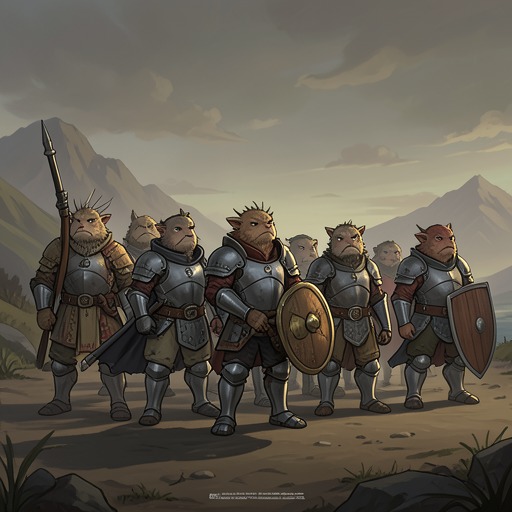
Blue Ranger first appears with Red Ranger, Yellow Ranger, Black Ranger, and Pink Ranger in the basement of an inn. The five are small, lizard-like humanoids, roughly the size and intelligence of human children, with sharp claws, short horns, long tails, and differently colored scales. Their rainbow arrangement gives them an immediately legible group identity, but Blue is not merely a color in a formation: he becomes one of the Rangers’ most active fighters and one of the clearest witnesses to their transformation from vulnerable kobolds into organized minions.
The Rangers had dug a tunnel from the countryside into the basement to steal food. Their circumstances place them at the bottom of the local power structure, yet their later conduct shows that they possess a shared culture centered on service to Vainqueur Knightsbane. They sell goods to enlarge Vainqueur Knightsbane’s hoard because they believe that entering the hoard means becoming part of it forever. Blue’s loyalty is therefore both practical and devotional: treasure is food, wealth, identity, and a promise of continued belonging.
Death and Undead Return
Blue’s first major ordeal comes during the confrontation with Gustave La Muraille. When Gustave attacks Victor Dalton, Blue attempts to defend his chief, but the knight cuts him in half. Gustave then strikes down Red Ranger as well and overpowers the remaining Rangers within seconds. Blue’s death establishes the violence of the world surrounding the group and makes the Rangers’ loyalty costly rather than decorative. He does not merely accompany Victor Dalton; he places himself between Victor Dalton and a superior opponent and pays for that decision with his life.
Victor Dalton later uses the Animate Dead perk to restore Blue and Yellow Ranger. The revival requires valuable sacrifices: Victor Dalton gives up his sun bracers, which are consumed in an unholy purple glow. The magic binds the broken remains together, consumes the flesh, and raises two skeletons whose bones retain their color identity. Blue rises with deep-blue bones and glowing eye sockets, while Yellow Ranger becomes a golden-boned counterpart. Their resurrection preserves the original souls and class levels, making the scene a literal continuation of their former lives rather than a replacement by mindless undead.
Blue initially tests the emotional and comic possibilities of his new body by uttering a cavernous threat about flesh, then revealing that he is joking. He remarks that he is still the same old Blue, only now able to see his clavicle. The joke matters because it marks continuity through bodily rupture: the skeleton’s altered voice and visible anatomy create horror, but Blue immediately converts that horror into performance. His undead state becomes another way to participate in the Rangers’ shared playfulness.
Combat Role and Evolution
Blue’s revived form remains combat-capable. At a later stage, Victor Dalton evolves him and Yellow Ranger from skeletal kobolds into Kobloods. Blue’s bones become deep blue, and a black beating heart appears in his chest, while Yellow Ranger receives the corresponding golden transformation. The evolution gives physical form to the group’s color system while also demonstrating how the Class System turns service, survival, and combat into advancement. Blue’s progression is not a clean escape from danger; it is a game-like escalation in which death itself becomes part of the route toward a stronger minion body.
Blue’s conduct during the Black Rabbit’s attack shows the difference between comic undead identity and genuine battlefield courage. The Kobold Rangers establish a defensive perimeter around Rolo’s carrot and lettuce fields. Blue and Black Ranger carry spears, while Yellow Ranger and Pink Ranger use bows and Red Ranger stands at the front with a musket and rapier. When the legendary Black Rabbit impales Yellow Ranger and threatens the vegetables, Blue charges with Red Ranger, weapons raised. The creature easily kicks Blue aside, but Red Ranger manages to wound it and keep it from advancing. Blue’s attack does not defeat the beast by itself, yet it contributes to the formation’s resistance and confirms that he remains a front-line defender even after repeated bodily changes.
After the battle, Blue recovers while Black Ranger remains paralyzed by lightning and Yellow Ranger struggles to reassemble his bones. Red Ranger orders Blue to help his living comrade, and Blue immediately rushes to Yellow Ranger’s side. The command reveals the Rangers’ internal discipline: Blue is not only a combatant but also a responder within a chain of command. Their victory is measured by the survival of Rolo’s vegetables and the preservation of the Bragging Day Feast, so Blue’s assistance helps convert a chaotic fight into a collective success.
Relationships and Group Loyalty
Blue’s closest relationship is with the other Kobold Rangers, especially Red Ranger as their leader and Yellow Ranger as his undead counterpart. Red Ranger’s authority is strong enough to stop the Rangers’ teasing and redirect them toward their duties. When Blue and the others mock Pink Ranger’s unfinished fan fiction, Red Ranger enters carrying the musket and rapier supplied by Victor Dalton and tells them to stop bullying Pink Ranger. Blue’s participation in the group’s joking culture does not override its hierarchy; the Rangers can tease one another, but Red Ranger’s intervention restores order.
His relationship with Victor Dalton is defined by service, dependence, and reciprocal investment. Victor Dalton revives Blue at considerable personal cost and later grants him a stronger form, while Blue repeatedly risks himself to defend Victor Dalton and the Rangers’ shared interests. The Monster Squire class and its associated progression frame this relationship in transactional terms, but the scenes also show a developing social bond. Blue calls Victor Dalton chief, accepts his commands, and treats advancement as a collective reward rather than a private possession.
Blue’s place in Vainqueur Knightsbane’s hierarchy is more unsettling. Vainqueur Knightsbane describes Victor Dalton as almost an honorary part of his hoard and explains that minions occupy a position in the dragon’s food chain, potentially serving as emergency rations if hunger leaves no other option. The Rangers’ willingness to enlarge the hoard therefore exists beside the possibility of being consumed by its owner. Blue’s loyalty dramatizes the strange mixture of affection, ownership, danger, and economic value governing Vainqueur Knightsbane’s minions.
Narrative Function and Significance
Blue Ranger’s repeated transformation makes him a compact emblem of the book’s monster civilization. He begins as a vulnerable kobold, dies defending a superior ally, returns as an intelligent skeleton, and evolves into a Koblood without losing his name, color, humor, or place in the team. The Class System rewards his service with advancement, but the narrative also shows the cost behind that reward: bodily destruction, dependence on Victor Dalton’s resources, and adaptation to an undead existence.
His story further complicates the moral boundary between living and dead. Blue’s skeleton body appears frightening, yet his personality survives intact and quickly overwhelms the visual horror. He can imitate a monstrous voice, joke about his exposed clavicle, and continue acting within the same social group. The result is not a simple redemption of undeath or a simple celebration of power. Instead, Blue’s continuity makes the undead state part of ordinary communal life, while his later concern for Yellow Ranger shows that solidarity persists across radically altered bodies.
Blue’s significance culminates in the Black Rabbit battle. The Rangers do not save an abstract kingdom; they protect Rolo’s crops and the food required for the Bragging Day Feast. Blue’s spear charge, recovery, and obedience to Red Ranger’s order all serve that concrete communal purpose. His arc turns a minor color-coded kobold into a durable defender of the hoard, a survivor whose greatest distinction is not individual glory but the ability to remain loyal, useful, and recognizably himself through death, resurrection, evolution, and battle.