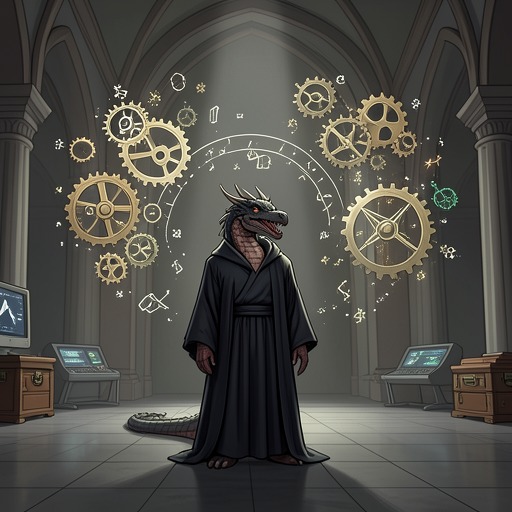
Church of the Dread Three
Vainqueur the DragonThe Church of the Dread Three is a religious organization defined in the available evidence less by a detailed theology than by its position within a competitive supernatural economy. Its most concrete action is an intention to invest in the new Ishfania, placing the church alongside the goddess Shesha and the commercial interests represented by Miel and Malfaisant. Through that move, the church becomes part of the wider struggle over markets, influence, and institutional expansion rather than remaining a purely devotional presence.
Religious Organization in a Commercial Supernatural Order
The church belongs to a world in which divine power is repeatedly connected to exchange. Shesha’s miracles are presented as transactions governed by market rules, and her priesthood treats prosperity and other benefits as services supplied for an appropriate monetary gift. The Church of the Dread Three appears within this same environment, not as an isolated faith but as an institution capable of making strategic economic commitments. Its decision to invest in Ishfania therefore suggests that religious organizations can operate as financial and political actors as well as spiritual authorities.
The available scenes also establish a contrast between different forms of supernatural power. The Moon Man’s blessing is imposed through direct contact with Victor Dalton, leaving a full-moon mark on his arm and granting the [Claimed by the Moon Man] Personal Perk, while Camilla’s representatives compete for claims over Victor Dalton’s soul by citing his service to the undeathstrial revolution and friendliness toward the church. Against these individualized or deity-centered interventions, the Church of the Dread Three is visible as a collective institution whose influence can be expressed through investment and organized presence.
Investment in the New Ishfania
The church’s clearest recorded initiative occurs when Miel announces that it intends to invest in the new Ishfania. Shesha has also voiced an intention to invest, and Miel warns Malfaisant that additional competitors will arrive. The statement places the Church of the Dread Three in a coalition of powerful entrants seeking a stake in a developing market, while also turning religious affiliation into a source of commercial competition.
This investment matters because Ishfania is presented as a new arena whose free-market structure attracts actors from several sectors. Miel has authorization from the Grand Vizier to invest, and Malfaisant responds by ordering his bodyguards to inform shareholders and reduce prices. The church’s planned participation thus helps trigger a defensive corporate response: its presence is not ceremonial, but significant enough to threaten existing market share and alter business strategy.
Institutional Competition and Expansion
The Church of the Dread Three’s involvement is part of a larger pattern in which organizations compete by extending services, claims, and influence across social boundaries. Nethermart, opened in Murmurin, is advertised as the first fiendish magic-item shop in all of Outremonde and accepts souls as collateral when customers cannot pay with coins. Its grand opening is explicitly linked to the coming war with Maure, with weapons offered at a thirty percent discount. The church’s prospective investment in Ishfania belongs to the same expanding landscape, where commerce, war preparation, monster society, and religion overlap.
The church is therefore associated with institutional reach rather than with a single revealed rite or doctrine. The evidence does not specify its internal hierarchy, membership, liturgy, or the identities of the three dreaded powers. What it does show is an organization able to enter a major economic project and stand beside divine and demonic investors. Its power is legible through coordinated institutional action: identifying a promising territory, committing resources, and entering a field where competitors immediately calculate the consequences.
Narrative Significance
The Church of the Dread Three helps establish that religion in the setting is not outside the market but one of its most consequential participants. Shesha sells miracles, Miel negotiates on behalf of heavenly interests, and rival powers make proposals concerning Victor Dalton’s soul. The church’s decision to invest in Ishfania extends this logic from individual salvation and divine favor to territorial and commercial expansion.
Its limited direct appearance is itself revealing. The church does not need a long doctrinal exposition to affect the plot; the announcement of its investment is enough to reshape Malfaisant’s calculations and signal that Ishfania will become a contested space. In this way, the Church of the Dread Three functions as an institutional force whose importance lies in the pressure it adds to an already crowded supernatural marketplace: faith, capital, divine claims, and organizational power all pursue the same newly available ground.