Demons
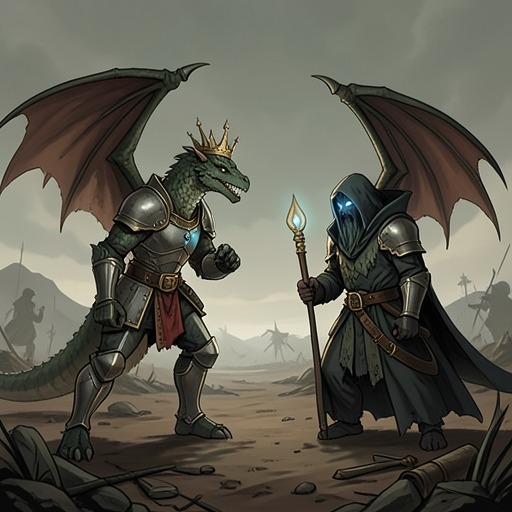
Vainqueur the DragonDemons occupy a central position in the book’s moral and institutional landscape. They are not merely monsters opposed to the protagonists: they form armies, operate companies, conduct religiously charged sacrifices, supply labor, compete for markets, and negotiate access to souls. Their defining significance lies in this double character. Demons embody supernatural violence, yet they also expose how violence can be normalized when renamed as administration, commerce, employment, or lawful enterprise.
Nature and Manifestations
Demons are presented through a range of fiendish bodies and roles rather than as a single uniform species. In one summoning, a winged, manling-sized goat carrying a fork appears inside a ritual circle and introduces itself through a customer-service persona before stopping in confusion at Vainqueur Knightsbane’s presence. The scene makes the infernal uncanny immediately theatrical: a creature associated with Hell behaves like a service representative, while its ordinary sales language collides with the overwhelming presence of a dragon.
Their supernatural identity also has a religious dimension. The Moon Man’s cult can mark Victor Dalton physically, leaving a shining white full-moon symbol on his arm after a Moon Beast touches him. Later, an angel reports that Dice and the Moon Man both claim Victor Dalton’s soul, while Camilla, the goddess of death, has submitted a third afterlife proposal praising his service to the undeathstrial revolution and his continued friendliness toward her church. Demons therefore exist within a crowded supernatural economy in which souls, divine favor, death, and service are competing claims rather than purely sacred abstractions.
War, Ritual, and Territorial Power
Demons are deeply connected with the history of the Castle of Murmurin. The castle was once an officer-training facility for the continent’s elite and the headquarters of the Ishfanian Inquisition. At the beginning of the Century War, Brandon Maure sent his general, the Lich Furibon, to seize it. Furibon transformed the fortress into a haven for fiends and awakened the volcano on which it had been built. The location consequently joins military history, demonic occupation, and geological catastrophe; its reputation as a haunted stronghold derives from a concrete transformation of an institutional center into a fiendish refuge.
Their political ambition becomes explicit in the account of King Balaur, described as the strongest and foulest of the fomors. Balaur raises a terrible army and wages war against the Mistral Continent, bringing down countries and threatening Gardemagne, the stronghold of mankind. His stated objective is not limited conquest but the destruction of mortal resistance: he intends to soak the continent in the blood of mortals so they can never rise again to challenge the fomors. Demonic and allied monstrous power therefore operates at continental scale, with war presented as an attempt to permanently reorder the relationship between mortals and the old monstrous powers.
The demon corrida converts that same warlike logic into public spectacle. A red fiend announces before a cheering crowd that three noble ladies will be sacrificed to gain Hell’s favor for the destruction of Gardemagne. The intended executioner is Melodieuse, introduced as a beautiful and poisonous guest of the king. The ritual gives conquest a ceremonial form: noblewomen become offerings, the crowd becomes an audience, and the destruction of a human stronghold is treated as a goal that can be advanced through sacrifice and entertainment.
Labor, Death, and Moral Displacement
The book repeatedly links demons to the management of bodies after death. Victor Dalton describes a system in which corpses are purchased from living relatives, converted into mindless zombies, and assigned to labor ranging from mining to farming. His question about the legality of the practice reveals the collision between infernal efficiency and ordinary moral or legal judgment. The corpse is simultaneously a dead person, a commodity, and a labor resource; the transformation into a zombie makes that conflict visible by stripping away the language of burial and replacing it with production.
This logic extends to Vainqueur Knightsbane’s own economic plans. He rejects giving money away or investing it, refuses to associate the name of V&V with what he considers madness, and proposes selling corpses because he is tired of eating manlings all the time. Victor Dalton interprets the plan as a shop selling junk, monster parts, and corpses. Demons belong naturally within this world because the boundary between predation and commerce has already been made unstable: bodies can be eaten, sold, animated, or employed, with each use justified through a different vocabulary.
Victor Dalton confronts the consequences of this system when he sees animated demon skeletons building a house beside a druidic circle. He recognizes the skeletons as members of his own kind and objects that their dead bodies have been raised as mindless slaves. The scene gives the labor system an immediate visual form: undead workers construct an ordinary building, while the violence required to produce them is concealed behind the apparent practicality of construction. Victor Dalton’s protest also marks a contrast between demonic institutional logic and an ethical response grounded in recognition of the dead as persons.
The response to this objection is not abolition but optimization. Victor Dalton proposes rerouting a summoning channel so that victims of corporate downsizing and violent layoffs will be sent to the demons. The demons would handle the severance package, obtain free labor, and reduce execution costs. The language of corporate restructuring turns human dispossession into an infernal supply chain, showing how the narrative’s comedy depends on the grotesque equivalence between modern economic euphemism and demonic exploitation.
Organization, Trade, and Legalization
By the later stages of the story, demons have become organized economic actors. Vainqueur Knightsbane proclaims that his empire allows demons to trade souls without paying taxes to manlings. His imperial vision combines mass undead labor, soul commerce, and exemption from human taxation, presenting the supernatural economy as a constitutional feature of the new state rather than a hidden criminal practice. When Knight Kia learns that the empire uses mass undead labor and trades souls with demons, her shock identifies the point at which Vainqueur’s private hoard-building has become public policy.
Vainqueur Knightsbane rejects the identity of banker and instead calls himself the Defender of the Hoard. He claims to have slain Furibon during the First War of the Hoard and the Moth King during the Second War of the Hoard, and to have uncovered the ancient dragon system that gives him power to protect the dragon way of life from forces that would turn it to lead. Demons are therefore not merely external enemies in his self-description. They are part of the historical and ideological field against which he defines sovereignty, even as he adopts some of their economic mechanisms.
The Nethermart makes demonic commerce especially concrete. Malfaisant and other demons protect the marketplace and insist that it is a free-trade area invested with the Emperor’s full support, making their presence perfectly legal. The claim matters because it converts infernal activity into recognized jurisdiction. Demons no longer need to hide behind summoning circles or battlefield occupation; they can invoke investment, legality, and imperial authorization.
Malfaisant also treats the market as a battlefield. He mocks a redemption chaser whose subscriptions have apparently declined and presents the Nethermart as a superior multiplanar company. He then declares that the market was taken from Maure Hellcorporated and that it is now his turn to establish a monopoly. When challenged, he orders his fiend bodyguards to inform the shareholders and cut prices in imitation of the Emperor’s way of cutting down foes. The demons’ weapons and corporate vocabulary belong to the same system: protection, intimidation, shareholder communication, price competition, and monopoly-building are coordinated methods of expansion.
Conflict and Narrative Function
Demons repeatedly serve as adversaries, but their function is broader than opposition in battle. Dozens of imps, fiends, and bug-like monsters eventually enter Vainqueur Knightsbane’s vault as an ordered regiment, carrying weapons and armor while marching directly onto his hoard. Their disciplined formation contrasts with the image of demons as chaotic supernatural creatures. They possess hierarchy, logistics, equipment, and collective purpose, making the assault a military operation rather than a random incursion.
Vainqueur Knightsbane’s response to surviving werewolves reveals how he incorporates former opponents into his own organization. He tells them that their survival cost him treasure and orders them to apologize by becoming his new minions. He frames continued life as the reward for obedience, claiming that another dragon would have eaten them but that he is forgiving enough to accept werewolves into his service. The logic is coercive, yet it also demonstrates the unusual breadth of his empire: demons, undead, werewolves, kobolds, and other monsters can be absorbed into one hierarchy when service is made the price of survival.
The demons’ broader political position changes after Maure’s defeat. With the army destroyed and Maure dead, Ishfania ceases to exist as a nation, although its demon-infested desert retains enough resources to attract the Eversun Empire, Barin, and Prydain. The resulting vacuum threatens to produce another Century War. Demons thus remain politically consequential even when defeated, because the territories and resources structured by demonic power continue to shape imperial competition.
Thematic Significance
Demons provide the clearest recurring image of a world where moral categories are translated into economic and administrative ones. Corpses become inventory, the dead become labor, sacrifices become ritual investment, souls become tradable assets, and military conquest becomes market acquisition. Yet the narrative does not reserve this transformation for demons alone. Vainqueur Knightsbane’s empire adopts soul trading and undead labor while proclaiming greed as law, and Victor Dalton’s corporate proposal mirrors the demons’ own methods. The result is a deliberately unstable boundary between monstrous behavior and respectable institution-building.
At the same time, demons are granted independent collective agency. They maintain armies, defend commercial infrastructure, pursue monopolies, protect shareholders, compete with other infernal companies, and participate in political projects aimed at destroying Gardemagne. They are not passive symbols of human fear; they are actors with institutions and strategies of their own. Their presence expands the story’s world from a simple human-versus-monster conflict into a contested marketplace of species, gods, empires, and corporations.
Their final significance lies in the tension between horror and normalization. A fiend can emerge from a summoning circle speaking like a customer-service agent; a regiment can march onto a dragon’s treasure; a demon can defend a soul market by citing free trade and imperial approval. The comedy makes the infernal familiar, but the familiarity sharpens the horror. Demons are frightening not only because they kill, sacrifice, or enslave, but because they can make those acts sound like ordinary business.