Discovery of the Class System by the Dragons
Vainqueur the DragonDiscovery of the Class System by the Dragons is the decisive public revelation that turns Vainqueur Knightsbane’s personal encounter with the Class System into a collective dragon awakening. The discovery changes class advancement from an invisible privilege into a reproducible social technology: dragons can claim identities, gain power, organize companies, and enter the adventuring economy, while human governments must accommodate them.
Causes and Background
The system first appears to Vainqueur Knightsbane as an insult to his self-image. When Victor Dalton suggests the possibility of a class, Vainqueur rejects the idea that a dragon could need something as ordinary as a thief’s profession. He considers himself a great red dragon, king of the mountains, and apex of creation. The system nevertheless rewards his ego and noble dragon bloodline with a level in the Noble class. The notification is therefore both mechanical and satirical: the qualities Vainqueur treats as proof of innate superiority become the criteria by which an external system grants him advancement.
The same mechanism also reshapes Victor Dalton’s position. After Vainqueur promotes him to minion chief of staff and living signature, making him responsible for paperwork and administrative duties, Victor gains a level in the Monster Squire class for becoming the chief enforcer of a mighty dragon. The reward grants him substantial increases to health, spirit, strength, vitality, skill, agility, intelligence, charisma, and luck. Later, fearless leadership of monsters against superior opponents gives him seven additional Monster Squire levels, the Monster Lifeforce (Red Dragon), Monster Rider, and Monster Insight perks. These earlier examples establish that the system converts service, leadership, bloodline, ego, and battlefield conduct into formal advancement.
Vainqueur’s wider organization supplies the practical conditions for the revelation. Victor is already expected to turn monster parts and corpses into profit, train the Kobold Rangers, prepare Vainqueur’s class progression, and manage an expanding body of minions. Recruitment for the war against Furibon draws one hundred kobold applicants as well as a troll, a dryad, and a golem with class levels above twenty. The Class System thus appears within an existing military and commercial experiment: monsters are being recruited, trained, assigned duties, and made useful to a dragon-centered institution.
What Happens
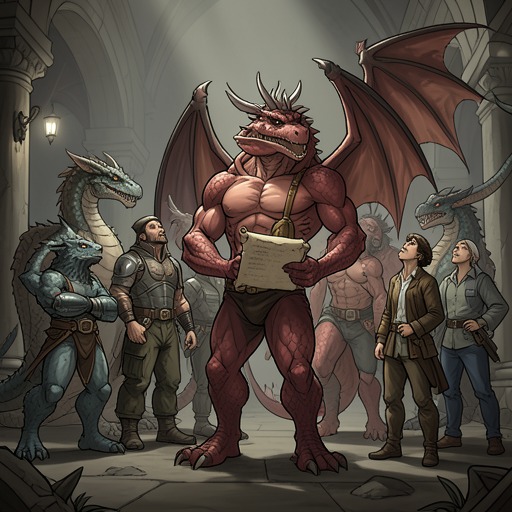
The discovery becomes public during Vainqueur’s self-presentation as an adventurer. He insists that he is not a banker but the Defender of the Hoard, claiming to have slain Furibon during the First War of the Hoard and the Moth King during the Second War of the Hoard. He also presents the system as the ancient power that can protect the dragon way of life from those who would reduce it to lead. His boast turns a personal achievement into a civilizational claim.
Icefang challenges that claim. He assumes that a system granting power and money would be available to him if it truly existed, and he demands that it appear before him. The challenge produces immediate proof: Icefang sees an invisible message congratulating him for gaining a level in Noble through bitter resentment and dragon ego. The wording mirrors Vainqueur’s own earlier experience while revealing that the system responds not only to noble blood but also to the emotional and behavioral traits of its user. Icefang’s status as a king does not prevent the system from classifying him; his wounded pride becomes an avenue of advancement.
The demonstration spreads rapidly. Genialissime declares that he can become a wizard and immediately unleashes a bolt at a house, confirming that the system can translate a declared class identity into functional magical ability. Other dragons begin declaring themselves sorcerers, knights, and nobles. The system’s reach is not unlimited, however: Blightswamp cannot reproduce true princessness, which lies beyond even its power. This limitation is crucial. The system makes identity operational, but it does not make every desired social quality equally attainable.
Nostredame explains the apparent mystery to the gathering. The first level requires awareness of the system and the statistical criteria for beginner classes; the dragons had not previously advanced because they did not know that advancement was possible. Discovery is therefore not merely the finding of an object. It is the acquisition of a rule set whose operation depends on recognition. Once the dragons become aware of it, class claims multiply almost immediately.
Institutional Consequences
The dragons’ awakening produces a political problem that Gardemagne cannot ignore. The King of Gardemagne responds by ordering Charlene to deal with the situation. If the dragons want to create their own adventurer companies under Gardemagne’s auspices, the guild must oblige. The king welcomes dragons willing to handle would-be Maures and unclaimed rewards, but he attaches one condition: they must not eat quest givers. The concession converts a potentially destabilizing supernatural discovery into a regulated partnership between dragon power and human administration.
Vainqueur interprets the result as the beginning of a new era of dragon adventuring. His claim is supported by the system’s spread beyond a single dragon. The report that all dragons present developed a class of their own confirms that the event is collective rather than anecdotal. The dragons do not merely acquire combat roles; they gain a vocabulary for organizing ambition, authority, magic, and public service. Their new identities can be connected to companies, quests, rewards, and government recognition.
The discovery also clarifies why Vainqueur’s broader institutions expand so quickly. The sale of monster parts and corpses becomes a commercial project, while Nethermart later opens as a fiendish magic-item shop in Outremonde, offering goods to monsters and mortals and accepting souls as collateral. These enterprises show the same underlying logic as the Class System: capacities once treated as monstrous or private are formalized, priced, branded, and inserted into a larger economy. The system provides identities and advancement; organizations provide work, hierarchy, and material circulation.
Rules, Rewards, and Limits
The Class System operates through visible notifications and quantifiable progression. Vainqueur’s Noble level arises from a combination of ego and dragon bloodline. Victor’s Monster Squire advancement arises from service and enforcement, then accelerates through leadership in battle. Genialissime’s wizard declaration produces an immediate spell. These examples establish a rule-driven interface in which narrative behavior becomes measurable reward, and in which self-conception can become an actionable class condition.
The system also imposes hard limits. After a class reaches level thirty, the user reaches the class ceiling and can no longer gain additional levels without using a Crest. Experience gains fall to zero, although special deeds can still provide perks. This ceiling prevents the discovery from becoming an unlimited escalation engine. Advancement requires not only awareness and qualifying traits but also a mechanism for breakthrough, while exceptional deeds remain valuable even after ordinary experience stops producing levels.
The contrast between Vainqueur’s certainty and the dragons’ initial disbelief gives the rules their dramatic force. Vainqueur treats the system as confirmation of his greatness; Icefang first treats it as a fraud and then receives proof directly. The system validates both the boast and the challenge, but it does so in an impersonal way: it rewards traits, declarations, and deeds without adopting the dragons’ own hierarchy of dignity. A king can receive Noble because of resentment and ego, a subordinate can become a Monster Squire through labor, and a dragon’s claim to princessness can still fail.
Narrative Significance
The event is a discovery plot disguised as a bragging scene, and its central reversal is that Vainqueur’s vanity becomes a vehicle for institutional change. The Class System does not simply make powerful characters stronger. It supplies categories through which monsters can enter roles previously associated with human civilization: adventurer, wizard, knight, noble, chief of staff, shopkeeper, and company member. In that sense, the discovery is also an act of organizational invention.
Its comedy comes from the mismatch between epic language and administrative mechanics. Vainqueur speaks of defending the dragon way of life, while the system answers with class levels, perks, stat requirements, and ceilings. Victor’s unpaid paperwork, the recruitment of one hundred kobolds, the rule against eating quest givers, and the later commercial opening of Nethermart all anchor cosmic transformation in labor and management. The world changes not through solemn revelation alone but through forms, duties, recruitment, sales, and negotiated permissions.
The event’s final significance is collective and irreversible. Before the discovery, the system is an obscure source of personal growth known through Vainqueur and Victor Dalton. After the public demonstration, dragons can see it, test it, imitate its classes, and demand institutional recognition. Gardemagne must permit dragon adventurer companies, and the dragons’ class development becomes the foundation for Dragon adventuring as a new social era. The discovery therefore marks the moment when hidden rules become public power and when Vainqueur’s private mythology becomes a shared political reality.