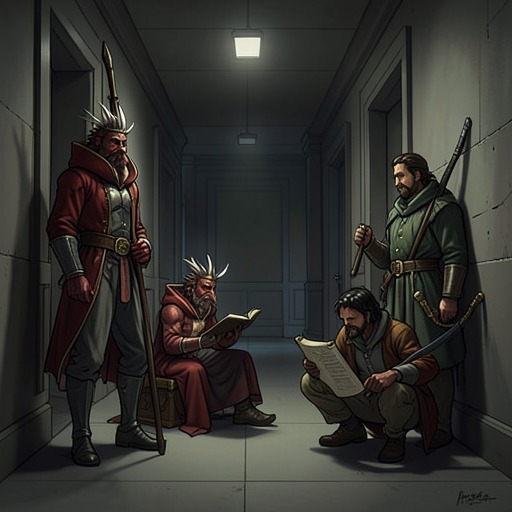
Dragon Class Awakening
Vainqueur the DragonDragon Class Awakening is the collective discovery by the dragons that the Class System can grant them classes, powers, and progression. Its decisive importance lies in the shift from Vainqueur’s supposedly unique access to a shared dragon technology: once the other dragons learn that awareness of the system and suitable beginner statistics are enough to begin, they start declaring and testing new identities, while the human authorities accept the consequences and prepare to formalize them as adventurers.
Causes and Background
Vainqueur presents the discovery as part of his larger career as an adventurer and defender of treasure. He insists that he is not a banker, but the Defender of the Hoard, claiming that he slew Furibon during the First War of the Hoard and the Moth King during the Second. He also identifies himself as the dragon who uncovered the ancient dragon system, a power he believes can protect the dragon way of life from those who would reduce it to lead. The boast links the awakening to the broader conflicts surrounding hoards, monster organizations, and the coming confrontation with Maure.
The revelation occurs in a social setting where Vainqueur’s claims are challenged by other dragons. Icefang dismisses the system as an invention that conveniently grants Vainqueur power and money, arguing that a genuinely accessible system should also be available to him. Nostredame interrupts to explain that the first level requires only awareness of the system and the statistical criteria for a beginner class. This explanation changes the dispute from a question of Vainqueur’s credibility into a testable claim about the rules governing dragon advancement.
The Discovery and Its Demonstrations
Icefang demands that the system appear before him. After making the challenge, he stops ranting and appears to read invisible text in front of him, forcing the assembled audience into silence. He then reports a congratulatory message stating that his bitter resentment and dragon ego have earned him a level in Noble. The result is comic because Icefang has just insisted that he is already a king, yet the system translates that pride into the very class advancement he had denied could exist.
Genialissime immediately tests the same principle by asking whether declaring a desired identity can make it real. After apparently receiving a message of his own, he points a claw at a house and unleashes a bolt at it. His successful spell provides a visible demonstration rather than a merely verbal confirmation. A red dragon follows by speaking a word and producing a weaker spell, announcing that he is a wizard. The system therefore appears not only to recognize pre-existing traits but also to convert declarations and latent capabilities into actionable class identities.
The spread of the discovery is rapid. Vainqueur’s guests begin declaring themselves sorcerers, knights, and nobles, turning a revelation into a communal game of experimentation. The episode also establishes a limit: Blightswamp cannot reproduce true princessness, even though she tries to make one of her dragonlings a princess. The system can assign or awaken recognizable classes, but it cannot manufacture every quality that the dragons desire. That boundary gives the awakening a rule-based shape beneath its absurdity.
From Personal Power to Dragon Adventuring
Vainqueur interprets the discovery as the beginning of a new historical era. He tells Victor that, just as Grandrake invented princess hunting, he himself has inspired dragon adventuring. The claim is characteristically grandiose, but it is not entirely empty: the dragons’ new access to classes gives them a framework for taking quests, acquiring rewards, and presenting their violence as a service to the wider world.
This new system is connected to the work already imposed on Victor. Vainqueur had promoted Victor to chief of staff and living signature, making him responsible for paperwork, class progression, and training the Kobold Rangers. He later ordered him to find a way to turn discarded monster parts and corpses into money, while also requiring him to teach suitable classes to the kobolds. The awakening therefore does not stand apart from administration or commerce. Class advancement becomes another responsibility to organize, monetize, and distribute through Vainqueur’s expanding hierarchy.
The same pattern appears in military recruitment. During the campaign against Furibon, Vainqueur observes a line of applicants, including one hundred kobolds and higher-level inhabitants such as a troll, a dryad, and a golem. He frames the war as a cause for which every creature can be mobilized, even while describing all creatures as equally inferior and potential emergency food. The dragons’ later discovery of classes gives this mixed population a common vocabulary of levels, roles, and powers, linking the hoard’s servants, monsters, and prospective adventurers to the same progression system.
Institutional Consequences
The human authorities respond pragmatically rather than attempting to suppress the dragons. Roland orders the relevant officials to accommodate dragon-created adventurer companies under the auspices of Gardemagne’s guild. He reasons that the world contains enough would-be Maures and unclaimed rewards, and that dragons willing to deal with such threats are useful, provided they do not eat quest givers. The condition preserves the basic tension of the arrangement: dragon adventuring is welcomed as a protective force only when its predatory instincts are constrained by an operational rule.
The awakening also supports a broader commercial and organizational expansion. Nethermart opens as a large six-floor fiendish magic-item shop in the northern part of Murmurin, built by bug fiends under Malfy’s direction. Its grand opening advertises service to monsters and mortals alike, allows customers without coins to pledge their souls as collateral, and offers a thirty percent weapons sale in anticipation of the war with Maure. The shop demonstrates how the world’s new class-and-monster economy turns combat, equipment, debt, and identity into connected institutions rather than isolated adventures.
The movement’s growth remains tied to destruction as well as construction. After every Bragging Day, the surrounding area resembles the aftermath of a volcanic disaster, with houses overturned and no sheep left alive. Vainqueur nevertheless summons the Kobold Rangers, gnolls, mimics, and other servants to resume organized activity once the party ends. Dragon adventuring thus emerges from a culture that repeatedly devastates its surroundings and then converts the resulting hierarchy, loot, and labor into administration.
Systemic Meaning and Limits
The Class System operates as a rule machine that rewards behavior while manufacturing social identities. Vainqueur gained Noble through his ego and dragon bloodline; Victor gained Monster Squire levels through service as a dragon’s chief enforcer; and Victor later earned seven additional Monster Squire levels for leading monsters to victory against superior opponents, along with the Monster Lifeforce, Monster Rider, and Monster Insight Perks. These examples show that the system does not merely name occupations. It translates lineage, submission, leadership, and combat success into measurable advancement and new capacities.
Yet advancement is not unlimited. After reaching the level 30 class ceiling, a character can no longer gain levels without using a Crest, although special deeds may still grant Perks and ordinary experience gains become zero. This ceiling places a hard boundary beneath the dragons’ sudden enthusiasm. The awakening promises growth, but it also subjects that growth to scarcity, thresholds, and an economy of exceptional deeds. Even Vainqueur’s later celebration depends on a Crest whose success grants him Malefic Secrecy, causing divination spells and Perks seeking information about him to fail unless they overcome an opposed Charisma check.
Dragon Class Awakening is therefore both a revelation and a conversion of status. What begins as a challenge to Vainqueur’s boast becomes proof that dragons can enter the same progression structure, invent class identities, wield new powers, establish companies, recruit monsters, and obtain recognition from human institutions. Its comic force comes from the mismatch between cosmic language and childish declarations, but its structural consequence is serious: the dragons cease to be merely powerful creatures living outside the world’s systems and become active producers of a new political, military, and commercial order.