Dragon adventuring
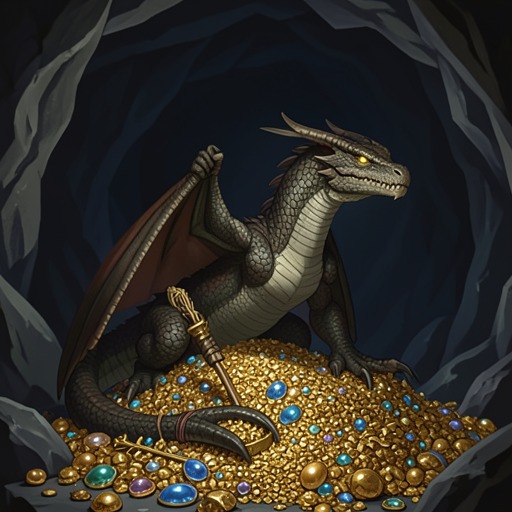
Vainqueur the DragonDragon adventuring is the state in which dragons enter the adventurer economy and identity system rather than remaining only legendary predators, rulers, or guardians of private hoards. Its decisive significance is that Vainqueur Knightsbane converts a personal boast about defending treasure into a collective model: dragons can claim classes, accept payment, undertake quests, establish companies, and make their power useful to mortal authorities—while retaining the appetite and entitlement that make the arrangement inherently unstable.
Origins in the Class System
Dragon adventuring begins with the discovery that the Class System responds to dragon self-conception as well as to conventional occupations. Vainqueur Knightsbane initially considers the possibility of a class absurd because he regards himself as a great red dragon, king of the mountains, and apex of creation. The system nevertheless grants him a level in Noble through his ego and noble dragon bloodline. The notification makes dragon identity itself a route to advancement: what Vainqueur considers proof of innate superiority becomes an administratively recognized qualification.
The same mechanism spreads beyond Vainqueur. When Icefang challenges the existence of the system and demands that it appear, he receives a Noble-class message attributed to his bitter resentment and dragon ego. Genialissime then discovers that declaring an aspiration can activate a corresponding possibility, producing a magical bolt after announcing the desire to become a wizard. Other dragons begin declaring themselves sorcerers, knights, and nobles. Dragon adventuring therefore develops from a broader realization that the system can translate belief, status, and performance into formal classes, even when the results expose a comic mismatch between a dragon’s self-image and the system’s categories.
Vainqueur Knightsbane’s Model
Vainqueur presents himself as the prototype and ideological founder of dragon adventuring. He rejects the suggestion that he has become a banker and instead calls himself the Defender of the Hoard, claiming responsibility for all hoards. His public credentials are the slaying of Furibon during the First War of the Hoard and the defeat of the Moth King during the Second War of the Hoard, together with his discovery of the ancient dragon system. In his account, adventuring is not a surrender of the dragon way of life but a mechanism for protecting it from forces that would reduce dragons to lead.
This self-description reframes paid service as dignified treasure defense. Vainqueur says that fragile manlings have paid him gold and entrusted him with their hoards because he can defend them. The distinction between adventurer, guardian, and collector is deliberately porous: external rewards become additions to a dragon’s hoard, while the hoard becomes evidence that the dragon is providing a valuable public service. His boast thus supplies dragon adventuring with its founding myth, even though the surrounding reactions make clear that the institution also rests on Vainqueur’s vanity and talent for turning opportunism into doctrine.
From Private Hoard to Institution
The practical basis for this transformation is labor performed by minions. Vainqueur appoints Victor Dalton as chief of staff and living signature, assigning him responsibility for paperwork and the management of affairs Vainqueur does not wish to handle. Victor’s class advancement reflects this hierarchy: becoming the chief enforcer of a mighty dragon grants him levels in Monster Squire, while leading monsters to victory against superior opponents earns him seven additional levels, along with the Monster Lifeforce (Red Dragon), Monster Rider, and Monster Insight Perks. Dragon adventuring is therefore not an individual career alone; it creates a chain of command in which dragons supply authority and minions convert that authority into administration, training, recruitment, and revenue.
Vainqueur extends the same logic to waste and commerce. After observing that meat, monster parts, and corpses are simply left for animals to eat, he orders Victor to find a way to make money from the discarded materials. The proposed shop turns the remains of monster life into an economic resource and links adventuring directly to hoard growth. Victor must also prepare Vainqueur’s class progression and teach suitable classes to the Kobold Rangers, showing that the new profession includes instruction and institutional reproduction: the dragon’s chief of staff is expected not merely to serve one master but to build the capacities of an entire monster organization.
The later opening of Nethermart makes this economic tendency visible on a larger scale. A six-floor, ivory-draped building rises in northern Murmurin, constructed by bug fiends under Malfaisant’s direction and standing second only to Emperor Vainqueur’s statue. The shop sells magic items to monsters and mortals, accepts souls as collateral when customers cannot pay in coins, and advertises a thirty-percent weapons sale for the coming war with Maure. Although Nethermart is not identical with dragon adventuring, it demonstrates the commercial environment that the practice generates: monster power, military preparation, branded public spectacle, credit, and treasure accumulation become parts of one expanding system.
Recruitment, Legitimacy, and Political Accommodation
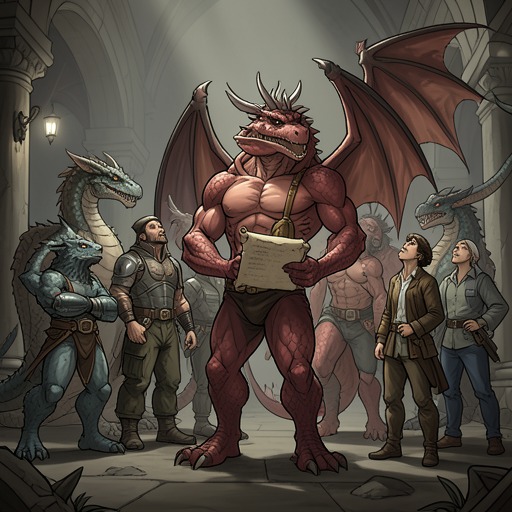
Dragon adventuring becomes collective when Vainqueur recruits monsters for war. He insists that the target is not a weak creature but Furibon, whom he defines as evil and deserving destruction. The recruitment line contains one hundred kobold applicants, while Victor has asked Croissant to send inhabitants with class levels above twenty, including a troll, a dryad, and a golem. The episode shows the profession absorbing varied monster bodies and abilities rather than restricting participation to dragons or a single species.
The recruitment also reveals the tension within its moral language. Vainqueur claims that all creatures are equally inferior to him and says that he will fight for everyone’s right to become his emergency food. Equality is presented as a universal principle, but it remains subordinate to predation. Dragon adventuring can therefore promise inclusion without abandoning the hierarchy that makes Vainqueur a dragon: every creature may join the system, yet the dragon still imagines every creature as potential nourishment.
The decisive political step occurs when Icefang accepts the system and declares himself an adventurer. He asks for a plate so that he can answer the requests of mortals in exchange for gold and silver, treating service as an honor granted by a dragon rather than a duty owed to clients. Other dragons immediately imitate the model. Jolie wants to go on adventures and find a minion she can love as much as Uncle Vainqueur, while another dragon imagines receiving passive revenue simply for not attacking mortals. The range of responses reveals both the profession’s appeal and its hazards: adventure offers purpose, payment, and social recognition, but dragons initially understand these benefits through entitlement, intimidation, and extraction.
Manling King Roland responds by ordering Charlene to manage the situation. Gardemagne’s institutions will allow dragons to create their own adventurer companies under the kingdom’s auspices. The policy is openly pragmatic: the world has enough would-be Maure figures and unclaimed rewards, so dragons willing to deal with them are welcome, provided they do not eat quest givers. This condition is the legal boundary of dragon adventuring. The state does not require dragons to become humanlike; it attempts instead to channel their violence into recognized contracts and to preserve the basic continuity of the quest economy.
Expansion and Consequences
Vainqueur proclaims that he has inspired a new era of dragon adventuring, comparing his achievement with Grandrake’s invention of princess hunting. The declaration turns a spontaneous social development into a branded historical movement centered on his name. Victor’s laughter and despair register the double consequence: the idea is absurd, yet its absurdity has become operationally real. Once the system has been demonstrated and the king has agreed to accommodate dragon companies, the practice can no longer be dismissed as merely one dragon’s boasting.
The Class System both enables and limits this expansion. Vainqueur reaches the level-thirty class ceiling and can gain no further levels until using a Crest; experience gains fall to zero, although special deeds can still grant Perks. Dragon adventuring therefore promises advancement through visible feats but eventually encounters bureaucratic limits built into the system itself. Progress depends not only on courage or combat but on access to the correct breakthrough mechanism, making the profession resemble a regulated game economy as much as a heroic calling.
The aftermath of Vainqueur’s celebrations exposes the cost of the new order. After every Bragging Day, the surrounding area resembles the aftermath of a volcanic disaster: houses have been overturned and no sheep remain alive. Vainqueur then summons the Kobold Rangers, gnolls, mimics, and other servants to end the party and resume command. The scene condenses the contradiction at the heart of dragon adventuring. Public recognition and institutional legitimacy may place dragons inside a shared social economy, but their celebrations still devastate the communities around them, leaving minions to restore order after the dragon’s appetite and ego have had their way.
Dragon adventuring thus marks neither the domestication of dragons nor a simple professionalization of violence. It is a hybrid institution in which inherited sovereignty, game-like classification, military recruitment, commercial exchange, and state licensing reinforce one another. Its central irony is that the system makes dragon exceptionalism administratively useful without making it ethically safe: dragons gain quests, companies, gold, and political standing, while mortals must continue writing rules around the possibility that the licensed adventurers may eat the people who issue those quests.