Fomor Wild Hunt Doctrine
Vainqueur the DragonThe Fomor Wild Hunt Doctrine is the exterminationist ideology advanced by the fomors and their champion, Mighty King Balaur. It defines the New Folk as pollutants and mortal civilization as a diseased intrusion into Outremonde, then converts that judgment into a proposed war of millions, the destruction of human societies, and a later invasion of Earth. The doctrine’s most revealing rejection comes from Vainqueur Knightsbane, who refuses not because he embraces mortal equality, but because exterminating his favorite prey would destroy the food chain and the material basis of his hoard.
Definition and Historical Aim
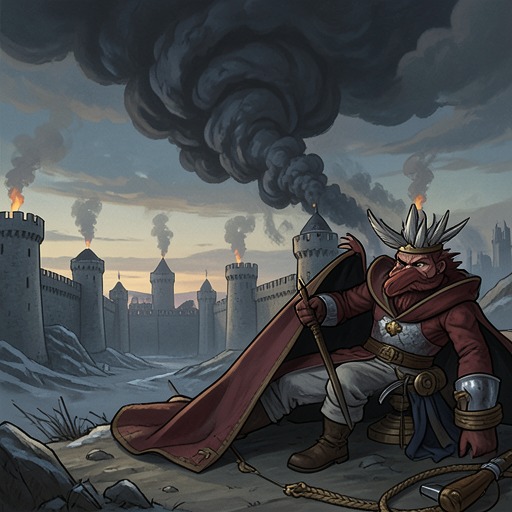
The doctrine begins with a stark division between the Old Folk and the New Folk. A fomor tells Vainqueur that the New Folk who pollute the land will die, presenting this extermination as the word of Mighty King Balaur rather than as an isolated act of violence. Mag Mell then offers Vainqueur a place beside the fomor king in a coming Wild Hunt, promising that the campaign will restore Outremonde to the condition it allegedly possessed in the old days, when the Old Folk ruled it.
This appeal is therefore both political and historical. The fomors describe themselves as the enduring inhabitants of the land and portray mortal settlement as dispossession. Their desired future is not coexistence or negotiated sovereignty, but the removal of every mortal population that prevents the Old Folk from reclaiming absolute dominion. The doctrine’s historical memory functions as a warrant for present violence: an imagined former order becomes the standard by which the current world is condemned.
Proposed War and Methods
The Wild Hunt is described as a horde numbering in the millions. Its immediate objective is to spill mortal blood until the last mortals of Outremonde have been slain, after which the war will be carried to Earth, the world from which the mortals supposedly originated. The campaign thus has two theaters: the purification of Outremonde and the conquest of the mortal nest beyond it.
The doctrine treats magic as a disease and mortals as vermin carrying that disease. Its method is consequently framed as extermination rather than ordinary military defeat. The fomor emissary speaks of hunting mortals into their houses and cradling their children to sleep, a deliberately chilling image that joins intimate domestic spaces to systematic slaughter. The movement claims it can replace whatever it destroys: gold can be raised from the air, and slaves can be shaped from dirt. This promise imagines creation itself as an instrument of domination, allowing the Old Folk to destroy existing societies while claiming that resources and labor can be manufactured afterward.
The proposed reward for participation is equally revealing. Vainqueur is offered fairy gold and mortal flesh, combining political payment with the gratification of predation. The doctrine therefore presents mass killing as ideology, military service, economic redistribution, and appetite at once. Its language of purification masks a program that would convert living populations into either enemies to be erased or commodities to be consumed.
Conflict with Vainqueur’s Dragon Order
Vainqueur rejects the offer when he asks why he would exterminate his favorite food. His objection is logistical and predatory rather than humanitarian: if every puny race disappeared, he would no longer have access to coins and princesses. The response punctures the doctrine’s claim to universal rationality. A plan that appears grand and sacred to the fomors becomes, from the dragon’s perspective, an impractical destruction of the resources that sustain his own supremacy.
This opposition is consistent with Vainqueur’s broader food-chain worldview. He regards sentient beings as ranked by preciousness and permits higher creatures to eat those below them; Victor Dalton is almost an honorary part of his hoard, while minions may become emergency rations. Vainqueur also explains reproduction through hoard display and treats wealth as evidence of fitness. His refusal of the Wild Hunt does not abolish this hierarchy. Instead, it preserves a predatory system in which mortals remain valuable precisely because they can be hunted, ruled, traded, or used to generate treasure.
The contrast with the doctrine is consequently unstable. The fomors want to erase the mortal world; Vainqueur wants to preserve it in a subordinate position. Both systems deny political equality, but they differ over whether domination is best achieved through annihilation or continued exploitation. Vainqueur’s intervention protects mortal survival only incidentally, as a consequence of his desire to maintain a functioning supply of food, wealth, and princesses.
Ethical and Political Implications
The doctrine’s claim that mortals are vermin excludes them from moral and political consideration before violence begins. Its vocabulary makes extermination appear medicinal: magic is a disease, mortals are its carriers, and killing becomes a cure. This is an ideology of purification in which the supposed restoration of a rightful world licenses unlimited force against an entire category of beings.
The surrounding narrative complicates that ideology through repeated arguments about the status of sentient life. Jolie states that manlings and other sentient beings possess souls and that eating them or abducting their princesses is morally wrong. Vainqueur accepts an exception for elves and continues to defend his own consumption of lesser beings, while Victor Dalton challenges the inconsistency by pointing out that elves are people too. The Wild Hunt Doctrine represents the most extreme version of the same classificatory impulse: where Vainqueur establishes a food chain, the fomors turn classification into a mandate for total removal.
The doctrine also collides with emerging forms of political organization. Monsters disguise themselves as humans to avoid inquisitors and adventurers, and shapeshifters maintain a school where they can learn to blend into a hostile society. Other groups enter service under new rulers after surviving older regimes. Vainqueur’s acceptance of gnolls who had served Furibon, followed by his violent enforcement of labor discipline, shows a harsh but incorporative model of rule. By contrast, the Wild Hunt allows no incorporation of the New Folk. Its answer to difference is extinction.
Narrative Significance
The Fomor Wild Hunt Doctrine broadens the story’s conflict beyond individual rivalries and territorial disputes. The destruction of Ishfania, once transformed into a red desert by the Sablaris cultists’ pursuit of universal entropy, provides an earlier image of ideology reshaping an entire region through catastrophe. The Wild Hunt threatens to repeat that logic on a continental and planetary scale, replacing one devastated landscape with a campaign against all mortal civilization.
Its encounter with Vainqueur also clarifies the limits of alliance. The fomors assume that a powerful dragon can be recruited through promises of tribute and shared hatred of mortals. Vainqueur instead treats the offer as a bad bargain and drives the emissary away, insisting that he is no one’s pet. The refusal preserves his autonomy while exposing the narrow basis of his resistance: he does not reject domination, but he will not surrender his preferred subjects, resources, or sovereignty to another power’s exterminationist project.
The doctrine therefore functions as both an external threat and a dark mirror. It reveals what Vainqueur’s hierarchical instincts could become if consumption and rule were replaced by absolute purification. Against the fomors’ demand for an Outremonde emptied of mortals, the dragon defends a world crowded with prey, treasure, labor, and political possibility. The result is not a defense of equality, but a rejection of apocalypse in favor of continued, possessive empire.